Opinion Greece
The Great Sea Interconnector and Turkey: the battle for international legitimacy and influence
Turkey's reactions to the resumed surveys for the Greece-Cyprus power link show a contest over meaning as well as over infrastructure, argues Dr Konstantinos P. Balomenos.

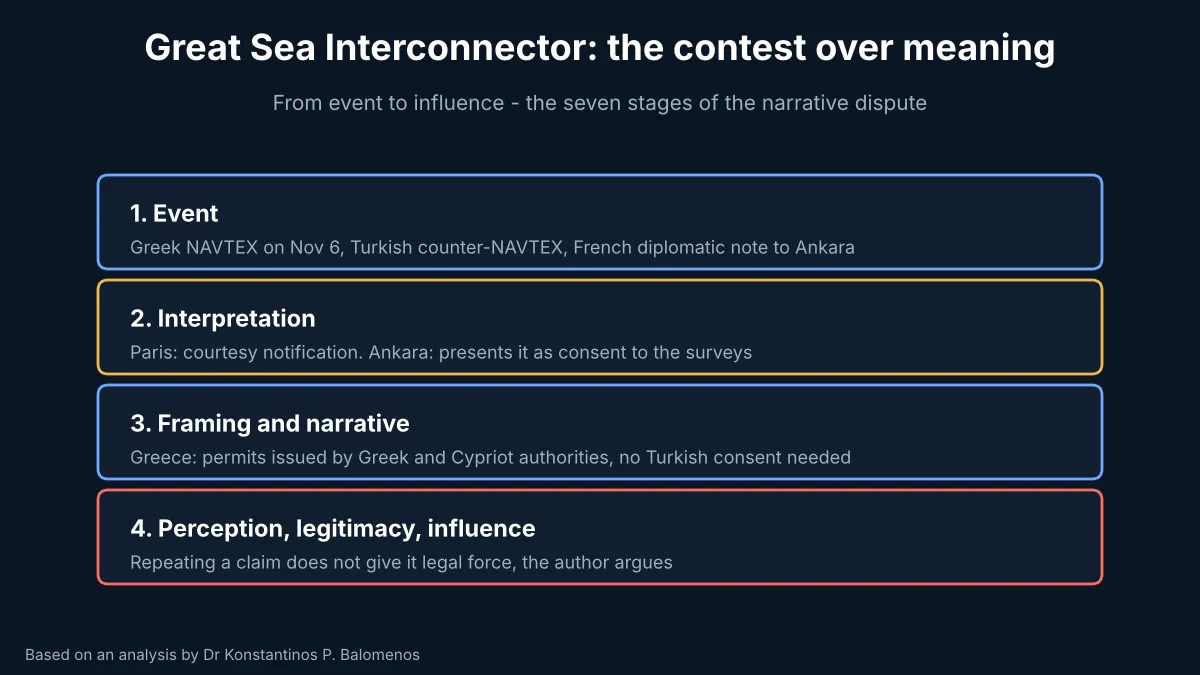
The narrative dispute over the Great Sea Interconnector, from event to influence.
By Dr Konstantinos P. Balomenos, political scientist and international relations analyst.
Turkey’s reactions to the resumption of surveys for the Greece-Cyprus electricity interconnector, the Great Sea Interconnector (GSI), show that the dispute is not only about a strategic energy project for European energy security, connectivity and the European Union’s geopolitical position in the Eastern Mediterranean. It also extends into a less visible but equally important field: the construction of meaning, that is, how events are interpreted, framed and presented to the international community in order to shape perceptions and exert influence.
Meaning-making is a dynamic communication process in which events are not merely transmitted as information but acquire significance within wider frameworks of understanding. In international relations it carries geopolitical weight, because states seek not only to present their own version of events but also to influence how third states and international organisations perceive and judge them. This is where “narrative dominance” comes in: the ability to make one’s own interpretation more persuasive than competing ones. It is not secured by speed alone. It requires consistency, credibility, documentation, and coordination between a state’s communication and its actual political, diplomatic and operational conduct.
The facts
On November 6, 2026, after the required licensing procedures were completed by the competent Greek authorities, a NAVTEX was issued for work related to the GSI. Turkey responded with a counter-NAVTEX, repeating its positions on jurisdiction over parts of the area. Athens stressed that the necessary permits were issued by the competent Greek and Cypriot authorities and that no Turkish permission or consent was requested or required.
In the same context came France’s diplomatic communication with Turkey, linked to French involvement in the project and the activity of the French-flagged research vessel Abeille Marengo. According to press reports, the French note includes the coordinates of the ship’s area of operation while clarifying that it is not a position on the legal questions concerning the disputed areas, and that the briefing was given without any obligation, as a matter of diplomatic courtesy.
The distinction matters. A diplomatic notification is not recognition of jurisdiction and not a request for a permit. Informing a third state of an activity does not automatically mean accepting its legal claims. Ankara, however, tried to place the communication in a different frame. According to Turkish sources, it presented the exchange as a process recognising its role and tied to its consent for the surveys, so that an act of information would take on the symbolic content of approval.
Seven stages from event to influence
The author breaks the GSI case into seven distinct but interlinked stages, tracing the path from the event to its meaning and from meaning to influence.
The first is the event: the Greek NAVTEX, the Turkish counter-NAVTEX and the French diplomatic briefing, the factual background before any interpretation. The second is interpretation. For France, according to the reported content of the note, this is a diplomatic briefing that takes no position on legal disputes and does not prejudge the status of the sea areas. Turkey presents the same communication as a sign that its position and role are recognised. The third is framing, where the argument shifts from what the French briefing really was to whether Turkey was informed and whether that can be read as recognition of its claims, with emphasis on some elements and downplaying of others.
The fourth is narrative. Ankara seeks to fit the episode into a broader story in which any activity in the Eastern Mediterranean touching areas it claims must take Turkish positions into account. Athens argues that the licensing procedures were completed by the competent Greek and Cypriot authorities and that the project does not require Turkish consent. The two are rival strategic narratives. The fifth is perception: how third states, European institutions, international organisations, companies and the media receive and judge developments. Systematic repetition of a claim can raise its presence in public and diplomatic debate, but it does not mean acceptance and does not give it legal force.
The sixth is legitimacy. Each side tries to present its stance as institutionally and politically justified and to weaken the other’s credibility. Yet communication does not replace legal grounding. Legality comes from the applicable rules of international law and the facts of each case, not from repeating a narrative. The seventh is influence, the end goal: shaping the perceptions and judgments of international audiences in ways that affect diplomatic positions and political decisions. Influence is a sought-after outcome, not an automatic result, and it depends on the credibility, consistency and acceptance of the narrative being advanced.
What Greece needs to do
The author concludes that Turkey’s attempt to present a diplomatic briefing as consent does not change the legal character of the act, but it may affect how third parties record and assess it. For Greece, it is not enough to repeat that no Turkish permit was requested, nor to brief partners only after an incident. Athens needs to shape the framework in which each development is understood in good time, and to take initiatives that strengthen its position as a leading and credible actor in setting the international framework of information and interpretation.
That calls for a coherent communication strategy with a clear distinction between information, consultation, consent and approval, along with systematic and timely briefing of European institutions and partners, a documented presentation of the facts, and continuous emphasis on the European character of the project. The GSI is not just a technical electricity link and does not belong to the framework of Greek-Turkish confrontation. It is infrastructure tied to energy security, European connectivity and the EU’s strategic presence in the Eastern Mediterranean.
The key, he writes, is not to let the communicative reading of an event replace the event itself. In today’s geopolitical environment, power is shown not only by a state’s ability to act but by its ability to explain consistently what it is doing, why, and within what institutional and legal framework. The contest is not only over who acts in the Eastern Mediterranean, but over who will shape how the international community understands and judges that action.
This article is an opinion piece. The views are the author’s own.