FIM-92 Stinger: How we went from the “Redeye” to the modern MANPADS

In recent years, man-portable anti-aircraft systems (MANPADS), particularly the FIM-92 Stinger, have gained prominence. The Stinger has a long history of service in various wars worldwide, beginning with its predecessor, the FIM-43 Redeye, which was the primary man-portable anti-aircraft system for the United States in 1967.

General Dynamics began developing an improved version of the Redeye in 1971, which was accepted by the Army as the Redeye II and later designated as the FIM-92 Stinger.

FIM-92 Stinger: How we went from the "Redeye" to the modern MANPADS
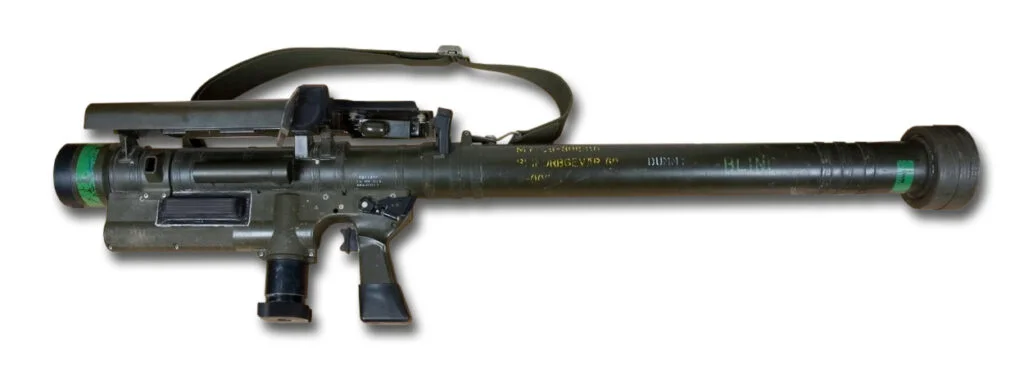
Photo By Armémuseum (Swedish Army Museum) – File:FIM-43_Redeye_(Robot_69)_001.jpg, CC BY-SA 4.0, https://commons.wikimedia.org/w/index.php?curid=82805726

One significant drawback of the Redeye was that it could only “lock” onto a target if it had direct visibility with the engine exit (rear-aspect), as it shared a seeker with the AIM-9B.

This limitation was overcome in the Stinger, allowing the operator to “lock” onto the target from all directions (all-aspect).

The FIM-92 Stinger can be classified into four main categories:

Basic, POST, RMP, and Air-to-Air ATAS. Each category has several sub-versions, including:
  • FIM-92A (Basic)
  • FIM-92B (POST): The first system upgrade with countermeasure improvements.
  • FIM-92C (RMP): Further resistance to countermeasures, as well as reprogrammability of its electronics.
  • FIM-92D (RMP): Improved immunity to interference.
  • FIM-92E (RMP Block I): Improved flight behavior thanks to hardware and software upgrades while improving its performance against small targets.
    • FIM-92F (RMP Block I): An upgrade of version E.
    • FIM-92G (RMP Block I): An upgrade of version D.
    • FIM-92H (RMP Block I): An upgrade of version D to the E level.
  • FIM-92J: A version with new subsystems to upgrade Block I RMPs and extend their life.
    • FIM-92K: A version of the FIM-92J with datalink integration.
  • ATAS (Air-To-Air Stinger): An air-to-air version of the system. Block 0 is based on the FIM-92B/C, Block 1 is based on the FIM-92E, and Block 2 uses the RMP missiles with a new seeker, battery, and other electronics.
FIM-92 Stinger: How we went from the "Redeye" to the modern MANPADS
ΠΗΓΗ: https://nemesishd.gr/analisis/fim-92-stinger-pos-ftasame-to-redeye-sygchrono/ | NEMESIS HD
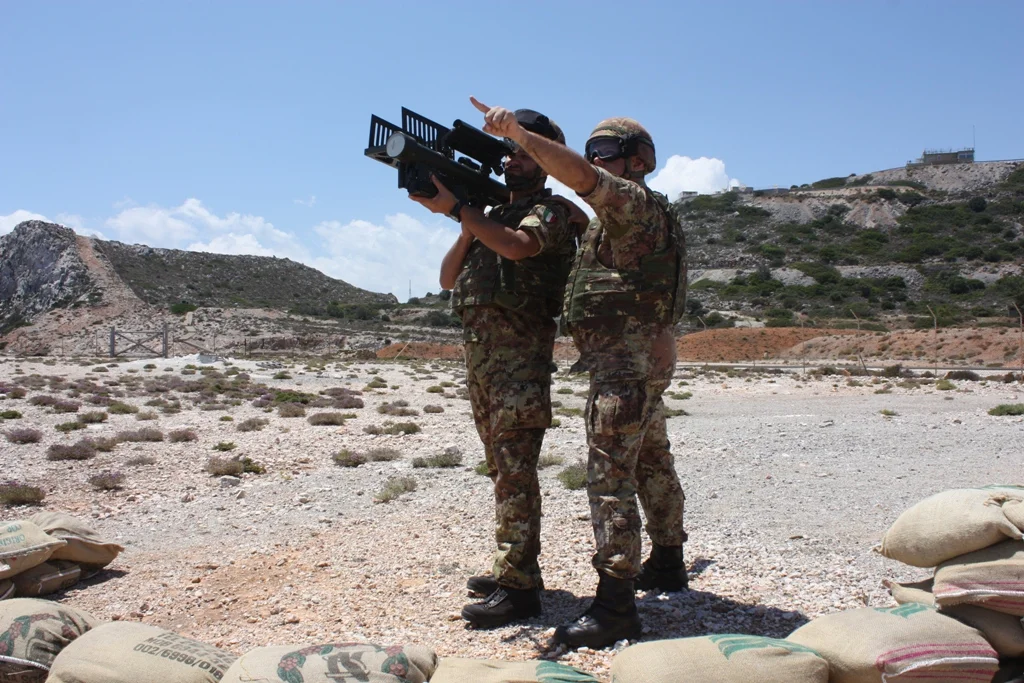
Photo By www.esercito.difesa.it, CC BY 2.5, https://commons.wikimedia.org/w/index.php?curid=82178536

The Stinger comprises three primary components: the missile, the launcher, and the canister that houses the missile.

The missile itself consists of three parts: the guidance system (seeker, battery, control surfaces), the warhead, and the engine. The launcher holds the AN/PPX-3 IFF system and other electronic equipment.

In conclusion, the FIM-92 Stinger is an essential component of modern anti-aircraft warfare, with a long history of service and a range of versions and upgrades to suit various military needs.

Latest

Chikli Frames Israel–Greece–Cyprus Partnership as Counterweight to Turkey

Israeli Diaspora Affairs Minister Amichai Chikli has portrayed cooperation with Greece and Cyprus as a united front against regional extremism that he attributes to Turkey. The remarks reflect widening tensions between Israel and Ankara.

d-Matrix Brings Raptor AI Chips Into Nvidia’s NVLink Fusion Ecosystem

d-Matrix plans to integrate its Raptor AI inference processors with Nvidia’s NVLink Fusion and MGX rack architecture. The move illustrates how strategic competition in AI hardware is shifting from individual chips to tightly connected systems.

BRICS Summit Faces Iran War Test as UAE-Tehran Rift Deepens

The BRICS summit in New Delhi will test whether the expanded bloc can maintain consensus amid the Iran war and a widening UAE-Tehran rift. Energy security and disruption around the Strait of Hormuz are raising the stakes.

Canada Commits C$350 Million for Ukraine Air-Defence Interceptors

Canada has announced C$350 million for air-defence interceptors as Ukraine faces an intensifying Russian missile and drone campaign. Ottawa also plans to send Kyiv one-third of millions of drones it aims to produce over two years.

Saab Wins SEK 2.9 Billion Order for Sweden’s Future Fighter System

Sweden’s FMV has awarded Saab a SEK 2.9 billion order to develop future fighter-system concepts through 2028. The work covers crewed and uncrewed designs, demonstrators and technologies intended to preserve Stockholm’s strategic options.

Check Also

NASA and IBM Release Open-Source AI Model to Map the Moon

NASA and IBM have released an open-source AI foundation model trained on multiple lunar datasets. It can help scientists map ice, craters and volcanic features as mission planning accelerates around the Moon’s south pole.

NATO Allies Disrupted Russian Undersea Cable Operation Near Svalbard, Report Says

British, Norwegian and US forces disrupted a reported Russian deep-sea exercise near critical cables serving Svalbard. No cable was damaged, but the episode highlights intensifying competition over Arctic infrastructure.

Yemen: Houthis Move on Zuqar and Perim/Mayun in Lightning Attack to ‘Close’ Bab el-Mandeb

Houthi forces advance toward Mayun after capturing Zuqar and Mocha, escalating fears for control of the Bab el-Mandeb and global shipping.

MEDUSA-15: Greece, Cyprus, Egypt, France and Italy Send Message of Strength South of Crete

Greece, Egypt, Cyprus, France and Italy launch MEDUSA-15 south of Crete, combining air, naval, special-operations and unmanned-system training in the Eastern Mediterranean.

IPERION: Greece’s New C-UAS System Against Drone and USV Swarms

The IPERION / ΥΠΕΡΙΩΝ system, developed by the Hellenic Aerospace Industry...

Analysis