Air Force
France goes it alone on the Rafale’s successor – after the FCAS collapse comes the “ACF”
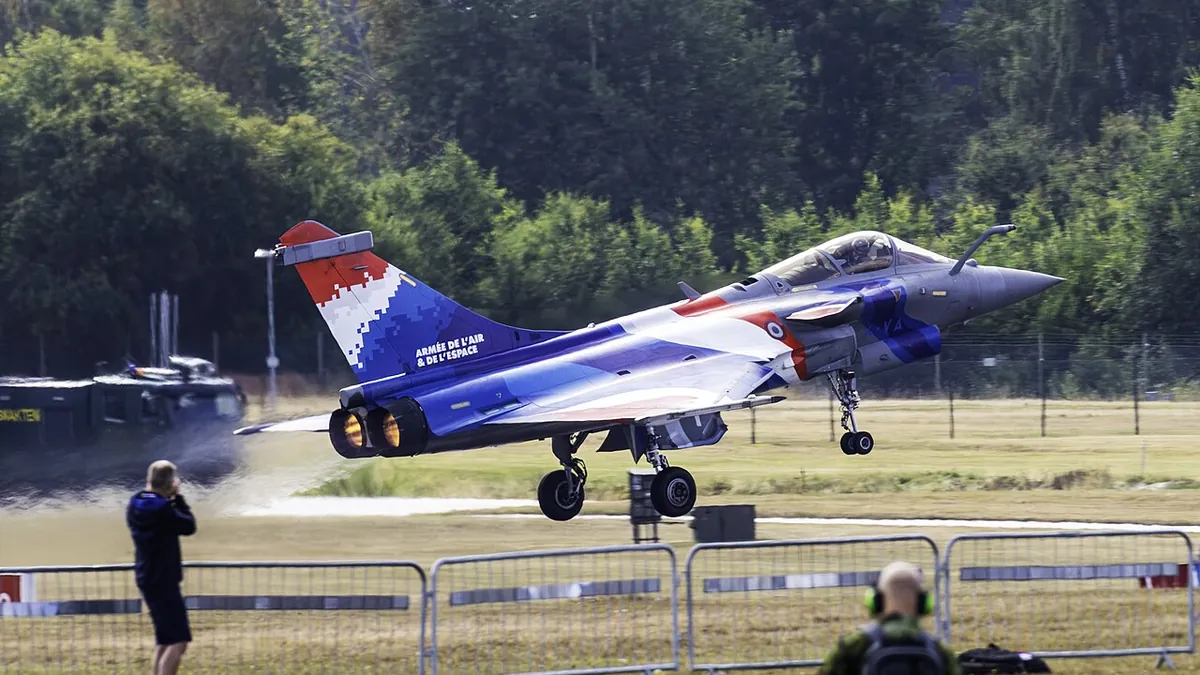
France will develop the successor to the Rafale at national level after the collapse of the Franco-German-Spanish FCAS programme. The aircraft, called NGF within FCAS, is now the ACF, the “Avion de Combat du Futur”, French Air and Space Force chief Gen. Jérôme Bellanger told parliament.

France will develop at national level the fighter that will succeed the Rafale, after the collapse of the Franco-German-Spanish FCAS programme (SCAF in French). The aircraft, which within FCAS was called NGF (New Generation Fighter), is now called ACF, “Avion de Combat du Futur”, that is, the Future Combat Aircraft.
The chief of the French Air and Space Force, Gen. Jérôme Bellanger, said so on Wednesday, October 14, to the National Defence Committee of the National Assembly. “We are starting work that will prepare this ACF at national level,” he said. “Nevertheless, cooperation with other countries will be possible, but in different frameworks, which will not be structural for the birth of this aircraft, which at this stage is being designed at national level.”
With this wording Paris signals that it is not looking for a new main partner for the aircraft, such as Sweden or India, which had been discussed as possible solutions after the break-up of the cooperation with Berlin.
“The halt of the FCAS programme does not mean we are throwing everything away. Our teams, our industrial teams, were working on the NGF, on stealth technology, on the cloud and other things. All this will allow us to continue on a national basis, while placing emphasis on interoperability,” Bellanger added.
What the ACF is meant to do
According to the figures presented, the ACF is to carry out conventional missions until 2040 and, from 2050, to carry the ASN4G, the hypersonic nuclear cruise missile that will replace the ASMP-A. In the interim, the Rafale F5 standard, by 2035, will incorporate the first “building blocks” of the new aircraft, such as the engine, sensors and the Stratus RS anti-air-defence missile. The step from the F4 to the F5, described here, thus becomes the bridge to the ACF.
Dassault Aviation CEO Éric Trappier has said that the company, together with Safran for the engine and Thales, can build the aircraft “well below” a budget of 50 billion euros.
Armed Forces Minister Catherine Vautrin explained to parliament on October 8 that “already since July 2026 it was decided to start, at national level, work on the critical path of what we used to call the NGF”, so as to secure “the initial timetable, which foresees capability available in the early 2040s”. “This work will be reused. So we did not lose money,” she said. The 2027 budget provides for a technology demonstrator aircraft from 2027.
France and Germany agreed in June 2026 to abandon the joint fighter, after years of disagreement between Dassault and Airbus over specifications and industrial control. The remaining pillars of the programme, such as drones, weapons, connectivity and the combat cloud, continue in cooperation. Germany is receiving the first of the F-35s it ordered in 2022 to replace its Tornados, with no clear successor for its Eurofighters.
Bellanger stressed that France must “absolutely continue” to cooperate with Germany and others on the combat cloud, “so that we do not think of a war in which we fight side by side, but a war in which we fight together”. Of the British-Italian-Japanese GCAP, he said it is a “different kind of aircraft, almost a strategic bomber”, and that within the consortium “not everything is rosy”.
At the same time the French Air Force is turning to cheap means too. “To strike the enemy on its own ground, we must now think about how to saturate air defences with cheap bomber drones and with electronic-warfare capabilities such as offensive jamming,” its chief said. The first single-use long-range munitions, MBDA’s Deluge, are expected in summer 2027 and will form the basis of the first squadron of bombing and reconnaissance drones. An interceptor-drone squadron and a stratospheric-balloon squadron are also planned, in a direction reminiscent of HypAIRion, with which France brings advanced autonomy to the Rafale and to unmanned aircraft.