Africa
Morocco unveils a roadmap for a domestic defence industry by 2035, aiming for about 40% of the armed forces’ needs
Morocco presented to King Mohammed VI a roadmap to cover about 40% of its armed forces' needs from domestic production by 2035, with 50,000 jobs and over 65% of the sector's revenue from exports.

Morocco wants to cover about 40% of the needs of the Royal Armed Forces (FAR) and the security services from domestic production by 2035. The target is in the roadmap for developing the national defence and security industry, presented to King Mohammed VI on Wednesday, November 18 at the royal palace in Rabat. The Royal Office’s statement also envisages about 50,000 direct and indirect jobs and more than 65% of the sector’s revenue from exports. The plan, called “Morocco Offer”, aims to put the country in the small group of states that produce defence and security equipment.
At the meeting, attended by Crown Prince Moulay El Hassan, presentations were made by Lt. Gen. Mohammed Berrid, Inspector General of the FAR and commander of the Southern Zone, and Ali Seddiki, director general of Morocco’s Investment and Export Development Agency (AMDIE). Industry Minister Riad Mezzour and the minister delegate to the head of government in charge of National Defence Administration, Abdeltif Loudiyi, also took part. The king ordered the Hassan II Fund for Economic and Social Development to contribute 4 billion dirhams (over $400 million) to financing the plan, and called for rapid implementation, with governance bodies and the financing plan as first steps.
What the roadmap covers
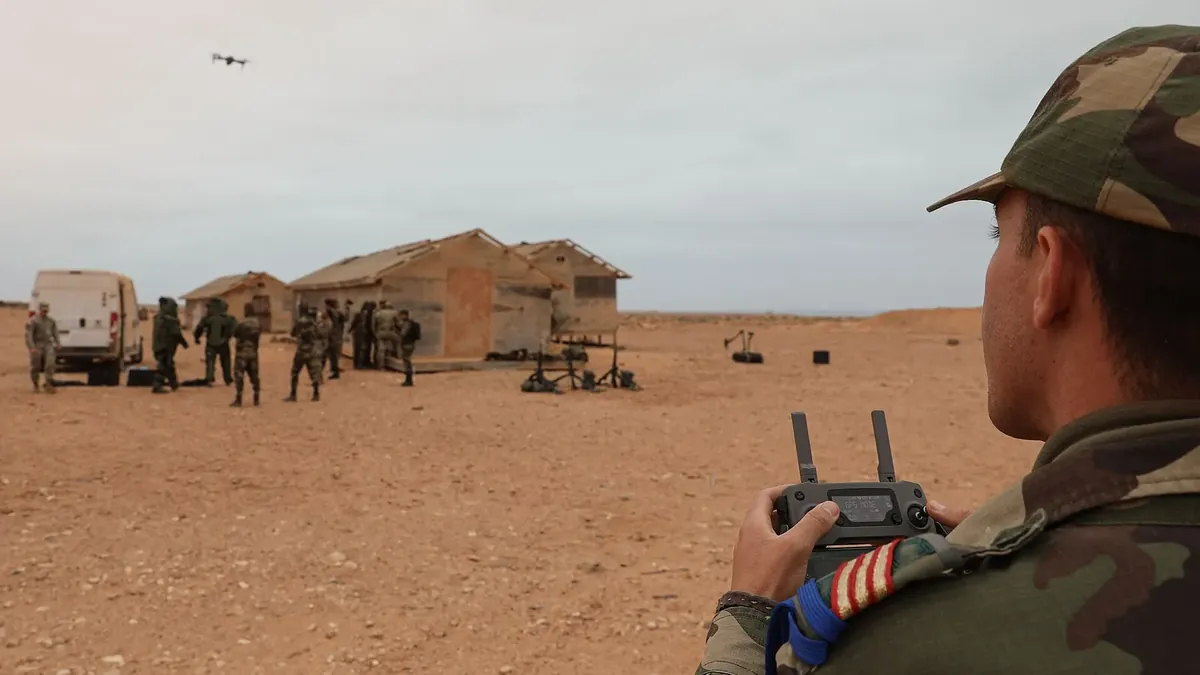
The roadmap describes an integrated industrial ecosystem covering the whole chain, from design and production to maintenance, testing and storage. Priority sectors are drones and autonomous systems, land and naval systems, defence electronics and cyber defence, and AI with emphasis on dual-use applications. For governance it provides a dedicated strategic body to implement the national strategy and support investors, and an industrial holding company pooling public and private capital. A specialised training academy is also planned.
Morocco already has two defence-industry acceleration zones, where the first industrial projects are being set up, and plans new large zones in Benguerir and Benslimane. The king was briefed on progress of the projects under way and on investor interest, especially in export-oriented projects. Mr Mezzour told the state agency MAP that the plan “confirms the maturity of Morocco’s industrial ecosystem” and is a new stage in a process the king began several years ago.
The framework rests on Law 10-20 of 2020 on defence and security equipment and on a 2024 decree on the first two zones. The 2026 budget law set a ceiling of 157.2 billion dirhams for multi-year defence commitments, a 17.8% increase over 2025, while the draft 2027 budget proposes 190.5 billion dirhams. In October the first F-16 Block 72 of the Royal Moroccan Air Force made its first flight, and Israeli sources have spoken of negotiations with Israel for LORA ballistic missiles.