Greece
Stryker with a 30 mm cannon: the parade’s Dragoon and what it could mean for the Hellenic Army
A Stryker with a 30 mm cannon, the Dragoon configuration, led the Stryker column at the Thessaloniki parade. How it was born, what the MCT-30 turret adds, and what a Greek Stryker package could look like.

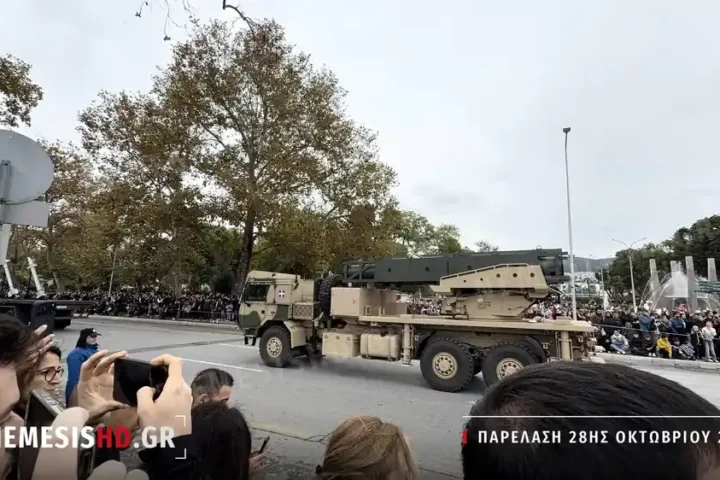
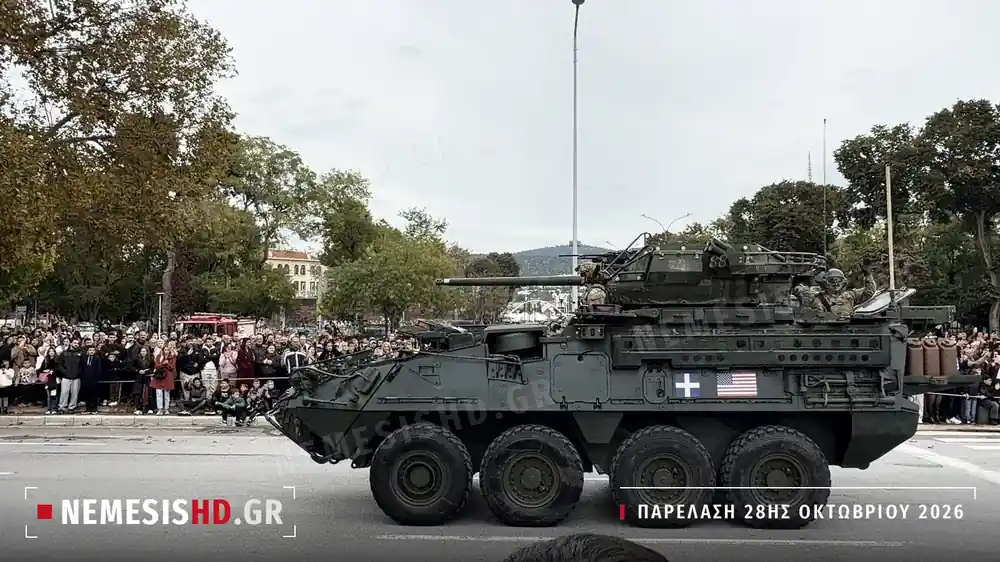
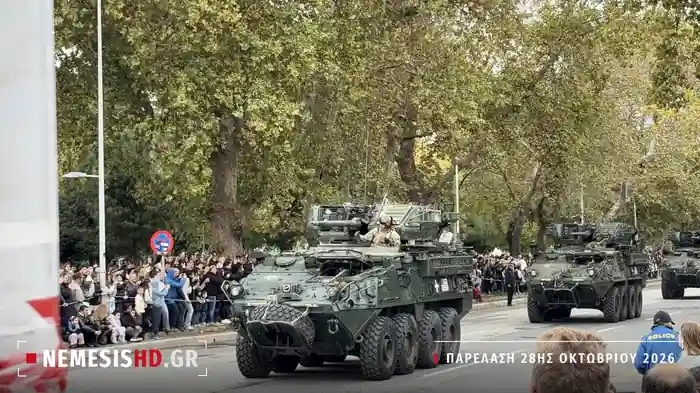
A Stryker with a 12.7 mm machine gun carries infantry; a Stryker with a 30 mm cannon can support it in battle and stop the enemy’s lightly armoured vehicles. That is the difference the public in Thessaloniki saw on October 28, 2026. In the military parade the Strykers passed with the Greek and US flags on their sides, and the first vehicle in the column carried a remotely operated turret with a 30 mm cannon, the configuration the US Army calls Dragoon. Eighteen days earlier, the joint Greece–US statement had for the first time officially mentioned the provision of Stryker vehicles to the Hellenic Army.
How the Dragoon was born
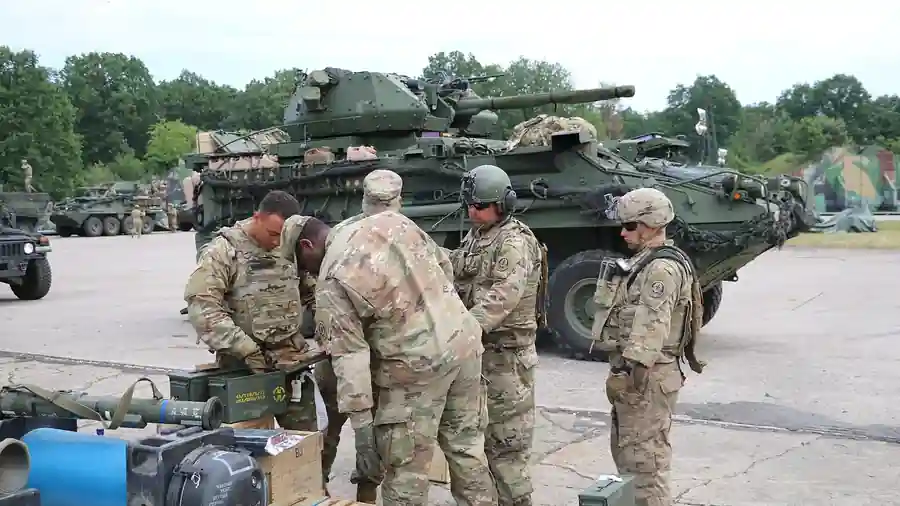
The Dragoon (M1296, originally XM1296 or ICV-D) is a child of Crimea. After 2014 the Americans in Europe found that their Stryker brigades, armed with 12.7 mm machine guns and automatic grenade launchers, lacked the firepower to face Russian infantry fighting vehicles. In 2015 the 2nd Cavalry Regiment, based at Vilseck, Germany, submitted an urgent operational request, and the Army accelerated the integration of a 30 mm cannon. The first prototype was delivered in October 2016, firing tests showed the new weapon is more effective and more accurate at long range than the machine gun, and on December 8, 2017 the first Dragoon was handed over to the 2nd Cavalry. The conversion of 81 vehicles was approved.
The MCT-30 turret and what it gives the infantry
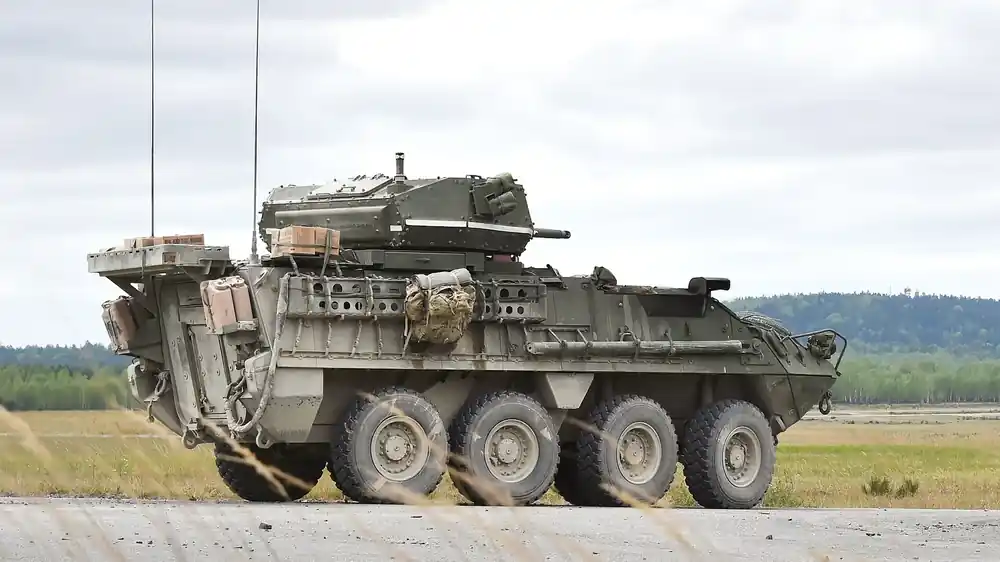
The heart of the Dragoon is the MCT-30 remotely operated turret from Norway’s Kongsberg, with the 30 mm XM813 cannon, a development of the Mk44 Bushmaster II, and a coaxial machine gun. Because the turret is unmanned and sits on the roof, it does not take up space inside: the vehicle keeps a crew of two, driver and commander-gunner, and the squad of nine soldiers, like the basic M1126. The gunner aims from a screen inside the armoured hull, with a thermal sight and stabilisation, so he can fire on the move and at night.
The gain for the infantry is simple. A 12.7 mm machine gun penetrates light armour and unarmoured vehicles, but a 30 mm cannon with armour-piercing rounds takes on infantry fighting vehicles like the BMP and BTR, and hits positions behind light cover from greater distance and with greater accuracy. The platoon leader no longer has to call a tank for every armoured vehicle he sees. It is not, however, a vehicle for every job: the turret carries a limited number of ready rounds and has no anti-tank missiles. That is why the US Army paired the Dragoon with the Javelin version (CROWS-J) and with the M-SHORAD air-defence vehicle, building a family instead of one all-in-one vehicle.
What it means for the Hellenic Army
The October 7, 2026 joint statement mentioned the provision of Strykers to Greece, and on October 20 Nikos Dendias said that a free transfer is under consideration, with only a small cost for shipping. The number and versions have not been announced. This is exactly where the parade’s Dragoon becomes significant. The value of the deal will be judged by the type of vehicle and the mix of versions. A package of only plain M1126s gives the Army a means of transport. A package that includes vehicles with a 30 mm cannon gives the mechanised units something they lack today: medium-calibre firepower on a wheeled vehicle that moves quickly along the road network of Thrace and the islands.
Bulgaria, which bought 183 Strykers through FMS, received according to figures NEMESIS HD has gathered 90 Dragoons, nearly half. Greece, if the transfer is free, has less room to choose, but not none. The question of “free” is not only the shipping cost: it is support, spare parts, training and 30 mm ammunition, which for the Hellenic Army would be a new item in the supply chain. The appearance of the Dragoon in Thessaloniki showed what may come. What finally stays in the country will be shown by the agreement.