Air Force
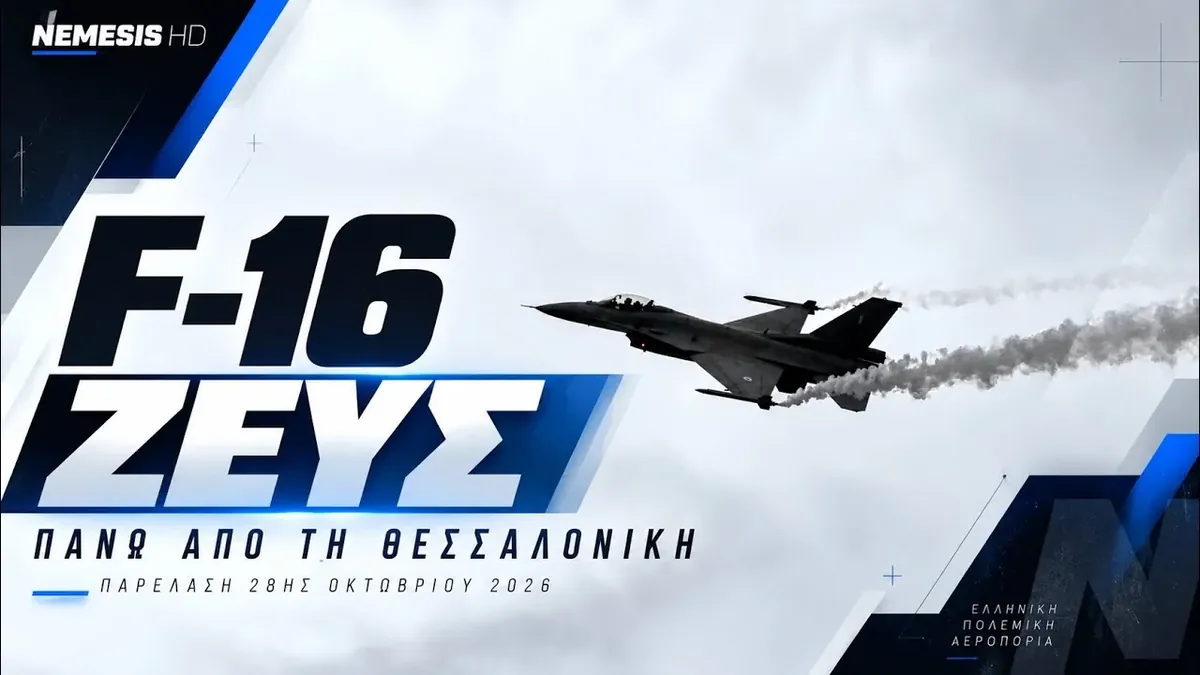
F-16 “ZEUS” over Thessaloniki: eight minutes of display and the pilot’s message at the October 28 parade
The Hellenic Air Force’s F-16 “ZEUS” demo team closed the Thessaloniki parade with an eight-minute display over the Thermaic Gulf and a message from the pilot: “One word changes History.”

The Thessaloniki parade always ends the same way, and this year the climax was again a single aircraft. The F-16 of the Hellenic Air Force’s single-aircraft demonstration team “ZEUS” flew for about eight minutes over the Thermaic Gulf, with vertical climbs, sharp turns and low passes over the water, in front of thousands of people on the waterfront. Behind the spectacle lies something more serious. A display programme is in essence a condensed lesson in air combat: the pilot takes the fighter to the limits of its performance, at low altitude and over a city, which demands years of training and a unit that keeps the aircraft in excellent condition.
In the cockpit was Squadron Leader Christos-Paris Charitos, the team’s Demonstration Pilot. According to the biography released by the Air Force when he took on the role in 2023, he entered the Hellenic Air Force Academy in 2006, moved to the F-16 Block 52+ of the 115 Combat Wing in 2012 and has served in the 340 Squadron “Fox” at Souda since 2013. He has been a member of “ZEUS” since 2014, first as announcer and member of the recording team and later as display pilot. Over the radio, Charitos sent from the cockpit this year’s message to Thessaloniki: “One word changes History. For the Greeks that word is NO. Today we honour those who stood tall. We remember that freedom is not given away. Happy national day, Greece.”
What the “ZEUS” team is
“ZEUS” is the Hellenic Air Force’s official F-16 demonstration team, based at the 115 Combat Wing at Souda, Crete. It began its displays in 2010, with pilots from the Wing’s two squadrons, the 340 and the 343, and has since appeared at national anniversaries and at the largest air shows in Europe. In 2023 alone it flew in France, for the 70th anniversary of the Patrouille de France, in Radom, Poland, and at the Belgian Air Force Days. The aircraft is an F-16C Block 52+, which traditionally flies the programme with conformal fuel tanks (CFT) on its spine. Those tanks make the F-16 heavier and less agile than an F-16 without CFTs, so every manoeuvre is more demanding for the pilot and more representative of how the aircraft flies on a real mission.
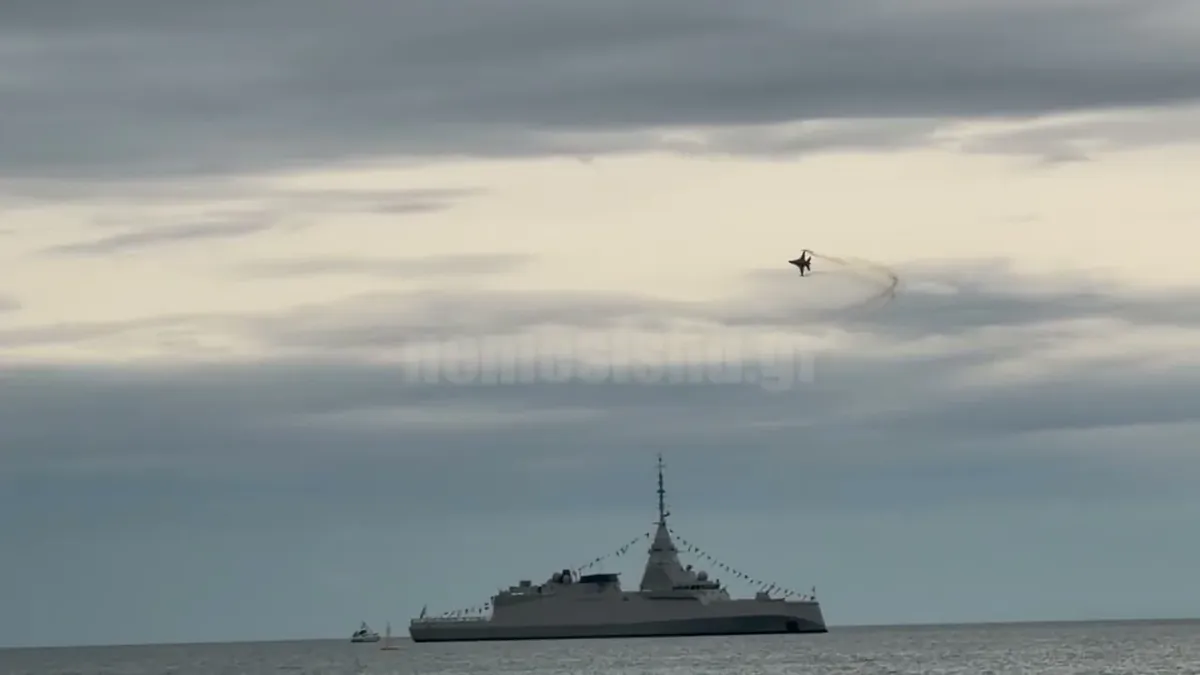
The image of the F-16 above the frigate KIMON, anchored in the Thermaic Gulf, tied together the two halves of this year’s parade. On one side, “ZEUS” and the F-16 that has been the backbone of the Air Force for three decades. On the other, the first FDI HN, with its Sea Fire radar, which reached Greece in January 2026 and opened to the public in Thessaloniki. In the same air segment, as we recorded in our report on the parade, the Embraer with the Erieye radar passed in formation with two F-16s, while on the ground the SCALP-EG cruise missile and the weapons carried by Greek fighters were on show.
Why displays matter, including towards Turkey
A display team is not a decorative element. It is the shop window of an air force: it shows the level of pilot training, the availability of aircraft and the ability of technicians to keep a fighter flying at its limits, year after year. Turkey knows this well and invests in its own F-16 team, SoloTürk, which appears regularly at shows abroad. When “ZEUS” flies in France, Poland or Belgium, Greece shows its NATO allies that the Greek F-16 pilot is among the most experienced in Europe, with thousands of flight hours accumulated in intercepts and engagements over the Aegean.
The 2026 display comes in a year when the Air Force is changing its face. The F-16s are moving to the Viper configuration, with a new AESA radar, while the question of the new targeting pod and of how the Greek F-16V stands against the F-16 Block 70/72 remains open. This year’s parade also showed something else: weapons for deep strikes, from the Israeli systems to the Greek Arpyia missile. “ZEUS” in the sky over Thessaloniki is the most visible reminder that all of this ultimately rests on the people who operate it.