Middle East & North Africa
Saudi, Pakistani and Turkish delegations meet Iranian officials in Tehran as Trump weighs a deal or renewed strikes
Delegations from Saudi Arabia, Pakistan and Turkey are in Tehran on 26 October to avert renewed war, while Trump says he is choosing between a deal and force.

Senior delegations from Saudi Arabia, Pakistan and Turkey were in Tehran on Monday 26 October for talks with Iranian officials, as the region braces for a possible return to open fighting between Iran and the United States and Israel. According to the Associated Press, citing two regional officials, the visitors include Saudi Defence Minister Khalid bin Salman, Pakistan’s army chief Field Marshal Asim Munir and the head of Turkey’s intelligence service.
A Saudi statement quoted by AP said the delegations hope to find “ways to de-escalate tensions, enhance regional security and promote its stability.” A Saudi official described the trip as support for the mediation led by Qatar and Pakistan, which helped broker the interim US-Iran arrangement of June. The visit comes a day before Israel’s election and eight days before the US midterm elections on 3 November, dates that AP and CBS News both cite as sources of anxiety about renewed strikes.
Trump: a deal, or “finish them off”
In Washington, President Donald Trump has kept both options open in public. According to CBS News, he told Fox News on Sunday 25 October: “Now, my question is, do I make a deal with them, or do I finish them off?” Asked whether a strike was imminent, CBS reports he answered that there would not be one that day. On Friday 23 October he had said the United States “may do another little Epic Fury”, the name given to the US campaign against Iran that began on 28 February, as our Iran war timeline 2026: Epic Fury, Hormuz and the US blockade recounts.
CBS News also reports that Trump has indicated any strikes would wait until after the 3 November midterms. The same live coverage says US Ambassador to the UN Mike Waltz stated on 23 October that the naval blockade of Iranian ports could continue “for the foreseeable future”.
Tehran: the diplomatic window is open, the conditions are not met
Iranian Foreign Ministry spokesman Esmail Baghaei said over the weekend that Tehran has not closed the window of diplomacy and that messages are passing to Washington through intermediaries. AP adds that he accused the United States of persisting in unilateral demands, and said Iranians do not accept the idea of “complete surrender” that he attributed to Trump and US officials. Foreign Minister Abbas Araghchi said on 25 October that a renewed war would not change Iran’s positions, according to CBS.
On 24 October Iran’s ambassador to Pakistan said Tehran had signalled, through Pakistani mediators, that it would reopen the Strait of Hormuz if Washington lifted the blockade, and that the United States had refused. Reports on this offer conflict: an outlet linked to the Revolutionary Guards denied that Iran had made any such proposal. The armed forces chief of staff said on 24 October that US warships would not be allowed into the Persian Gulf “under any circumstances”, a statement covered in our report on Pezeshkian’s call for a way out of “neither war nor peace”.
Oil and the wider front
CBS News reports that Brent crude reached $112 a barrel on Thursday 22 October, its highest since mid-May, and rose more than 3.5 percent on Friday to above $117, from under $97 at the start of the month. Netanyahu warned on Sunday, citing intelligence, that Iran or its proxies could attack before the Israeli vote; he said in a video statement that the military “is ready both to defend and to strike”, in AP’s account. AP also notes that Yemen’s Houthis are increasingly attacking Saudi Arabia, and that Yemen is on the agenda in Tehran.
Why it matters for Greece
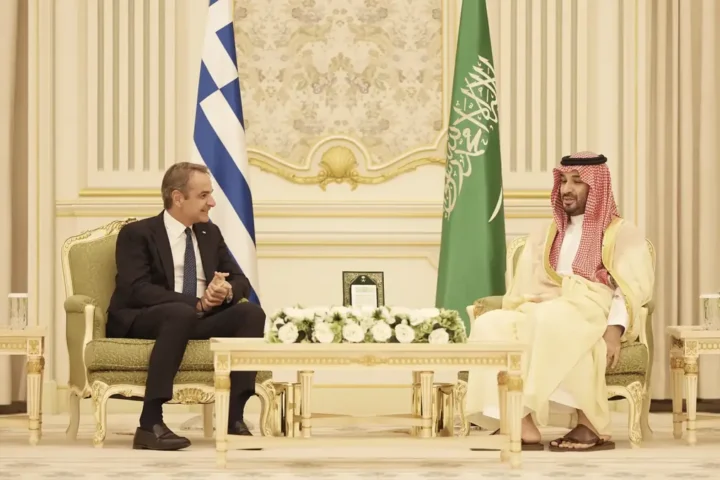
Prime Minister Kyriakos Mitsotakis said during his visit to Saudi Arabia that the Greek Patriot battery deployed there will stay, as we reported in Mitsotakis in Saudi Arabia: the Greek Patriot battery stays, with defence, Iran and energy security at the centre.
No outcome of the Tehran meeting had been announced at the time of writing.