Analysis
Mines in the Aegean: what Hormuz teaches and why two minehunters on the Hellenic Navy list are not enough
Hormuz has shown how few mines it takes to paralyse a sea lane. The Hellenic Navy lists just two minehunters, both decades old, while Turkey fields six and drills every year at the Dardanelles. An analysis of the gap and how to close it.

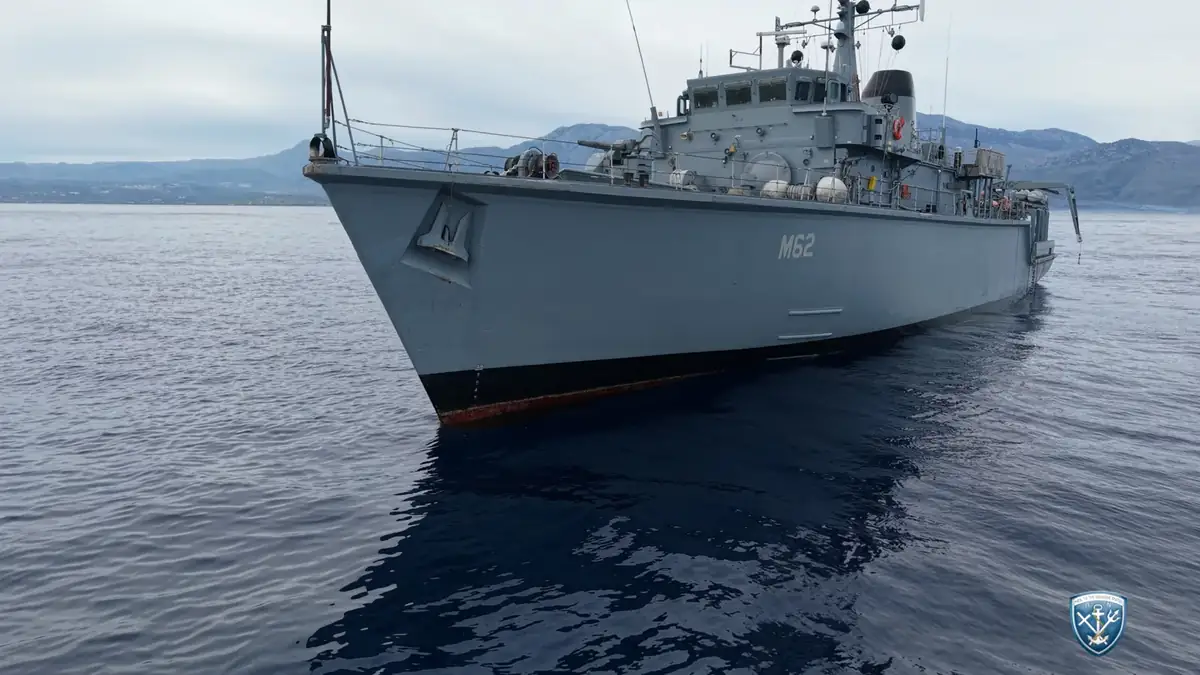
The minehunter Evropi (M62) during the multinational mine warfare exercise ARIADNE 26, Cretan Sea, March 2026. Photo: Hellenic Navy General Staff.
Mines are a threat Greece is asked to face with very few national means, while its geography makes it unusually vulnerable. The crisis in the Strait of Hormuz, where since the spring of 2026 tankers have moved among minefields, claims and conflicting announcements, shows how little it takes to paralyse a sea lane. The Aegean, with its narrow passages, the ports that supply dozens of islands and its proximity to the Dardanelles, has every geographic feature that makes the mine effective. Against that, the official list of the Hellenic Navy records just two minehunters, with an average age above thirty-five years.
Our argument is that mine warfare is a precondition for getting frigates, submarines and landing ships out of port, and for keeping coastal shipping running in a crisis. We examine what Hormuz showed in 2026, the historical experience of the mine in our own neighbourhood, from the Dardanelles in 1915 to the Corfu Channel in 1946, which ships the Mine Warfare Command (DNAR) actually has, what the Turkish Navy fields, and how Italian minehunters and unmanned systems can fill the gap. All data on the Greek fleet comes from the official website of the Hellenic Navy General Staff (HNGS).
What Hormuz showed in 2026: mines, claims and shipping under pressure
Since the start of the war with Iran on February 28, 2026, the Strait of Hormuz has again become a theatre of real mine warfare, as in the late 1980s and the Gulf War of 1991. The British government formally declared Iran’s mining of the Strait unlawful and, in November, linked that to its decision to acquire three mother ships for unmanned mine-detection systems. London and Paris are jointly planning a multinational mission to secure the passage of merchant ships, while South Korea decided to send unmanned mine-hunting assets and an explosive ordnance disposal team to the region.
The US Central Command (CENTCOM) said on October 25 that the main transit corridors are free of Iranian mines and that more than 3,000 merchant ships had passed with its support in six months. Meanwhile, the Revolutionary Guards and the Navy of Iran’s regular army announce almost daily that tankers moving on “unauthorised” routes struck mines and caught fire; our report on the latest such claim describes one of them. On November 14 Tehran spoke of three such incidents within a few hours, without giving a name, flag or position, and the claim was not confirmed by an independent source.
This is the first lesson for Greece. A mine does not need to sink many ships to succeed; it only has to convince owners, insurers and crews that a route is dangerous. The UK Maritime Trade Operations centre (UKMTO) recorded at least seven attacks on tankers in and around Hormuz in the week to November 11 and traffic about 65% below pre-war levels. Even when CENTCOM denies that a ship hit a mine, as it did for the GFS Pride, which it says was struck by a projectile, the doubt has already done its work. The threat, in other words, works psychologically before it works explosively.
The second lesson concerns time. Eight months after the war began, Britain and France were still planning their multinational mission and London was deciding in November to buy new mother ships. The Strait of Hormuz is about 39 kilometres wide at its narrowest point, far wider than any Greek passage, and yet clearing and watching the corridors requires a continuous presence of ships, helicopters and autonomous assets. A country with two minehunters cannot expect allies to reach the Aegean faster than they reached the Gulf, above all if the crisis involves Turkey, a NATO ally.
From the Dardanelles in 1915 to the Corfu Channel: the mine in our own neighbourhood
The mine has already won a major naval battle a few miles from the Greek islands. In the attack of March 18, 1915, the British-French fleet tried to force the Dardanelles with battleships, believing its minesweepers would clear the approaches. But the Ottoman minelayer Nusret had laid, a few days earlier, a line of mines in Erenköy Bay along the Asian shore that aerial reconnaissance had not detected. The French battleship Bouvet sank within minutes with more than 600 dead, the British Irresistible and Ocean were lost and the Inflexible was badly damaged. The naval attack was abandoned and the struggle shifted to the land campaign at Gallipoli.
Ankara has not forgotten that memory. The Turkish Navy’s annual mine warfare exercise carries the name “Nusret”, and from October 6 to 16, 2026 it was held in the Gulf of Izmir, opposite Chios and Lesbos, and at Ereğli on the Black Sea, as an invitation exercise with allied and friendly countries, according to the Turkish naval authorities. The Dardanelles are 61 kilometres long and between 1.2 and 6 kilometres wide, roughly thirty times narrower than Hormuz at their tightest point. For anyone planning a defence or a blockade, that geography favours the mine, and the Turkish Navy practises it every year.
The Hellenic Navy has its own, often forgotten, history in mine warfare. According to the HNGS, the first dedicated Greek mine countermeasures command was EMAN (Neutralisation of Magnetic and Acoustic Mines), founded in 1941 in Alexandria. In 1943 it was renamed the Senior Mine Countermeasures Service Command, with 23 minesweepers and 39 observation posts, and when the fleet returned to Greece in 1944 it settled at Skaramangas with about 50 ships. The war had already shown the Navy the cost of the mine: in October 1943 the destroyer Adrias lost her bow to a mine off Kalymnos and returned to Alexandria without it, an episode the Navy commemorates to this day.
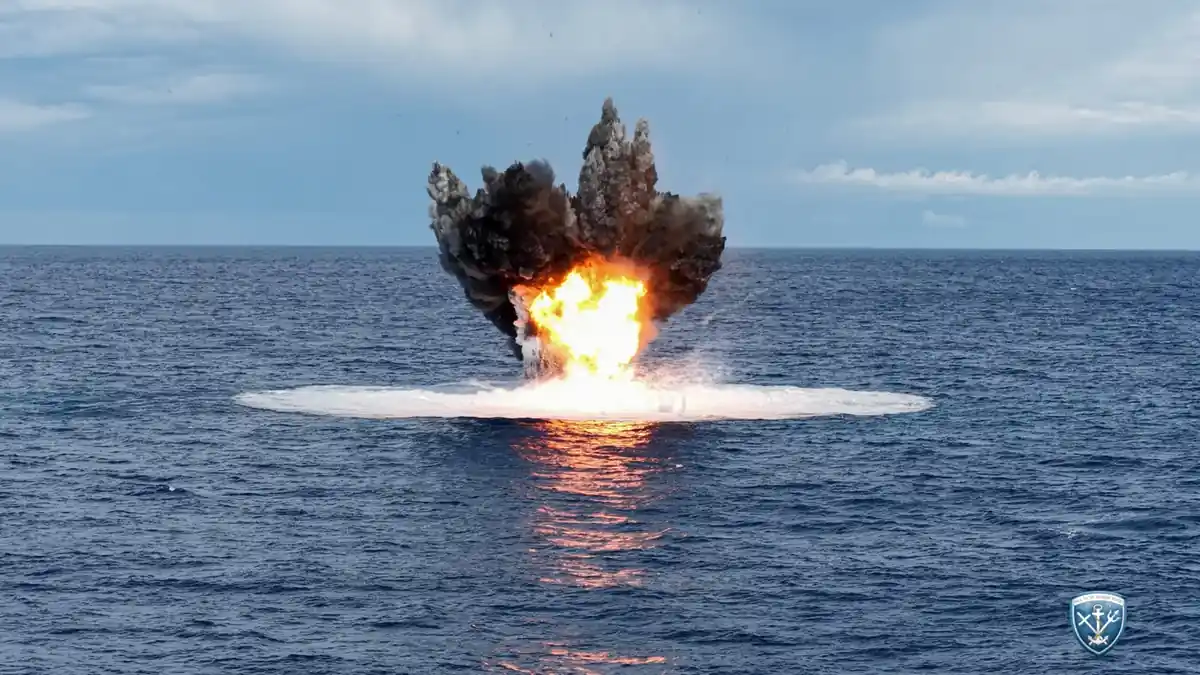
A second precedent bears directly on the Greek Ionian. On October 22, 1946, British destroyers sailing in the Corfu Channel struck mines near the Albanian coast, with dozens of sailors killed. The case became the first heard by the International Court of Justice in The Hague, which in 1949 ruled that Albania should have known of the minefield near its coast and warned of it, as the case page at the Court records. The Court also found the later British clearance in Albanian waters, carried out without consent, to be unlawful. The lesson is timeless: the mine blurs responsibility, and whoever lays it can deny involvement for years.
The Greek minehunter fleet: Evropi and Evniki
The Navy’s official website is clear: the Mine Warfare Command has two ships, one Osprey-class minehunter and one Hunt-class minehunter with minesweeping capability. They are Evniki (M61) and Evropi (M62). That is far from 1980, when the DNAR had, according to the HNGS, three squadrons of minesweepers and a group of minesweeping boats. Between 2000 and 2007 the Navy took delivery of four second-hand ships, two British Hunts and two American Ospreys, but Kallisto and Kalypso no longer appear on the official fleet list. Kallisto was badly damaged in October 2020 when she collided with a merchant ship in the Saronic Gulf, as the HNGS announced at the time, while Kalypso last appears in HNGS announcements for ARIADNE 22 in March 2022. We found no public announcement of her decommissioning, but from ARIADNE 23 onwards the HNGS names only Evropi and Evniki.
Evropi is the former HMS Bicester (M36), one of the Hunt-class minehunters built by Vosper Thornycroft in Portsmouth. Her hull is glass-reinforced plastic (GRP), a material with a very low magnetic signature, so that the ship does not trigger the magnetic mines she is sent to find. She entered Royal Navy service in May 1986 and, according to the HNGS, found and neutralised 75 mines in the 1991 Gulf War. She was handed to the Hellenic Navy on July 31, 2000 and arrived at the Salamis Naval Base on September 8, 2000. The ship therefore has real experience of mine clearance in the Persian Gulf.
Evniki is the former USS Pelican (MHC-53), one of 12 Osprey-class minehunters built by Avondale in New Orleans, also with a GRP hull. According to the HNGS she was launched in June 1993, commissioned on January 4, 1994 and taken over by a Greek crew at Ingleside, Texas on March 16, 2007. She carries the AN/SLQ-48 remotely operated vehicle (ROV) for detecting, identifying and neutralising mines, while Evropi carries three PLUTO PLUS vehicles from the Italian company Gaymarine. The difference matters in practice: two ships with different systems mean two different supply, training and spare-parts chains.
| Item (per the HNGS) | Evropi (M62) | Evniki (M61) |
|---|---|---|
| Class / origin | Hunt, former HMS Bicester (Britain) | Osprey, former USS Pelican (USA) |
| Original entry into service | May 1986 | January 4, 1994 |
| Entry into the Hellenic Navy | July 31, 2000 | March 16, 2007 |
| Displacement | 665 tonnes (full load) | 970 tonnes |
| Hull material | GRP | GRP |
| Underwater vehicles | 3 PLUTO PLUS ROVs, 2 civilian-type ROVs | 1 AN/SLQ-48 ROV, 2 civilian-type ROVs |
| Accommodation | 50 people | 49 people |
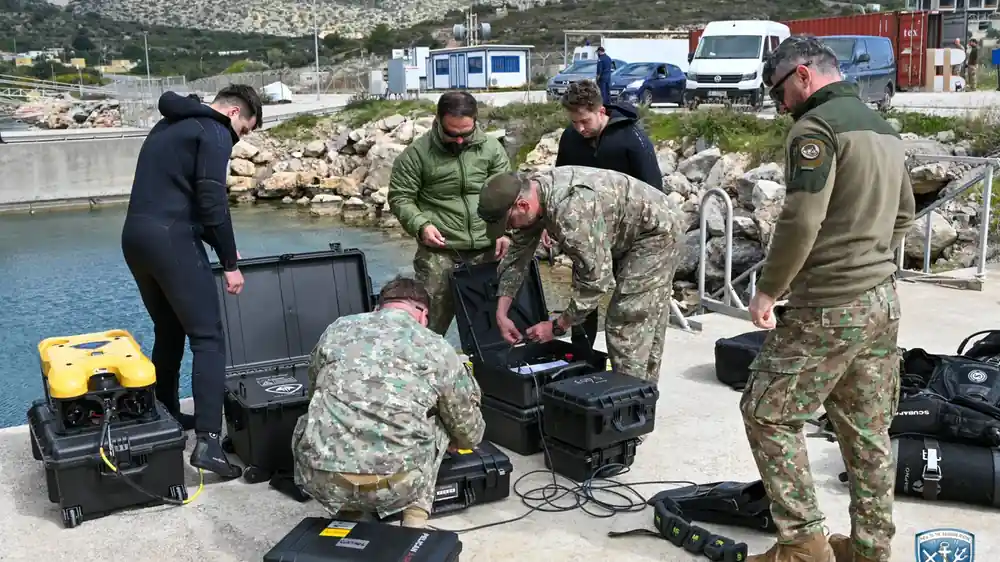
The two ships are not the DNAR’s only tool. According to the HNGS, the Command includes the Mine Warfare School, with a PLUTO PLUS simulator, the Mine Warfare Data Center, which gathers seabed environmental data and updates the classified charts, and the Mine Disposal Teams, trained by the Underwater Demolition Command. The DNAR’s tasks explicitly include protecting critical undersea infrastructure and ports and guiding commercial shipping in a crisis through NATO’s NCAGS procedures (Naval Cooperation and Guidance for Shipping). That is exactly what allies are doing in Hormuz at the moment.
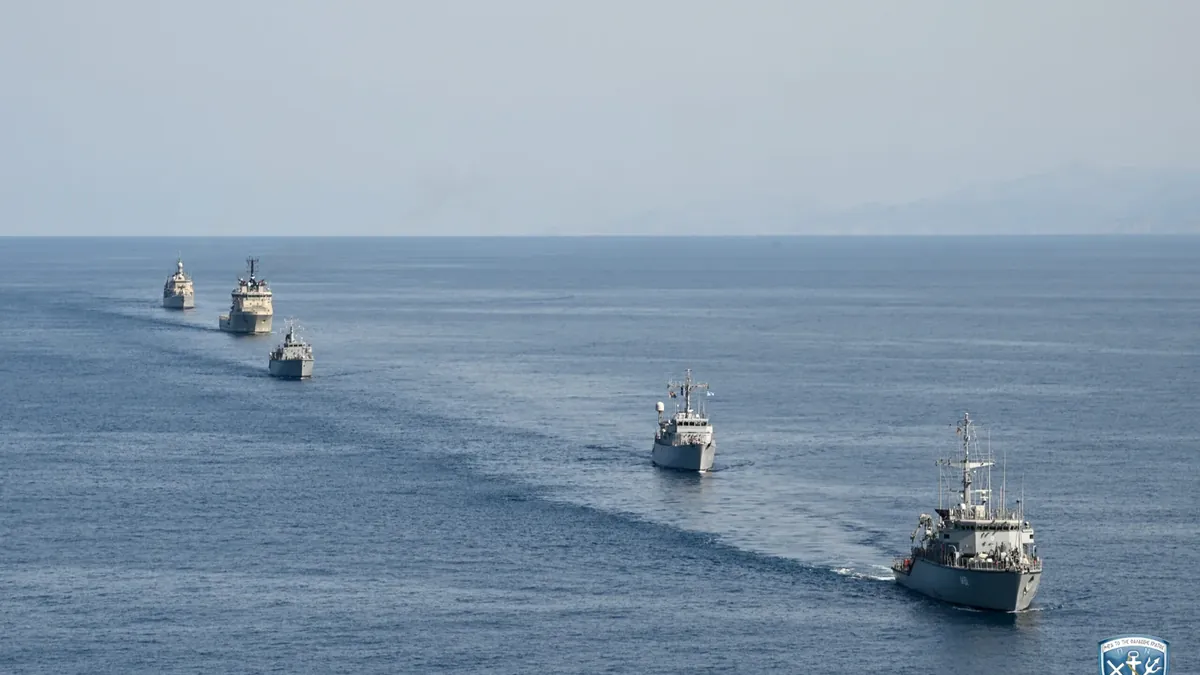
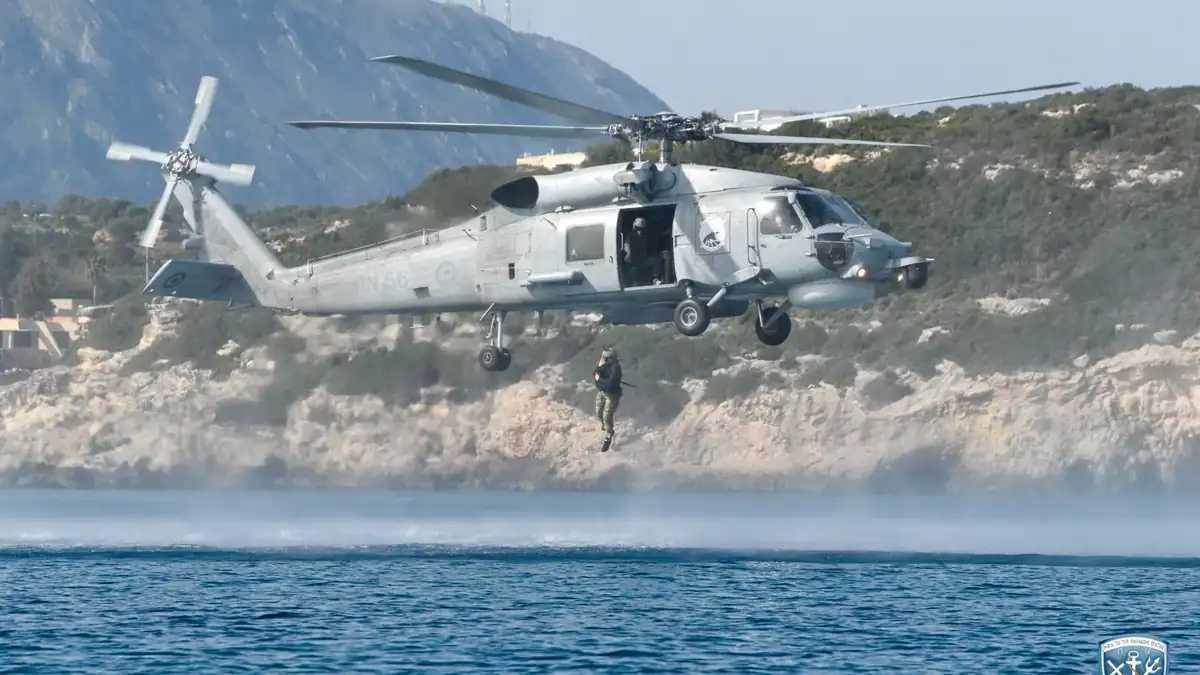
Readiness is tested every year in the multinational exercise ARIADNE. ARIADNE 26 was held from March 2 to 13, 2026 in the Cretan Sea, covering mine warfare, mine countermeasures in very shallow water and the use of autonomous underwater vehicles (AUVs). Participants included frigates, surveillance vessels, the DNAR, a Navy helicopter, the Underwater Demolition Command, Hellenic Air Force aircraft and a Coast Guard vessel, along with assets from the US, Britain, Bulgaria, France, Croatia and Romania and two NATO centres. The exercise shows a high level of cooperation, but it does not change the basic number: in a real crisis Greece would have two national minehunters.
Turkish mine warfare capability: Aydın, Nusret and submarines
Turkey took a different path. Rather than rely only on second-hand ships, in 1999 it ordered six new Aydın-class minehunters, a variant of the German Frankenthal design by Lürssen and Abeking & Rasmussen, with the first ship built in Germany and the rest at the Navy Shipyard in Istanbul. The ships carry the names of Turkish coastal towns, such as Alanya, Amasra, Ayvalık, Akçakoca, Anamur and Akçay, and the first entered service in 2005. In the 1990s the Turkish Navy also acquired former French Circé-class minehunters, for which we found no official data confirming they remain in service.
The number does not measure availability, training or systems, but it shows the order of magnitude. Counting only the Aydın ships, Turkey has six minehunters against two on the Greek list, built almost two decades after Evropi. Ankara also takes part, with Romania and Bulgaria, in the trilateral Black Sea Mine Countermeasures Group, set up by a memorandum of the three defence ministers on January 11, 2024 and operational from July 1, 2024 to clear mines drifting with the currents since the invasion of Ukraine. In July 2026, as the Romanian defence ministry announced, the three countries signed an amendment to the memorandum extending the group’s mission to the protection of critical undersea infrastructure. Turkey, in other words, builds operational experience with real mines, not only in exercises.
What matters most for Greece is not the countermeasure but the offensive side. Turkey has minelaying means, and conventional submarines such as the new Reis class with air-independent propulsion (AIP) are among the most discreet ways of laying mines. A submarine that quietly lays mines at the entrance to a Greek port or in a Cycladic passage is exactly the scenario that makes life hard for the defender: there is no photograph, no announcement, and the first sign is the explosion. Mine warfare, in this form, becomes an instrument of the grey zone, something Tehran has shown it knows how to use.
Turkey is also investing in unmanned systems. The Turkish company STM developed the NETA family of autonomous underwater vehicles, and the NETA 300 operates, according to the company, at depths of up to 300 metres on missions of up to 24 hours, with mine detection and neutralisation for the Turkish Armed Forces as its first use. Ankara has not solved the problem this way, but it treats mine warfare as a national industrial priority. The irony is that Turkish ships have also trained in Greek waters: in ARIADNE 21 the Turkish minehunter Ayvalık took part as part of NATO’s standing mine countermeasures group SNMCMG2.
| Capability | Greece | Turkey |
|---|---|---|
| Minehunters (modern generation for Turkey) | 2 (Hunt, Osprey) on the HNGS list | 6 of the Aydın class (status of the Circé ships unconfirmed) |
| Original entry into service | 1986 and 1994 (USA), per the HNGS | Aydın class, from 2005 |
| Origin | Second-hand from Britain and the US | German design, mostly built in Turkey |
| Annual mine warfare exercise | ARIADNE (INVITEX) | Nusret (invitation exercise) |
| Regional cooperation | NATO SNMCMG2 | SNMCMG2 and the trilateral Black Sea group |
| Unmanned assets | PLUTO PLUS and AN/SLQ-48 ROVs, Pyrpolitis USV | STM NETA AUV |
Where a mine would hurt in the Aegean: ports, passages and coastal shipping
The Aegean differs from the Persian Gulf in one critical respect: the Greek economy and the defence of the islands depend on dozens of smaller sea lines, not on a single passage. Coastal ferries, the tankers that supply the islands with fuel and the landing ships that would carry reinforcements all move through narrow passages, such as the Kafireas Strait between Euboea and Andros, the corridors between the Cyclades and the straits around Crete. A mine at the entrance of Piraeus, Souda or the Salamis Naval Base would not need to sink a ship: it would be enough to force the port authorities to stop traffic until the channel is checked.
In the same scenario the Fleet would have two needs at once: to get frigates and submarines out of their bases and to keep the corridors to the islands open. With two minehunters the DNAR would have to choose which port or passage to check first, and mine hunting is by nature slow: ships move at a few knots, sweep the seabed with sonar and examine every suspicious contact with an underwater vehicle or a diver. Maintenance, breakdowns and NATO commitments reduce availability further. In practice there may be days when only one ship is ready to sail.
There is also the dimension of merchant shipping, which for Greece is a matter of national importance. Hormuz showed that when an area is declared dangerous, ships change routes, insurance premiums rise and the market reacts before any official decision. In the Aegean, NCAGS shipping guidance, a DNAR responsibility, would be a tool for informing masters of safe corridors. But that tool presupposes that someone has already checked the corridors, and that someone is the minehunters. Without enough ships, guidance becomes a simple warning, and the decision passes to the insurers.
The last point concerns undersea pipelines and cables, which link the islands with the mainland and Greece with its neighbours. Mine warfare and seabed protection converge because they use the same sonars, the same underwater vehicles and the same specialists. The Italian minehunter Chioggia, for example, watched pipelines and cables in the Central Mediterranean from December 2024 to March 2025, as we reported when the Navy chief toured the ship in Venice. A minehunter, in other words, is now also a critical-infrastructure protection vessel, a role the HNGS explicitly recognises for the DNAR.
Italian minehunters, drones and Pyrpolitis: how to close the gap
The political leadership has recognised the problem. On October 5, 2026, after meeting his Italian counterpart Guido Crosetto in Venice, Defence Minister Nikos Dendias said he had discussed the transfer of two second-hand Italian minehunters, a reference also included in the ministry’s announcement, as covered in our report on Dendias’s request to Italy. On October 13, at the inauguration of the Unmanned Maritime Systems Centre at Skaramangas, he spoke of an “initial understanding” with the Italian minister and the Chief of the Italian Navy on the transfer of “a number of minesweeping vessels”. Neither the class, the terms nor any contract has been announced so far.
The stage matters and should be stated precisely: this is political discussion and an initial understanding, not a signed agreement. The Italian Navy said in 2026 that it has eight Gaeta-class minehunters, with modernised sensors, command systems and communications, and is moving to the new generation, Cacciamine di Nuova Generazione, so units of the current generation will be withdrawn gradually. The Lerici- and Gaeta-class ships, built by Intermarine, have GRP hulls and use vehicles of the PLUTO family, the same ones Evropi already carries and the Mine Warfare School trains on in its simulator.
That compatibility is the strongest argument for the Italian solution. The design of the American Ospreys, to which Evniki belongs, was based on the Italian Lerici class, so Greek crews already know the ship’s philosophy. Two Italian minehunters would double the DNAR’s strength at relatively low cost and training time, and would give Greece four ships, a number that allows two to be ready at all times. The weak point is obvious: the Gaeta class was built in the 1990s, so the solution buys time, not a new generation.
The new generation, in every modern navy, is unmanned systems. Britain is committing £1.1 billion to the next phase of the autonomous mine-hunting programme it procures with France and will acquire mother ships from Norway, while South Korea is sending sets of unmanned surface vessels and underwater vehicles to Hormuz, as Seoul announced. The logic is to keep people out of the minefield: the surface vessel tows the sonar, the autonomous vehicle maps the seabed and the remotely operated vehicle destroys the mine, while the mother ship stays at a safe distance.
Greece has taken the first steps. Pyrpolitis, the unmanned surface vessel designed and built by the Hellenic Navy itself, was unveiled in October 2026, and the minister announced that the next step is production in large numbers, as we covered in our report on Pyrpolitis and the new Skaramangas centre. The PLUTO GIGAS was shown at the Thessaloniki parade, as we described in our analysis of the Navy’s underwater warfare, and ARIADNE 26 focused on autonomous underwater vehicle operations. The next logical step is a Greek autonomous mine-hunting package, with towed sonar for Pyrpolitis, autonomous underwater vehicles and a base ship, which could be one of the Fleet’s general support vessels.
Hormuz has shown that a state with a limited navy can hold world trade hostage with mines. Turkey has the geography of the Dardanelles, submarines and an annual exercise bearing the name of Nusret, in other words everything needed to think along the same lines in the Aegean. Greece, which lives from the sea and defends islands, cannot entrust freedom of navigation to two ships that entered service, according to the HNGS, in 1986 and 1994. The transfer of the Italian minehunters must become a contract as soon as possible and, in parallel, Pyrpolitis must acquire a mine-hunting role. Mine warfare is cheap for the attacker and expensive for the defender, and Greece cannot afford to find that out on the day Piraeus closes.
Frequently asked questions about Greek minehunters
How many minehunters does the Hellenic Navy have? According to the HNGS website, the Mine Warfare Command has two ships: Evniki (M61), an Osprey-class minehunter, and Evropi (M62), a Hunt-class minehunter with minesweeping capability.
Where do the Greek minehunters come from? Evropi is the former British HMS Bicester, in service since 1986 and with the Hellenic Navy since 2000. Evniki is the former American USS Pelican, in service since 1994 and with the Hellenic Navy since 2007.
How many minehunters does Turkey have? The Turkish Navy has six Aydın-class minehunters, based on the German Frankenthal design and entering service from 2005. It also acquired former French Circé-class ships, for which there is no official confirmation that they remain in service.
Will Greece get minehunters from Italy? Nikos Dendias said on October 5, 2026 that he had discussed with his Italian counterpart the transfer of two second-hand minehunters, and later spoke of an initial understanding. No class, terms or signed contract have been announced.
What is the ARIADNE exercise? It is the Hellenic Navy’s annual multinational mine warfare exercise, of the INVITEX type. ARIADNE 26 took place from March 2 to 13, 2026 in the Cretan Sea, with participation from seven countries and two NATO centres.
Why are mines so dangerous in narrow passages? Because they force every ship through a confined space, while clearance is slow and needs specialised vessels. In 1915 at the Dardanelles a few Nusret mines sank three Allied battleships and stopped the naval attack.