Analysis
Greece’s ammunition stocks: how long could it sustain a high-intensity conflict, and what Lavrio and Aigio change
No one outside the General Staff can say how many days Greece's artillery could fight. Official data show how fast stocks drain, how slowly they refill, and what the Lavrio joint venture and the Aigio tender could change for Greek shell production.

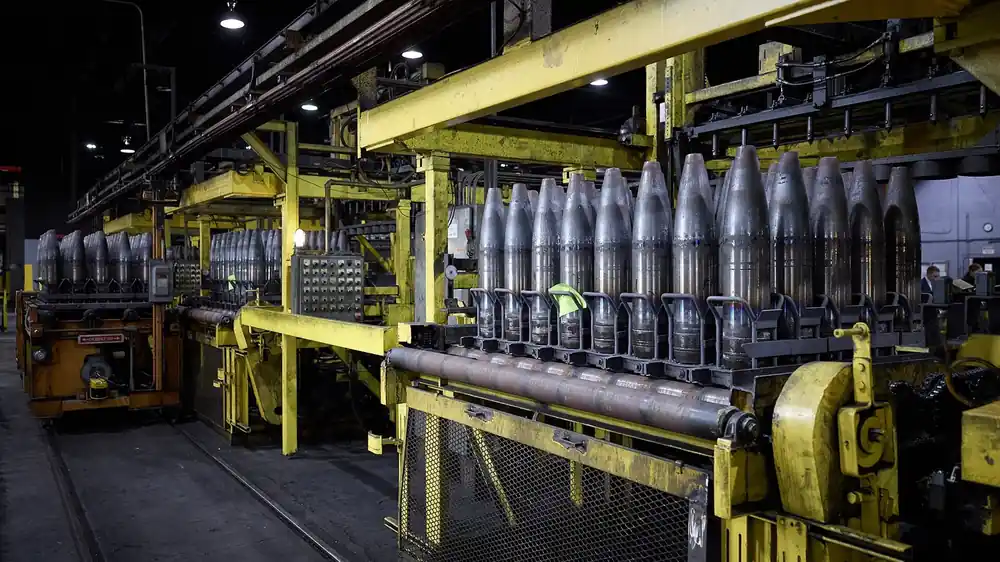
A production line of steel 155mm artillery shell bodies at the Scranton Army Ammunition Plant in Pennsylvania, September 2024. Photo: President of Ukraine (Office of the President of Ukraine), CC0.
A country’s deterrence is usually measured in aircraft, frigates and launchers, but a high-intensity conflict is ultimately decided by something far less photogenic: how many shells, rockets and missiles an army can fire after the first week, when the initial stocks have already thinned. The war in Ukraine showed that even the United States needs years to replace what it expended, and that Europe, from 2022 onward, needed dedicated funds just to recover its capacity for propellant and explosives. For Greece, which plans its defence against a Turkey with a far larger industrial base, the issue is practical. The country is rebuilding large-calibre shell production on an industrial scale, with the Lavrio joint venture and the Aigio tender. But the value of the two projects will depend on whether they are tied to national stockpile targets and multi-year orders, and not only to exports.
The exact Greek stocks are, as everywhere, classified, and no serious analyst can say publicly “how many days” the Hellenic Artillery could last. What can be shown with official data is three things: how fast stocks drain in a real war, how slowly they refill even in the world’s largest industries, and what exactly Greek industry, chiefly Hellenic Defence Systems (EAS), can produce at present. From these follows what the Hellenic National Defence General Staff (HNDGS) should demand of the new industrial schemes before the money from SAFE and the 12-year programme is shared among other priorities.
War stock: what it means and why Ukraine overturned every plan
A war reserve is the ammunition kept exclusively for use in conflict and not for training. It is the quantity that lets a force fight at the planned rate for a set period, until new production or allied aid begins to arrive. In NATO, stock targets are set through the Defence Planning Process, and the updated Defence Production Action Plan, approved on February 13, 2025, asks allies to apply NATO ammunition standards in their industrial contracts and to prefer joint procurement, so that demand is pooled and justifies new production lines. The same text says the Alliance’s industrial production board will focus in the short term on general-purpose ammunition and air defence.
The problem is that these targets were designed in an era when no one expected a war of attrition in Europe. The clearest official figures on what that means come from the report of the US Department of Defense Inspector General (which now also uses the secondary title “Department of War”), number DOWIG-2026-095, dated July 9, 2026. According to the report on 155mm shell production, the US gave Ukraine over 3 million shells through presidential drawdowns from its stocks, about 217,857 were provided through FMS sales and another 111,637 were expended in training and testing. The US 155mm stockpile thus fell by more than 3.6 million shells in four years.
Against that decline, the same report records that US production rose from 14,000 shells a month, which was also the initial capacity target, to 36,000 a month in March 2026, or 432,000 a year, while the target had been set at 100,000 a month by October 2025. The US Army had invested $4.5 billion in 155mm production between February 2022 and September 2025, and yet the limiting factor remains the manufacture of the metal shell bodies. If one divides the report’s two figures, even at today’s rate, which is more than double the original, replacing what left US warehouses would take about eight years of production, with no new consumption in the meantime.
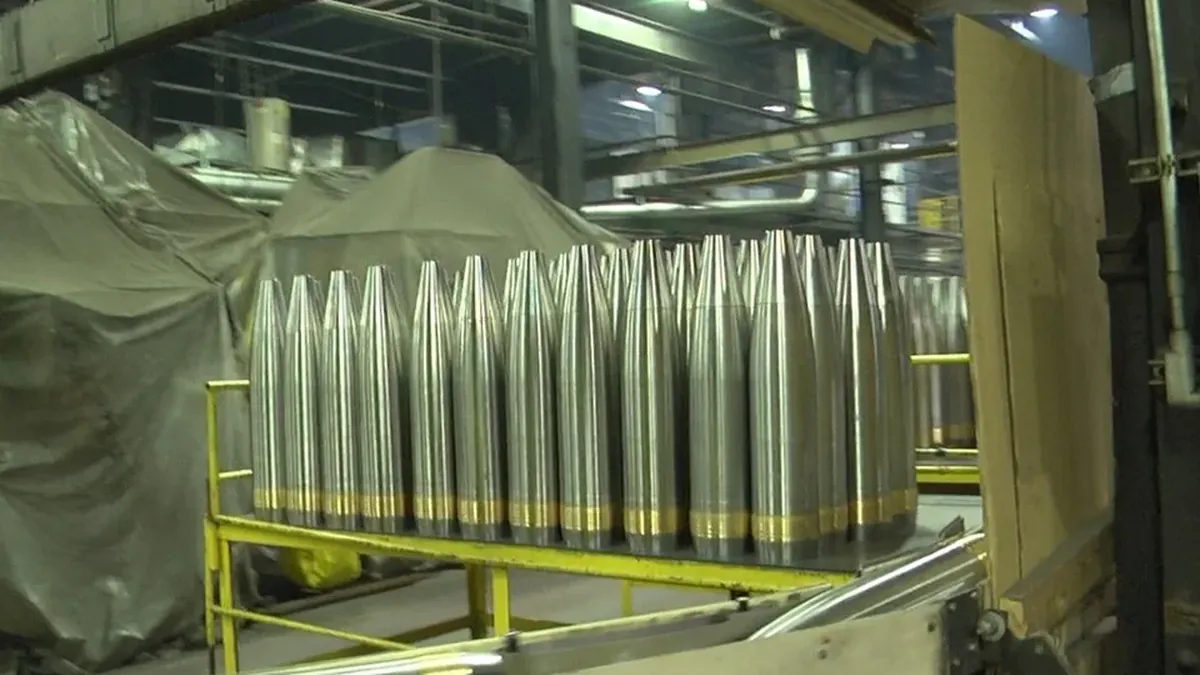
For a smaller country this has a specific consequence. In a high-intensity war the initial stock is not a “cushion” that the market will quickly refill, because everyone will be asking for the same thing at the same time. What is in the warehouses on day one, together with what can be produced in the country or secured through priority contracts, is in practice what will be there for months. In a crisis with Turkey, Greece cannot plan on the mass flow of allied ammunition that Ukraine had, and for that reason dependence on imports is a strategic vulnerability and not merely a procurement matter.
Production against consumption: the US, Europe and Russia in numbers
The European Union was slow to react, but from 2023 it put money directly into industry. The ASAP regulation (Act in Support of Ammunition Production) allocated €500 million, and the European Commission, when it announced the selected projects on March 15, 2024, noted that European capacity for 155mm shells had already reached 1 million a year in January 2024, with a target of 2 million by the end of 2025. The distribution of the money is revealing: €248 million went to propellant and €124 million to explosives, because that was where the real choke point of European production lay. As CSG itself notes in its Lavrio announcement, explosives production in Europe was limited for years because energy-intensive processes had been moved outside the continent.
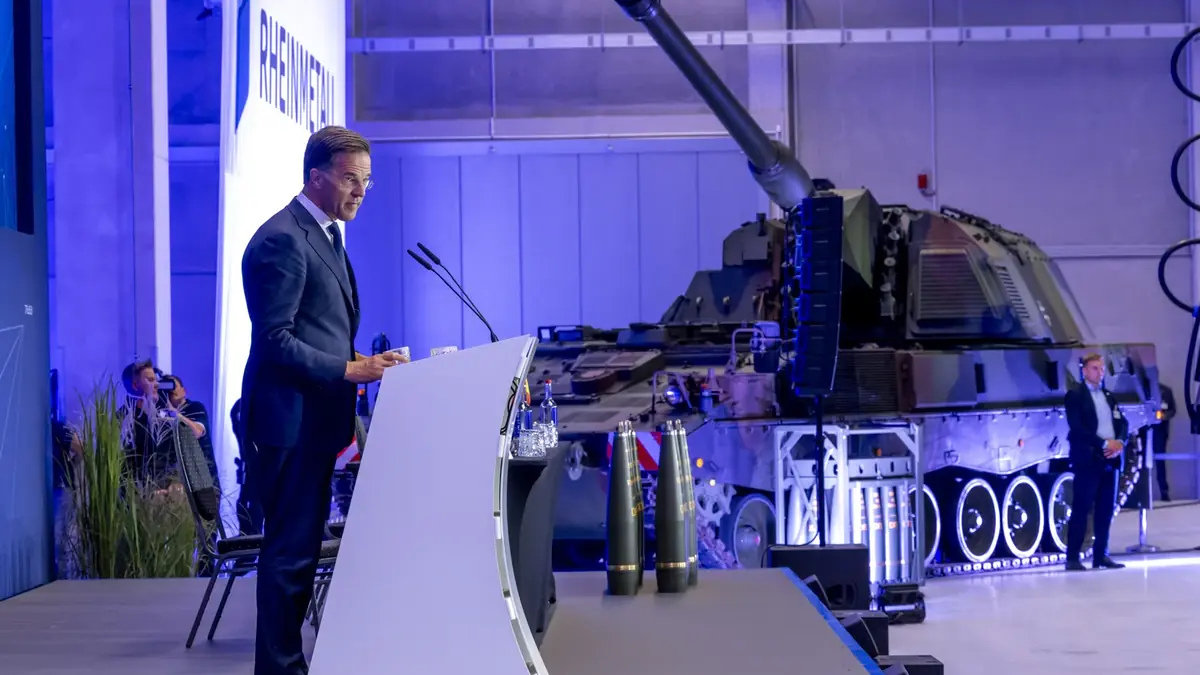
On August 27, 2025, at the opening of Rheinmetall’s new plant in Unterlüß, Lower Saxony, NATO Secretary General Mark Rutte said that Europe’s annual artillery-shell production capacity was now six times larger than two years earlier and was expected to reach two million by the end of the year. According to him, that plant alone plans to produce 350,000 shells a year. The two million also appears in the EAS tender for Aigio, but there as annual demand in Europe, citing the EU’s White Paper on European defence of March 2025.
Russia moved on another scale. The Stockholm institute SIPRI, in its report on the world’s 100 largest defence companies for 2024, says Russia reportedly produced 1.3 million 152mm shells in 2024, against 250,000 in 2022. The same report records the world’s biggest annual revenue increase for the Czech Czechoslovak Group, parent of MSM, at +193%, attributed in part to the Czech shell initiative for Ukraine. It also points to a new risk: in late 2024 China cut antimony exports by 97%, a critical raw material for ammunition, and its price rose by 200%. A shell line can therefore also stop for lack of raw materials, even if the machinery is in place.
| Producer / target | Size | Source |
|---|---|---|
| US, 155mm shells, starting point (initial capacity target) | 14,000 a month | Inspector General, report DOWIG-2026-095 |
| US, 155mm shells, March 2026 | 36,000 a month (432,000 a year) | Inspector General, report DOWIG-2026-095 |
| US, target | 100,000 a month by October 2025 (not met) | Inspector General, report DOWIG-2026-095 |
| US, stock reduction 2022–2026 | more than 3.6 million shells | Inspector General, report DOWIG-2026-095 |
| Europe, 155mm capacity | 1 million a year (January 2024), target 2 million by end-2025 | European Commission, NATO |
| Rheinmetall, new Unterlüß plant | 350,000 shells a year (design) | NATO Secretary General speech, 27/8/2025 |
| Russia, 152mm shells | reportedly about 1.3 million in 2024 (against 250,000 in 2022) | SIPRI, Top 100 for 2024 |
| Aigio, investor’s minimum capability | 300,000 shells over three years, an average of 100,000 a year (after the September 2026 amendment) | EAS tender 01/KD/2026 and amending invitations |
How long does a high-intensity conflict last in the Greek theatre
A war in the Aegean and Evros would not resemble the Donbas front, but it would have two features that make stocks even more critical. The first is geography: island garrisons would have to fight with what is already forward-deployed on the islands, because sea and air resupply would be under threat from missiles, drones and submarines from the first hour. The second is the intensity of the first days: in a short but violent conflict, the greatest consumption is concentrated at the start, when each side tries to impose a fait accompli. This means that the “duration” of a stock is measured not in a total number of shells but in the quantity available at the right place at the right time.
The Greek arsenal also has three very different categories of ammunition. The first is bulk ammunition: 155mm and 105mm artillery shells, mortar rounds, small-arms ammunition, grenades. These are consumed in large quantities, are relatively cheap and can be produced in Greece. The second is precision guided munitions, such as PULS rockets, anti-tank and naval missiles, which are bought abroad. The third is air-defence missiles, from Patriot to the frigates’ ESSM, where Greece depends entirely on foreign production lines, which after Ukraine and the Middle East are working with large order backlogs.
This distinction also determines realistic policy. For air-defence missiles and precision weapons, the only solution is stocks bought in advance and Greek industry’s participation in European consortia, as already happens with the EAS unit that makes warheads for the IRIS-T missile. For bulk ammunition, by contrast, Greece can and must have domestic production that can scale up quickly in a crisis. In Ukraine the periods of shell shortage coincided with loss of initiative on the front, and drones, however much they multiplied, served as a complement to massed fires and not a substitute for them.
The comparison with Turkey is unfavourable here. The state-owned MKE entered SIPRI’s 2024 list at 93rd place with arms sales revenue of $1.21 billion (it was 102nd the year before), and so Turkish companies in the top 100 reached five, the highest number on record, with total revenue of $10.1 billion. MKE is the state manufacturer of ammunition for the Turkish armed forces, from cartridges to artillery shells. Greece does not need to copy the Turkish scale, but it cannot rely on an industry that, as EAS itself admits, now operates with obsolete equipment in its shell-forging plant.
EAS: the four factories and what they can produce
Hellenic Defence Systems (EAS) emerged from the 2004 merger of two historic state companies, the Hellenic Powder and Cartridge Company (PYRKAL) and the Hellenic Arms Industry (EBO). The main shareholder is the Ministry of Finance and oversight lies with the Ministry of National Defence. According to the company, the Hymettus complex produces small-arms ammunition, aircraft practice bombs, metal parts for medium and large-calibre ammunition, and warheads for Stinger and IRIS-T missiles. Lavrio does the loading (filling the shell with explosive) and assembly of medium and large-calibre ammunition, aircraft bombs and warheads, and produces propellant powders.
Aigio is the old EBO plant where the G3A3 and A4 rifles and the Minimi machine guns were made, and now, as EAS writes in the concession tender, it can produce only light weapons and ammunition components. Mandra deals with weapon systems, external aircraft loads, naval turrets with 30mm guns, the ASRAD-HELLAS system, the assembly of the Kornet-E anti-tank missile and the modernisation of the Velos air-defence system. Lavrio is also NATO-certified as a missile assembly and disassembly facility (MADF), one of five such facilities worldwide according to the company, a capability that matters for maintaining the country’s missile stocks.
| EAS plant | What it produces (per the company) | What is changing |
|---|---|---|
| Hymettus | Small-arms ammunition, metal shell parts, Stinger and IRIS-T warheads, practice bombs | Relocation of headquarters, ammunition machining shop and the IRIS-T unit; transfer of the shell-forging and cartridge-case plants to Aigio |
| Lavrio | Loading and assembly of ammunition, propellant powders, NATO MADF certification | Hellenic Ammunition S.A. with MSM (CSG): 155mm shells, base bleed, TNT |
| Aigio | Light weapons and ammunition components | Concession tender for shell forging and cartridge cases, duration of at least 25 years |
| Mandra | Weapon systems, naval turrets 30mm, ASRAD-HELLAS, Kornet-E, Velos modernisation | No change announced |
EAS’s product catalogue includes the 155mm M107 shell, the 155mm long-range ERA/BB and HERMES shells, 155mm propellant charges and primers, the 105mm M1 cartridge, 81mm and 4.2-inch mortar rounds, 40mm grenades and the 84mm anti-tank round. The catalogue does not say how many can be produced. The company itself, in the Aigio tender, writes that the shell-forging and cartridge-case plants at Hymettus have reduced production capacity, mainly because of obsolete equipment and a lack of capital and know-how for producing large-calibre cases, and that the equipment for producing large shells “is not being used”. There is no public annual production figure for EAS or for the new joint venture.
Lavrio and Aigio: the two schemes that will decide Greek shell production
The first move came from Lavrio. On May 12, 2023, as the Ministry of National Defence announced at the time, Hellenic Army General Staff officers met representatives of EAS and the Slovak MSM Nováky about a proposal to donate 40 155mm shells for trial firings. In 2024 EAS, together with MSM Export, secured from ASAP €23.39 million for the TNTrion explosives project and €9.69 million for the LAVGRAIN propellant project, as shown in the European Commission’s official project list. The two sums together, about €33 million, went exactly to the two choke points the Commission had identified, explosives and propellant, and laid the basis for the scheme that followed.
On January 30, 2026 the articles of association and the concession agreement for the establishment of Hellenic Ammunition S.A. were signed in Athens. According to CSG’s announcement, MSM takes over management of the Lavrio plant for 25 years; about 120 people then worked at the plant and 180 hires were planned during 2026, bringing staff to about 300 by the end of the year. CSG said the plant already produces 155mm shells and that other calibres would be added during the year, that large-calibre production would run in multiple shifts during 2026, that production of base bleed grains (a composite propellant at the base of the shell that reduces drag and extends range) was planned for the second half of 2026, and that TNT production would start at the turn of 2026 into 2027. The group committed to investments of up to €50 million over the long term.
Each partner’s stake in the joint venture is not stated in the announcement, nor is the annual quantity of shells. If CSG’s schedule is kept, Lavrio will again have the whole chemistry chain: explosive, propellant powder, base bleed and loading, exactly the stages the European Commission called a choke point. The choice of a partner with an established market position explains the speed, but it leaves an issue the State must regulate explicitly: who will have priority in Lavrio’s production in a crisis, the Hellenic Armed Forces or the customers with the largest orders.
The second scheme concerns Aigio and is less well known. On June 17, 2026 EAS announced an international public tender with competitive dialogue (tender 01/KD/2026, posted on Diavgeia and in KIMDIS) for the concession of shell forging and cartridge-case production, that is, the manufacture of the steel shell bodies and cases, in a joint company with a private strategic investor. EAS will hold at least 51% and will contribute part of the Aigio facilities and the unused equipment of Hymettus, while the investor will bring capital, know-how, staff and customers. The duration is indicatively estimated at at least 25 years, after which the plant will return to EAS. The initial deadline of July 22 was extended several times, and under the second amending invitation of October 15 applications were submitted by October 26, 2026, with the opening of bids the same day. The result of the pre-selection had not been posted on Diavgeia by mid-November.
The tender’s criteria show the scale being sought. The candidate must have annual turnover of at least €100 million from shell forging and cartridge-case production, net worth of at least €50 million and a credit rating of at least “AA”. The technical criteria were relaxed with the first amending invitation of September, “in order to widen competition”: the minimum capability for manufacturing steel bodies fell from 20,000 to 7,000 tonnes a year and the minimum capacity from 300,000 shells a year to 300,000 over three years, an average of 100,000 a year, while the requirement remained that the candidate has delivered at least 300,000 shells over the last three years. Experience is also required in operating a hydraulic forging press by EUMUCO from the 1980s, the same as the one at Hymettus. According to the tender, to complete the line, machines are missing for nose forming (nosing) and base forming (heading), for annealing and for CNC machining. The final scope and production target will be set in the second phase.
Money and priorities: SAFE, the 12-year programme and the missing stock target
Funding, this time, is not the main obstacle. The SAFE regulation (Security Action for Europe, the EU’s €150 billion loan programme for defence investment) was approved by the Council on May 27, 2025, and according to the European Commission Greece has a total allocation of €787.7 million, of which the first instalment of €118.2 million, or 15%, was disbursed on July 23, 2026. In parallel, the prime minister presented to Parliament on April 2, 2025 the 12-year €25 billion armaments programme, with an explicit commitment to “Greek added value” and the participation of domestic industry in all programmes, as we have analysed in our guide to armaments since 2019. No public analysis has been given of how much of these sums goes to ammunition.
This is the real gap. The new Lavrio and Aigio lines are designed as commercial investments with an export orientation: the Aigio tender speaks of “profitable growth” and the “global market”. That is logical, because no shell production line survives on the peacetime needs of an army the size of the Greek one alone. Precisely for that reason, however, the State must secure two things in the contracts: first, a priority clause for the Hellenic Armed Forces in a crisis or mobilisation, and second, multi-year framework contracts that will steadily fill the warehouses at the rate set by the HNDGS plan and not at the rate of annual budgets.
The US is already moving this way. On November 5, 2026 the Pentagon announced a $4.17 billion framework contract by the US Army with eleven companies to modernise its state-owned ammunition plants, among them MSM Group North America, the US subsidiary of the CSG group. Britain and Poland made large-calibre ammunition a key part of their bilateral cooperation. At the Hague Summit in June 2025, allies committed to defence spending of 5% of GDP by 2035, of which 3.5% for core defence needs, and NATO’s updated Defence Production Action Plan explicitly asks for clear demand signals to industry, long-term orders and multi-year multinational contracts. The common logic is that industry invests when it sees certain orders.
For Greece, this means that building up the ammunition stock should become a separate, visible strand of the 12-year programme, with figures that may be classified as to their content but not as to their existence. There are also opportunities for regional cooperation, such as co-production of ammunition with neighbouring countries, and Europe-wide certification of shells can shorten the time it takes for a Greek shell to be accepted by another army. As for precision and air-defence munitions, such as the PAC-3 MSE, the solution is orders placed with enough lead time before demand, because in a crisis they will not be available on the market.
Conclusion: deterrence needs warehouses, not only platforms
Over the last seven years Greece has spent billions on fighters, frigates and air-defence systems, and rightly so. But a PzH 2000 without shells, a Patriot battery without missiles and a frigate with an empty vertical launcher are very expensive furniture. Lavrio and Aigio are the most serious attempt in recent years for the country to regain real large-calibre shell production, with a partner that knows the job and with European funding, and deserve support. The decision that will determine the outcome, however, belongs to operational planning: the State must set stock targets, fund them with multi-year orders and legally lock in the priority of the Armed Forces in domestic production. If that is not done, Greece will have built a successful ammunition export industry and will continue not to know how many weeks it can hold out.
Frequently asked questions about the ammunition stockpile
How many days of war can the Greek ammunition stockpile sustain? The figure is classified and has not been published, so any public estimate of days is speculation. The official US data show how fast stocks drain: the US reduced its 155mm stockpile by over 3.6 million shells in four years and produced 36,000 a month in March 2026.
Does Greece make 155mm artillery shells? Yes. CSG said in January 2026 that the Lavrio plant already produces 155mm shells, and EAS has the M107 and long-range shells in its catalogue. The annual production quantity has not been published.
What is Hellenic Ammunition S.A.? The joint venture of EAS with MSM of the Czech CSG group for producing large-calibre ammunition at Lavrio. The founding documents were signed on January 30, 2026, MSM manages the plant for 25 years and, according to CSG, the group committed to investments of up to €50 million. The partners’ stakes have not been made public.
What does the EAS tender for Aigio provide? The concession of shell forging and cartridge-case production to a joint company with a private investor, with EAS holding at least 51% and an indicative duration of at least 25 years. After the September 2026 amendment, the investor must have a capacity of at least 300,000 shells per three years and have delivered at least 300,000 shells in the last three years. Applications were submitted by October 26, 2026.
How much money did Greece receive from the European ASAP programme for ammunition? EAS, with MSM Export, received €23.39 million for the TNTrion explosives project and €9.69 million for the LAVGRAIN propellant project, about €33 million in total.
How much is Greece entitled to from SAFE? According to the European Commission, €787.7 million in loans, of which €118.2 million was disbursed in July 2026. It has not been published how much concerns ammunition.