Greece
HELLAS-SPACE 2.0: ESA tender for Greek night-time thermal surveillance satellites
Greece is tendering through ESA for mid-wave infrared thermal imaging satellites that can monitor sensitive infrastructure and border zones from space after dark. Offers are due on January 18, 2027.

Greece is seeking mid-wave infrared (MWIR) thermal imaging satellites, with which it will monitor from space, even after sunset, sensitive infrastructure and border zones. The Ministry of Digital Governance and Artificial Intelligence announced on Friday, November 20, 2026 the launch of tender P1.2 “High-resolution thermal imaging satellites (HR Thermal MWIR)” under the HELLAS-SPACE 2.0 programme. The announcement was also published on the website of the Hellenic Space Center (HSC).
The difference from optical satellites is that thermal sensors do not need light. They record the heat emitted by every surface and so “see” in the dark. According to the announcement, the system will cover gaps of optical satellites, such as detecting thermal signatures, wildfire fronts and energy infrastructure. On the security side, the first of three indicative applications is the surveillance of critical infrastructure and areas near the border at night. The other two are disaster management, with early detection of hot spots and mapping of fire fronts, and climate and environmental monitoring, for example of the urban heat island effect.
The tender and its deadline
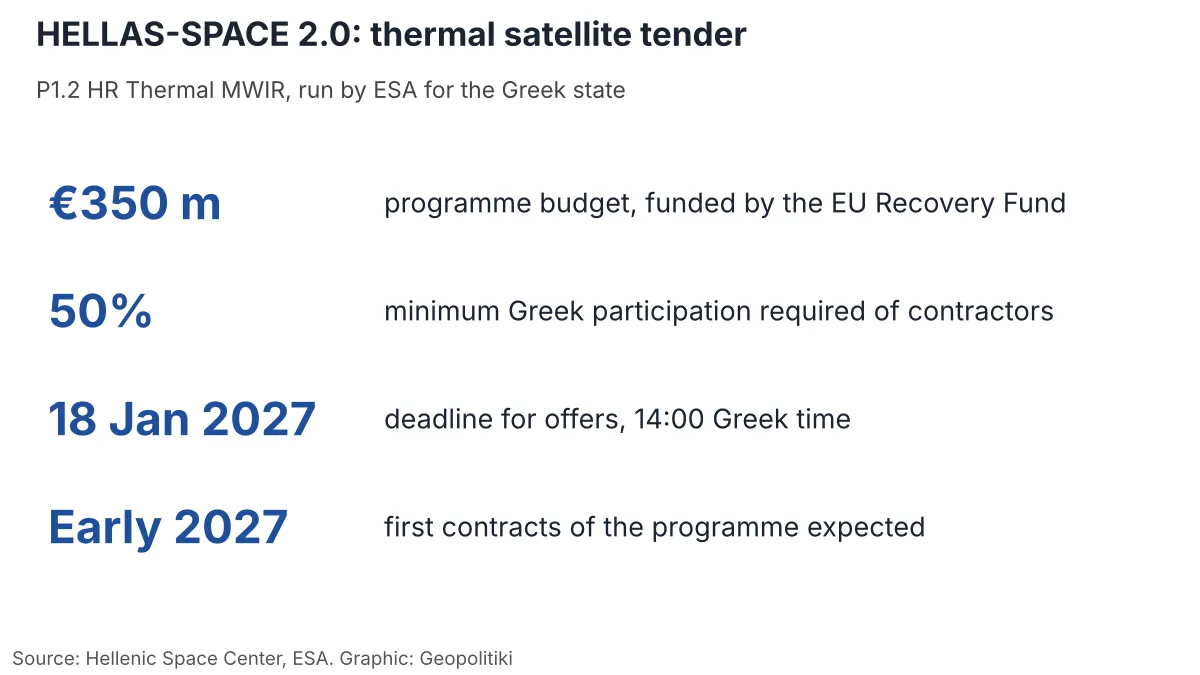
The tender is run by the European Space Agency (ESA), together with the ministry and the HSC. The Invitation to Tender (ITT) is numbered 1-13788 and titled “Greek National Satellite Space Project P1.2 HR Thermal MWIR Satellites”. It is on ESA’s electronic procurement platform (esa-star Publication), where offers are also submitted. The deadline is strict: Monday, January 18, 2027, 13:00 Central European Time, that is 14:00 Greek time. The subject is a high-resolution thermal imaging satellite system.
A €350 million programme
The tender belongs to a wider programme. According to the HSC page, HELLAS-SPACE 2.0 is the successor of the National Microsatellite Programme, has a budget of €350 million and is fully funded by the EU Recovery and Resilience Facility. It is implemented through ESA on a timetable to the end of 2029, with the possibility of extension into 2030. The first National Space Programme, worth €200 million, gave the country 13 earth-observation satellites of its own, CubeSats, ground infrastructure and assembly and test facilities. The second phase has seven programme lines. One of them is the thermal satellites, which complement the very-high-resolution optical satellites and the radio-frequency monitoring satellites.
For industry, the HSC sets conditions: contractors must be established in Greece and secure at least 50% Greek participation. They are assessed not only on price but also on their commercial exploitation plan and long-term investment presence in the country. Before final selection there is a maturation phase for the satellites with parallel competitors. As announced, the programme’s first contracts are expected in early 2027.
Tender P1.2 follows P1.1 for very-high-resolution optical satellites, with a deadline for offers on Wednesday, December 23, 2026. In space surveillance, the country is already testing its new Hellenic radar for tracking orbital debris (HSTR).