Greece
Israel upgrades David’s Sling, which Greece is also acquiring, for a wider range of ballistic threats
Israel has upgraded its David's Sling air defence system to counter a wider range of ballistic threats and withstand attacks lasting weeks, Bloomberg reports. Greece is buying the system for its Achilles Shield.

Israel has upgraded its medium-range air defence system David’s Sling so that it can counter a wider range of ballistic threats and withstand attacks lasting weeks. The information was given by Bloomberg on Friday, November 20, citing the head of air defence incident investigations of the Israeli Air Force, who spoke anonymously because of Air Force policy. The officer said Iranian salvos earlier in 2026 exposed weaknesses, but also produced a large volume of operational data that led to fixes, sometimes within days. The Israeli military spokesman referred questions to Rafael, which declined to comment, as did the American company RTX.
Why it matters to Greece
The development is of direct Greek interest, because Greece is also acquiring the system. David’s Sling will be the upper tier of the “Achilles Shield”, the country’s multi-layered air and missile defence system, which is part of the armament programmes Greece has ordered since 2019. The agreement, worth about €3 billion, was signed on August 31, 2026 at the Israeli Ministry of Defence and also includes Israel Aerospace Industries’ BARAK MX and Rafael’s mobile SPYDER. According to Rafael, Greece is the second European country to acquire David’s Sling, after Finland. It has not been made known whether the upgrade will also be included in the systems Greece will receive.
The system and its record
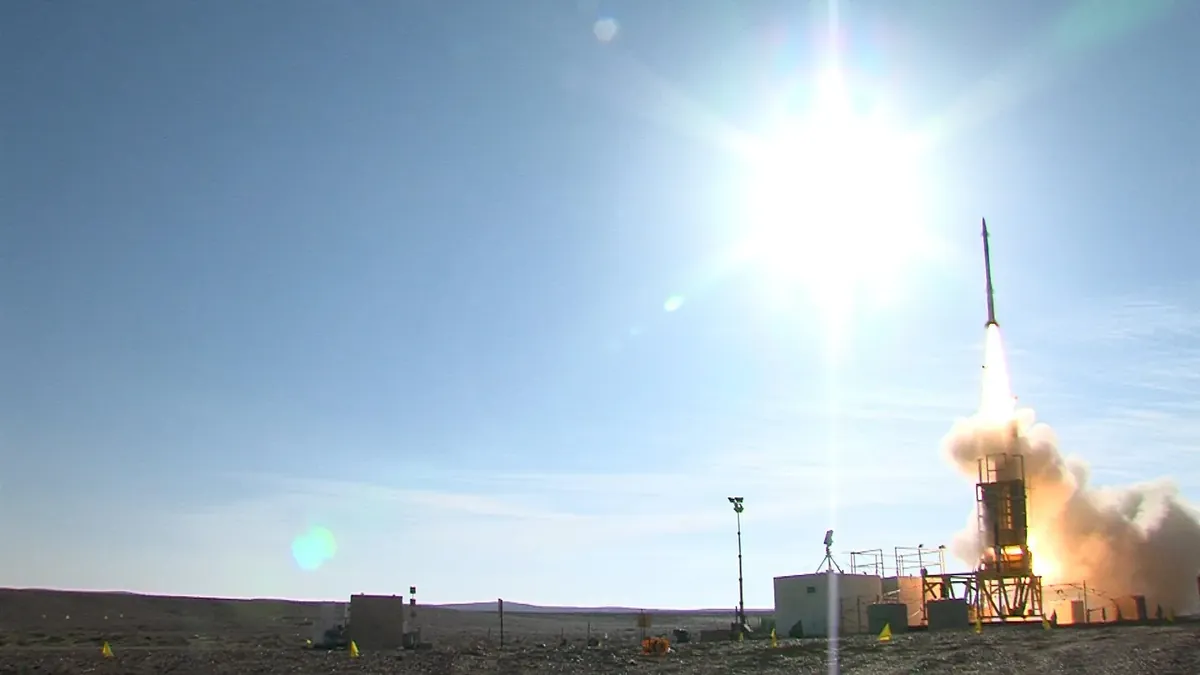
David’s Sling, built by Rafael, has been operational since 2017 and is the middle tier of Israeli air defence, between Iron Dome and Iron Beam below and the Arrow systems above. It was designed against rockets, ballistic and cruise missiles, aircraft and drones at ranges of 40 to 300 kilometres. It was first used against Iranian missiles in the 12-day war in June 2025 and extensively in the 2026 war, not always successfully. The Times of Israel recalls that in March the Israeli military confirmed that missiles of the system failed to intercept two Iranian ballistic missiles that hit Dimona and Arad, injuring almost 200 people. In early February the Ministry of Defence had announced it completed “complex” tests for “upgrading readiness for future threats”.
Cost plays a role. The system’s Stunner interceptor, developed jointly by Rafael and RTX, costs about $1 million, roughly a third of an Arrow 3, while a Patriot PAC-3 can exceed $4 million. Using David’s Sling instead of Arrow 3 helped conserve the stock of long-range missiles. Israeli military officers say, however, that the upgrade is not mainly about savings but about more options for the Air Force. An industry source told Bloomberg that the two companies can produce thousands of missiles a year in Israel and another 2,500 in the US for Iron Dome and David’s Sling.
“When we developed the first generations of ballistic defence, the idea was that you face a few threats, not hundreds or thousands. Now we have to find cheap kinetic-kill missiles,” said Uzi Rubin, the first director of Israel’s Missile Defense Organization. A Western intelligence assessment cited by Bloomberg says Iran has at least 1,700 ballistic missiles and produces about 50 a month. Besides Greece, Finland has also ordered David’s Sling, while Germany has integrated Arrow 3 into its air defence.