Technology
NASA AMPERE: a $500,000 prize challenge for American 3-7 kW mid-power Hall thrusters
NASA launched the AMPERE challenge with $500,000 in prizes for US companies to build and demonstrate 3-7 kW Hall thruster prototypes, in a market dominated by foreign suppliers. Registration runs to January 27, 2027.

NASA is calling on American companies to develop and demonstrate in practice prototype mid-power electric thrusters, in a market dominated by foreign suppliers. The agency announced on Monday, November 9, 2026 the “Advanced Mid-Power Electric Rocket” (AMPERE) challenge with total prizes of 500,000 dollars, according to the official NASA announcement.
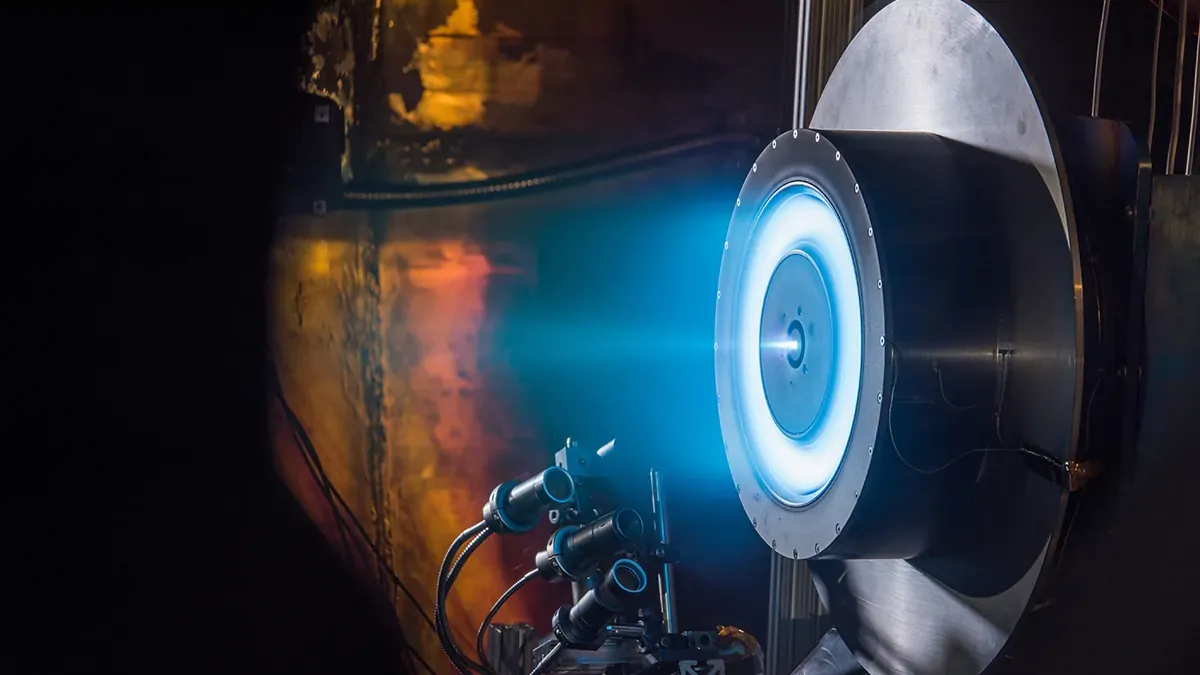
The subject is Hall thrusters, a type of electric propulsion that converts electric power and inert gas into thrust for spacecraft. NASA is asking for mid-power prototypes, meaning 3 to 7 kilowatts (kW), a class that government and industry bodies have called critical for satellite, defence and exploration missions. With the challenge the agency wants to accelerate the maturation of electric propulsion, verify the thrusters’ real performance in its own test facilities and lay the foundations for future missions, its own and the private sector’s.
Behind the challenge lies a supply-chain issue. On the project’s industry-day page, NASA notes that in the past decade Hall thrusters of about 5 kW have spread more widely in commercial, military and government missions, from telecommunications satellites in geostationary orbit to deep-space science missions. But the market is now dominated by foreign suppliers, which raises national security concerns and creates geopolitical risks for the supply chain of American space missions. To fill the gap, NASA’s Space Technology Mission Directorate, Glenn Research Center and the Jet Propulsion Laboratory (JPL) started the AMPERE project, aiming for a domestic mid-power thruster.
Three phases
The challenge is open to companies incorporated and with their principal place of business in the US. It is managed by the company yet2, which says in its press release that it does so under a contract with NASA’s Center of Excellence for Collaborative Innovation (CoECI), that participating organisations must also be run by a US citizen or permanent resident, and that AMPERE is the first challenge of NASA’s new “Tech Maturation Prize” programme.
According to the same release, the challenge has three phases. In the first, teams submit a preliminary concept design, a production plan and cost and performance estimates. NASA may select two winners, who receive up to 125,000 dollars each and move to the second phase. There they have about six months to build a working prototype and receive another 125,000 dollars on delivery, up to 250,000 dollars per team, as NASA also states. In the third phase, the prototypes are tested at no charge to the teams in the Vacuum Facility 12 (VF-12) chamber at Glenn.
yet2 also says the two second-phase teams will be able to use NASA’s technology for Hall thrusters running on krypton, under a royalty-free licence, and will receive from the agency the krypton they need for testing. The prototypes must ultimately meet or exceed the preliminary performance specifications published on the challenge website, with emphasis on durability, reliability, repeatability and low cost. Participants keep their intellectual property rights, while the licensing terms to NASA are still being finalised.
Registration opened on November 9, 2026 and closes on January 27, 2027, while, according to yet2, each team’s concept paper must be submitted by February 10, 2027. On Thursday, November 19, 2026, from 12:00 to 15:00 US Eastern time (19:00 to 22:00 Greek time), NASA is holding an online industry day with Glenn, where the project’s rationale, goals and timeline will be presented, followed by short company presentations. After the challenge, NASA intends to enter public-private partnerships with domestic manufacturers so that commercial mid-power Hall thrusters mature to certification, with the support of a consortium of companies and government bodies for mid-power electric propulsion.
NASA already uses Hall thrusters in deep-space missions, such as the Psyche spacecraft, which operates its thrusters almost 90% of the time. AMPERE joins the cash-prize challenges the agency issues, such as the 1 million dollar challenge for students to design elements of the Moon Base.