Technology
Voyager 1 reaches one light-day from Earth as the Empire State Building glows gold, while engineers work on a data problem
NASA's Voyager 1 crossed a distance of one light-day from Earth on November 18, a first for any human-made object, while engineers try to solve a problem with the spacecraft's data transmission.

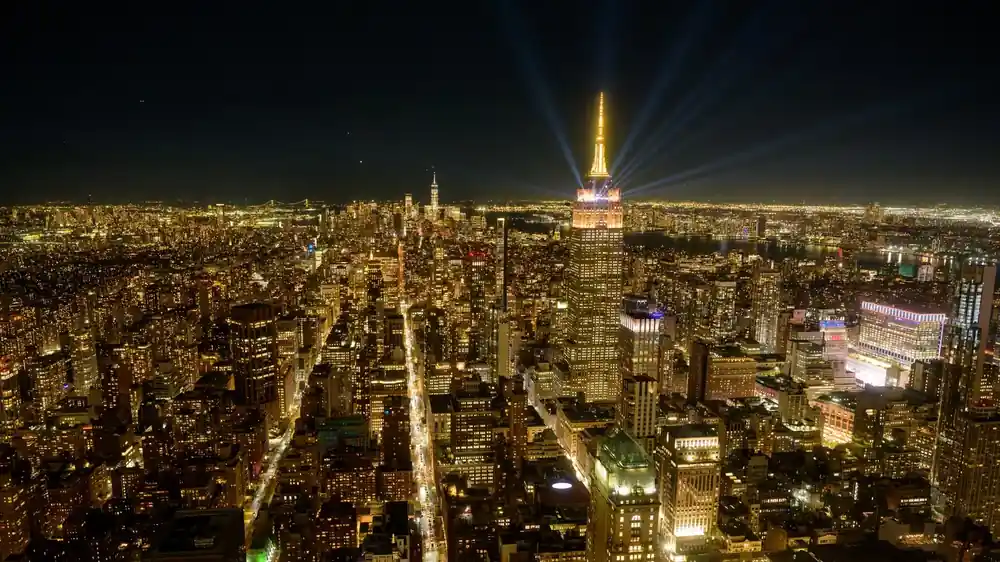
NASA’s Voyager 1 has reached a distance of one light-day from Earth, a milestone no other human-made object has reached. According to the agency’s calculations, the spacecraft crossed it on Wednesday, November 18, 2026 at 5:16:07 a.m. Eastern Time (10:16:07 UTC). In practice, a signal from Earth now takes 24 hours to reach it. For the milestone, New York’s Empire State Building was lit gold, while engineers are trying to solve a problem with receiving data from the spacecraft.
One light-day is the distance light travels in 24 hours and equals 25,902,068,356 kilometres (16,094,799,096 miles), about 25.9 billion kilometres. NASA stresses that the milestone concerns distance, not time: Voyager 1 needed 49 years, two months and 11 days since its launch in 1977 to get there, travelling at nearly 61,000 km/h. It is the most distant human-made object in space.
A wave of golden light
On Tuesday, November 17, the eve of the milestone, NASA invited the public to join “Shine Bright for Voyager’s Light-Day”, a symbolic wave of golden light around the planet after sunset. Through a dedicated web page, phones and tablets could flash “VGR”, the spacecraft’s call sign, in Morse code, as we described in our earlier report on NASA’s initiative.
As part of the campaign, the Empire State Building was lit gold. NASA said the gold refers to the gold-plated copper phonograph record that travels on the spacecraft. The Golden Record contains sounds and images chosen to portray the diversity of life and culture on Earth. The announcement is accompanied by a photograph by NASA’s Bill Ingalls.
A data problem
A few days before the milestone, however, the mission faced a problem. On November 14 the team found that the spacecraft had stopped sending science and engineering data, after an antenna of NASA’s Deep Space Network (DSN) in Canberra, Australia picked up only a carrier signal, with no data. The carrier signal shows that the attitude-control and articulation computer is keeping Voyager 1 pointed at Earth and that the antenna and transmitting equipment are working. The lack of data points to the computer that collects the data from the subsystems and science instruments and formats it for transmission.
NASA explains that the problem does not affect the milestone: the spacecraft moves away from Earth at constant speed on a known trajectory and cannot change speed, so technical problems do not affect the moment it reaches one light-day. Confirmation is due on Thursday, November 19, with the carrier signal and trajectory calculations. Diagnosis could take weeks or longer, since a radio wave needs 24 hours to reach the spacecraft and another 24 for the reply to come back. The team is also examining whether there is a link to the October episode, when contact was lost for about 48 hours, as we reported when NASA regained the signal. A similar phenomenon occurred in 2023 and was due to one of the spacecraft’s computers, an experience engineers are drawing on.
A discussion at JPL
On Thursday, November 19 at 12:00 Eastern Time (17:00 UTC), NASA’s Jet Propulsion Laboratory (JPL) is holding a discussion in the von Kármán auditorium with mission members and agency officials on the status of Voyager 1 and 2. Participants include Nicky Fox, Suzanne Dodd and Linda Spilker, and a preview of the NASA+ documentary for the mission’s 50th anniversary in 2027 will be shown.
The Voyagers’ journey
The two spacecraft were launched in 1977 to explore the outer planets, using a planetary alignment that recurs every 176 years. Voyager 1 entered interstellar space in 2012 and Voyager 2, which followed a different trajectory, in 2018. Voyager 2 is expected to reach one light-day in November 2035. Voyager 1 is heading toward the star AC +79 3888 (Gliese 445) in the constellation Ursa Minor and will pass within about 1.7 light-years of it in 40,000 years. More is on NASA’s page on what a light-day is and in its announcement on the gold Empire State Building.