Analysis
Cyprus 1983 secession explained: what the UN and ECHR said
On 15 November 1983 the Turkish Cypriot authorities declared a separate state in occupied northern Cyprus. The UN Security Council called it legally invalid, and the ECHR has since ruled on Turkey's responsibility.

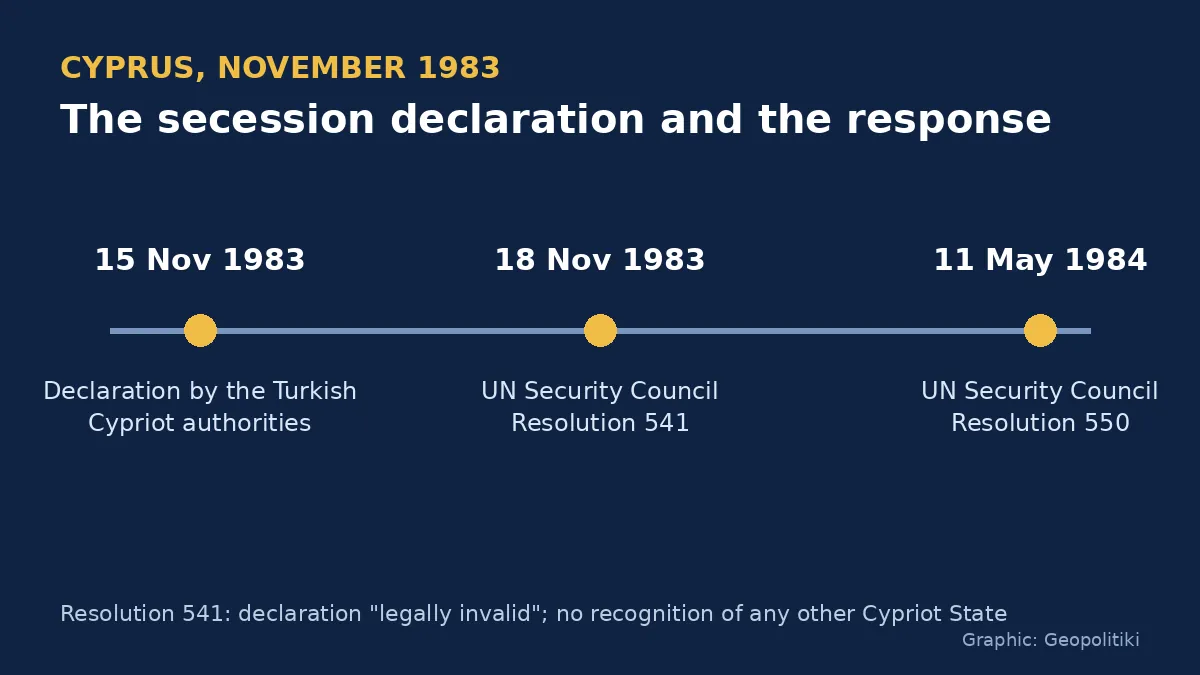
On 15 November 1983 the Turkish Cypriot authorities declared a separate state in the occupied north of the Republic of Cyprus. Three days later the UN Security Council called the declaration “legally invalid”, demanded its withdrawal and asked every country not to recognise any Cypriot state other than the Republic of Cyprus. The European Court of Human Rights has repeatedly held that the Republic of Cyprus is the only legitimate government of the island.
Key points
- The declaration of 15 November 1983 was a secession from the Republic of Cyprus, carried out in the part of the island occupied by Turkey since the 1974 invasion.
- Resolution 541 (1983) deplored it, called it legally invalid and told states not to recognise any Cypriot state other than the Republic of Cyprus.
- Resolution 550 (1984) condemned further secessionist steps, including the exchange of ambassadors between Turkey and the Turkish Cypriot leadership.
- The European Court of Human Rights has ruled that the “TRNC” is not a State under international law and that Turkey is answerable for violations in the north.
- Turkey alone has recognised the entity. Greek Cypriot missing persons, displaced owners and the enclaved of Karpas are still living with the consequences.
What happened on 15 November 1983
The Security Council text records the facts in its preamble. It was “concerned at the declaration by the Turkish Cypriot authorities issued on 15 November 1983 which purports to create an independent State in northern Cyprus”. The Council had heard the Foreign Minister of the Republic of Cyprus before it acted, and representatives of Cyprus, Greece and Turkey, among others, were invited to take part in the debate.
The Council considered the declaration “incompatible with the 1960 Treaty concerning the establishment of the Republic of Cyprus and the 1960 Treaty of Guarantee”. In other words, the founding treaties of Cyprus ruled out exactly this step. For the wider background, see our timeline Cyprus 1974 timeline: coup, Turkish invasion and UN resolutions.
How the world responded: a short chronology
| Date | Body | What it did |
|---|---|---|
| 15 Nov 1983 | Turkish Cypriot authorities | Issued the declaration purporting to create an independent state in northern Cyprus |
| 16 Nov 1983 | European Communities (ten member states) | Rejected the declaration and said they continued to regard the government of the Republic of Cyprus as the sole legitimate government |
| Nov 1983 | Council of Europe Committee of Ministers | Decided it continued to regard the Government of the Republic of Cyprus as the sole legitimate Government of Cyprus |
| 18 Nov 1983 | UN Security Council | Resolution 541: deplored the secession, declared it legally invalid, called for its withdrawal |
| 23-29 Nov 1983 | Commonwealth Heads of Government, New Delhi | Condemned the declaration as legally invalid and called for non-recognition |
| 11 May 1984 | UN Security Council | Resolution 550: condemned all secessionist actions and reiterated non-recognition |
What Resolution 541 actually says
The operative paragraphs are short and unambiguous. The Council deplores the “purported secession of part of the Republic of Cyprus”, considers the declaration legally invalid and calls for its withdrawal. It calls on all States to respect the sovereignty, independence, territorial integrity and non-alignment of the Republic of Cyprus, and, in paragraph 7, “not to recognize any Cypriot State other than the Republic of Cyprus”. It also asks the Secretary-General to continue his good-offices mission towards a just and lasting settlement.
The resolution also says that the attempt to create a “Turkish Republic of Northern Cyprus” is invalid and “will contribute to a worsening of the situation in Cyprus”. A fuller reading of this and the Council’s other texts is in UN resolutions on Cyprus explained: what 353, 541 and 550 demand.
Resolution 550: the ambassadors and Varosha
Turkey and the Turkish Cypriot leadership did not stop. By May 1984 the Council was “gravely concerned” by the exchange of ambassadors between Turkey and the “Turkish Republic of Northern Cyprus” and by plans for a “constitutional referendum” and “elections”. It described the area as the “occupied part of the Republic of Cyprus”.
Resolution 550 condemned all secessionist actions and called on states “not to facilitate or in any way assist” the secessionist entity. It also considered attempts to settle any part of Varosha by people other than its inhabitants inadmissible and called for the transfer of that area to UN administration.
What the European Court of Human Rights decided
Strasbourg has dealt with the 1983 declaration directly. In Loizidou v. Turkey (Grand Chamber, 18 December 1996) Turkey argued that Greek Cypriot property in the north had become the property of the “TRNC” under Article 159 of its 1985 constitution. The Court took note of Resolutions 541 and 550 and of the stance of the Council of Europe, the European Community and the Commonwealth, and concluded that “the international community does not regard the ‘TRNC’ as a State under international law” and that the Republic of Cyprus has remained “the sole legitimate Government of Cyprus”. It could not attribute legal validity for the purposes of the Convention to Article 159. It held, by eleven votes to six, that Turkey was responsible for denying the applicant access to her property and that Article 1 of Protocol No. 1 had been breached.
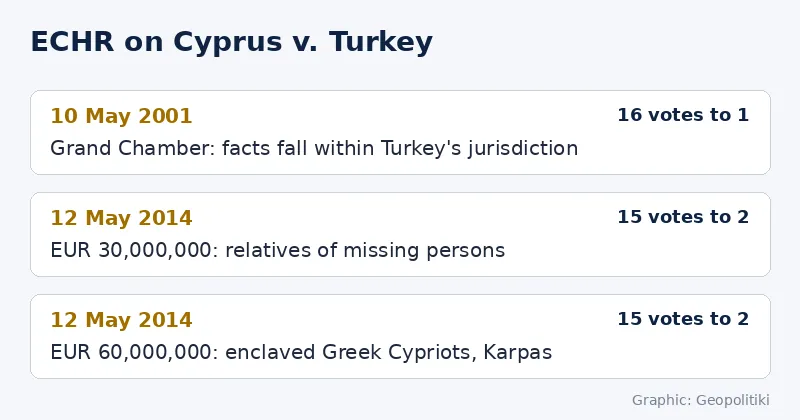
In Cyprus v. Turkey (Grand Chamber, 10 May 2001) the Court went further. It held by sixteen votes to one that the facts complained of fell within Turkey’s “jurisdiction” and found continuing violations, among them:
- Article 2, for the failure to investigate the fate of Greek Cypriot missing persons, and Article 3 for the suffering of their relatives;
- Article 8, for the refusal to allow Greek Cypriot displaced persons to return to their homes in the north;
- Article 1 of Protocol No. 1, because Greek Cypriot owners were denied access to, and use of, their property and any compensation;
- Article 3, because Greek Cypriots living in the Karpas area had been subjected to discrimination amounting to degrading treatment.
In the just-satisfaction judgment of 12 May 2014 the Grand Chamber ordered Turkey to pay EUR 30,000,000 for non-pecuniary damage suffered by the relatives of the missing persons and EUR 60,000,000 for the enclaved Greek Cypriots of the Karpas peninsula, both by fifteen votes to two. More on the enclaved community is in Enclaved Greek Cypriots in Karpas explained: the ECHR findings.
Ankara’s argument and the Court’s answer
In the 2001 case the Turkish Government described the “TRNC” as a democratic and constitutional state, politically independent of all other sovereign States including Turkey. The Court found that this claim could not be sustained. It repeated that the international community does not recognise the “TRNC” and that the Republic of Cyprus alone is the legitimate government. A separate opinion annexed to the judgment itself notes that Turkey alone has recognised the entity.
The human cost still on the table
The Committee on Missing Persons in Cyprus, in figures dated 31 August 2026, lists 1,510 Greek Cypriots among 2,002 missing persons on its list, and shows that 745 Greek Cypriot cases remain unresolved. Our explainer Missing persons in Cyprus explained: CMP figures and ECHR rulings sets out the figures and the rulings in detail.
The footage below, from BBC News, follows the teams that search for graves in Cyprus and return remains to families; it dates from 2017 and is shown as background on the missing-persons work.
Why it matters now
The Council resolutions of 1983 and 1984 remain the legal frame for any discussion of the north: respect for the sovereignty and territorial integrity of the Republic of Cyprus, no recognition of a separate state, and the transfer of Varosha to UN administration. The Court’s rulings attach legal responsibility, and a financial award, to Turkey. The record is on the page: the secession is invalid, the territory is occupied, and Turkey carries the legal responsibility for what happens there.
Sources: Resolution 541 (1983) and Resolution 550 (1984) of the UN Security Council; the European Court of Human Rights judgments Loizidou v. Turkey (1996), Cyprus v. Turkey (2001) and its 2014 just-satisfaction judgment; Committee on Missing Persons in Cyprus, figures dated 31 August 2026.