Analysis
Loizidou v. Turkey explained: the ECHR rulings on northern Cyprus
The 1996 Loizidou judgment and the 2001 and 2014 Cyprus v. Turkey rulings hold Ankara responsible for northern Cyprus. What Strasbourg decided, and why.


Loizidou v. Turkey is the 1996 judgment in which the European Court of Human Rights held that Turkey is responsible for what happens in the part of Cyprus its army occupies, including the denial of a Greek Cypriot owner’s access to her land in Kyrenia. Together with the 2001 Grand Chamber ruling in Cyprus v. Turkey, it is the legal backbone of the case that Ankara, not a local administration, answers for the consequences of the 1974 invasion.
Key points
- In 1996 the Court found that Turkey’s army “exercises effective overall control over that part of the island”, so Turkey answers for the policies and actions of the secessionist administration in the north.
- It held that Titina Loizidou had not lost title to her Kyrenia land and that the continuing denial of access breached the right to property (Article 1 of Protocol No. 1).
- In 2001 the Grand Chamber extended the same reasoning to the whole Convention and found continuing violations on missing persons, the return of displaced Greek Cypriots and their property.
- In 2014 the Court ordered Turkey to pay EUR 30 million for the relatives of missing persons and EUR 60 million for the enclaved Greek Cypriots of Karpas.
Who was Titina Loizidou and what happened to her land?
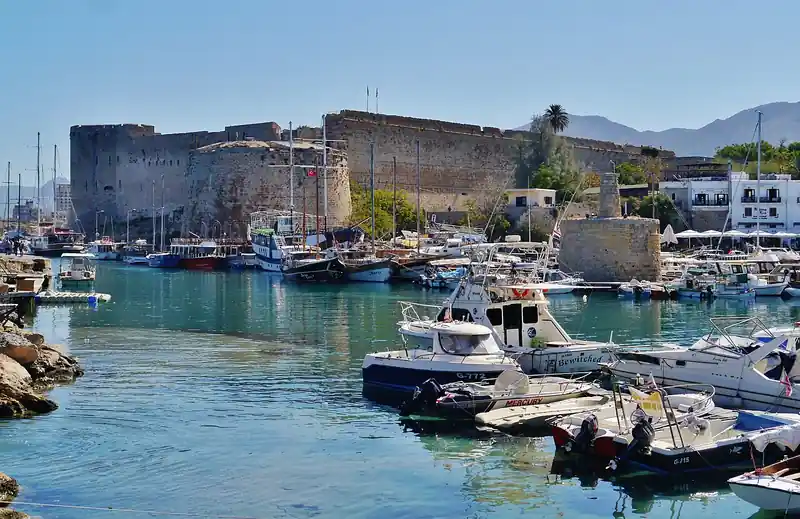
Titina Loizidou is a Cypriot national who grew up in Kyrenia. According to the judgment, she married in 1972, moved to Nicosia, and owned plots of land in Kyrenia, with registration certificates issued by the Cypriot Lands and Surveys Department. Work had begun on one plot to build flats, one of which was meant as the family home. Since the Turkish occupation of northern Cyprus on 20 July 1974 she has been prevented by Turkish forces from returning to enjoy her property, the Court records.
On 19 March 1989 she led a group of fifty marchers of the “Women Walk Home” movement towards a church in the occupied area, to assert the right of Greek Cypriot refugees to return to their homes. The Court records that they were surrounded by Turkish soldiers and stopped, and that she was then detained for more than ten hours before being released. In July of that year she lodged her complaint. The case went to the Court, which ruled twice: first on whether it could hear the case at all, in March 1995, and then on the merits in December 1996.
What did the Court decide in 1995?
Turkey had accepted the Court’s powers only with restrictions that excluded events in northern Cyprus. By sixteen votes to two, the Court held that the territorial restrictions attached to Turkey’s declarations were invalid, while the declarations themselves remained valid acceptances of the Court’s competence. It also held, by the same majority, that the facts alleged were capable of falling within Turkish “jurisdiction” under Article 1 of the Convention. The question of timing was joined to the merits.
What did the Court decide in 1996?
On 18 December 1996 the Grand Chamber dismissed Turkey’s objection on timing by eleven votes to six. It then ruled on three points, each by eleven votes to six.
- Imputability. The denial of access to the property and the resulting loss of control is imputable to Turkey.
- Property. There was a breach of Article 1 of Protocol No. 1, the right to peaceful enjoyment of possessions.
- Title. Turkey relied on Article 159 of the 1985 constitution of the secessionist entity, which declared immovable property found abandoned or considered ownerless to be the property of that entity, whatever the Land Registry said. The Court refused to give it legal effect and found the applicant could not be deemed to have lost title.
On Turkey’s defence, the Court noted that Ankara had itself acknowledged that the applicant’s loss of control stemmed from “the occupation of the northern part of Cyprus by Turkish troops”, yet denied responsibility, arguing that its forces acted “exclusively in conjunction with and on behalf of” local authorities. The Court rejected that line: the “large number of troops engaged in active duties in northern Cyprus”, which the judgment puts at more than 30,000 personnel, showed that Turkey’s army exercises effective overall control, which “entails her responsibility for the policies and actions” of the administration there.

Why does the 1996 ruling treat the north as unlawful in practice?
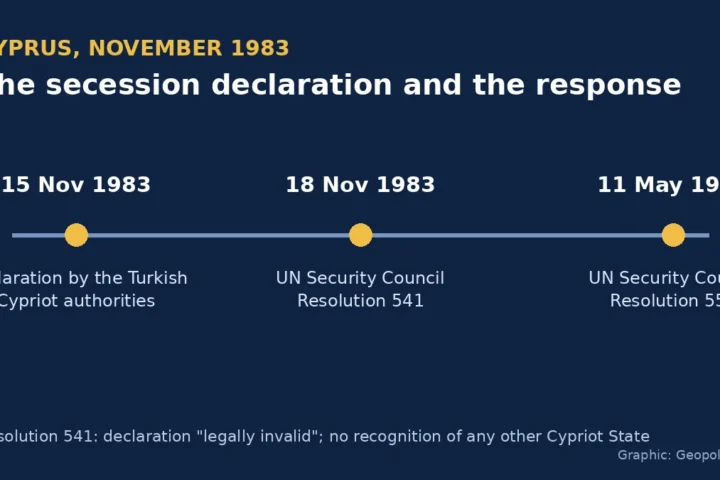
The judgment draws on United Nations Security Council Resolutions 541 (1983) and 550 (1984), which declared the proclamation of the secessionist entity legally invalid, and on Council of Europe and European Community positions. From these the Court concluded that “the international community does not regard the “TRNC” as a State under international law” and that the Republic of Cyprus “has remained the sole legitimate Government of Cyprus”. It added that it would not need to rule on whether the 1974 intervention was lawful, because State responsibility under the Convention does not depend on that. For the background to those resolutions, see our explainer UN resolutions on Cyprus explained: what 353, 541 and 550 demand.
How did Cyprus v. Turkey (2001) widen the case?
The Grand Chamber judgment of 10 May 2001 arose from an inter-State application by the Republic of Cyprus. By sixteen votes to one it held that the matters complained of fall within Turkey’s jurisdiction. Citing Loizidou, it said that Turkey’s jurisdiction “must be considered to extend to securing the entire range of substantive rights set out in the Convention”, and warned that any other finding would leave a “regrettable vacuum in the system of human-rights protection” in the territory.
Its operative findings, each adopted by sixteen votes to one, included:
- a continuing violation of Article 2 for the failure to investigate the whereabouts and fate of Greek Cypriot missing persons, and of Article 5 where there was an arguable claim that they were in Turkish custody;
- a continuing violation of Article 3 in respect of the relatives of the missing, whose number Cyprus put at about 1,491 Greek Cypriots in its application;
- a continuing violation of Article 8 because no displaced Greek Cypriot was allowed to return to their home in northern Cyprus;
- a continuing violation of Article 1 of Protocol No. 1, since Greek Cypriot owners were denied access to, and control, use and enjoyment of, their property, as well as any compensation;
- a violation of Article 13 for the lack of any remedy for Greek Cypriots not living in the north.
The Court found no breach of the substantive part of Article 2 for any missing person and no breach of Article 4. It also held, by ten votes to seven, that remedies in the north may be regarded as domestic remedies in the Convention sense, to be examined for effectiveness in the circumstances of each case. The Karpas findings are covered in Enclaved Greek Cypriots in Karpas explained: the ECHR findings, and the missing persons in Missing persons in Cyprus explained: CMP figures and ECHR rulings.
What did the Court order in 2014?
In the just satisfaction judgment of 12 May 2014, the Grand Chamber ruled by fifteen votes to two that Turkey must pay the Cypriot Government EUR 30,000,000 for non-pecuniary damage suffered by the relatives of the missing persons, and EUR 60,000,000 for the enclaved Greek Cypriot residents of the Karpas peninsula. The Court described the first group as 1,456 missing persons. The money is to be distributed by the Cypriot Government to the individual victims under the supervision of the Committee of Ministers of the Council of Europe, and interest runs from the expiry of three months after the judgment until settlement.
The rulings at a glance
| Date | Judgment | Main finding |
|---|---|---|
| 23 March 1995 | Loizidou v. Turkey (preliminary objections) | Turkey’s territorial restrictions invalid; facts capable of falling within its jurisdiction (16-2) |
| 18 December 1996 | Loizidou v. Turkey (merits) | Denial of access imputable to Turkey; breach of property right (11-6) |
| 10 May 2001 | Cyprus v. Turkey (Grand Chamber) | Turkey’s jurisdiction covers northern Cyprus; continuing violations (16-1) |
| 12 May 2014 | Cyprus v. Turkey (just satisfaction) | EUR 30 million and EUR 60 million awarded (15-2) |
Why it matters for Cyprus today
The case law answers a standing Turkish argument, that northern Cyprus is run by an independent authority. Strasbourg looked at facts, not labels: the size of the army, and the dependence of the local administration on Turkish military and other support, make Turkey the responsible State. It also rests on the same international position that the Security Council set out in 1983, which we covered in Cyprus 1983 secession explained: what the UN and ECHR said. The wider chronology is in Cyprus 1974 timeline: coup, Turkish invasion and UN resolutions.
Sources: European Court of Human Rights judgments (HUDOC): Loizidou v. Turkey, preliminary objections, 1995; Loizidou v. Turkey, 1996; Cyprus v. Turkey, 2001; Cyprus v. Turkey, just satisfaction, 2014.