Greece
Turkish Navy chief: ships “not allowed” to survey or drill for Greece and Cyprus in “disputed” waters – with a dig at Kastellorizo
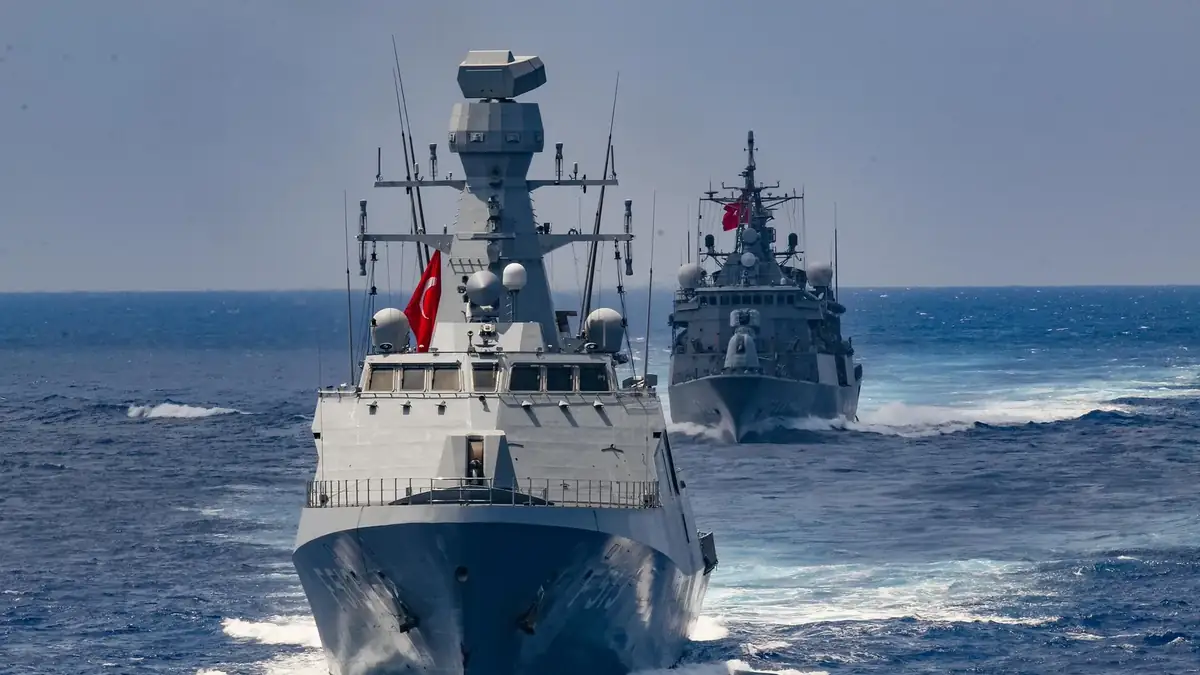
In a new Anadolu analysis on the “Blue Homeland”, Turkish Navy commander Admiral Ercument Tatlioglu writes that ships may not survey or drill for Greece and Cyprus in what Ankara calls disputed waters, and targets Kastellorizo without naming it.

The commander of the Turkish Navy, Admiral Ercüment Tatlıoğlu, writes that ships are not allowed to carry out surveys or drilling on behalf of Greece and Cyprus in “disputed” sea areas, in a new analysis of his on the “Blue Homeland”, this time focused on the Eastern Mediterranean. The text was published in the analysis column of Anadolu on Wednesday, November 11, while the tension over the survey vessel for the Greece–Cyprus cable is under way, as we reported in the Abeille Marengo sailing from Heraklion.
A dig at Kastellorizo
Tatlıoğlu writes that Ankara, as the country with the longest coastline in the Eastern Mediterranean, over 2,500 kilometres, “cannot allow” its maritime zones to be curtailed by claims based on islands. Without naming it, he clearly refers to Kastellorizo: he mentions an island of 10 square kilometres, just 3 kilometres from the Turkish coast, which, as he claims, asserts a maritime zone of 40,000 square kilometres, 4,000 times its own area. Turkey, he concludes, “never recognises” the “so-called maps” that shrink the “Blue Homeland”.
In the same spirit, the Turkish Navy chief argues that Greece tried to apply the same logic to the blocks south of Crete, where it met Libya’s objections, and that the partial delimitation with Egypt was made with the same reasoning. He even cites the Greece–Italy agreement in the Ionian as a precedent which, in his view, supports the Turkish position that islands should not have full effect.
These are Turkish claims, and Greece rejects them. Under the law of the sea, as codified in the UN Convention (UNCLOS), islands generate maritime zones just as other land territory does, and Turkey is not a party to the Convention. For the Greek reading of the Blue Homeland, see our explainer on what Turkey’s maritime doctrine claims.
“Never” for others to use the resources
The harshest phrase of the text concerns the Navy itself. Tatlıoğlu writes that for the Turkish naval forces the decisive point is that other countries “will never be allowed” to use national resources inside Turkey’s maritime zones. He recalls that Ankara notified the UN of the limits of its continental shelf through notes verbales in 2004, 2013, 2019 and 2020 and that in 2025, with its Maritime Spatial Planning, it also declared the limits of its maritime zones.
On Cyprus, the text repeats that Turkish Cypriots have “equal and indivisible” rights to the island’s natural resources. It refers to the final investment decision of Eni and TotalEnergies for the Cronos field and notes that such projects do not mean disputes have been resolved. Among the strategic issues it lists electricity interconnections and undersea cables, adding that maritime spatial planning, energy interconnections and environmental initiatives may have political consequences in areas that Ankara considers disputed. The Republic of Cyprus is a sovereign EU member state, and its sovereign rights over its EEZ are recognised under international law.
Libya, Egypt and deterrence
The Turkish Navy chief comments positively on the unanimous ratification of the 2019 Turkish-Libyan memorandum by Libya’s House of Representatives on October 20. Greece considers the memorandum illegal, since it ignores the existence of Crete. He recalls that the Turkish Ministry of Defence said on October 28 that Ankara is ready to sign a maritime delimitation agreement with Egypt and presents the “Dostluk Denizi-2026” (“Sea of Friendship”) exercise, hosted by Egypt in early November, as a confidence-building measure. He also argues that permanent naval power combines wartime deterrence with peacetime presence and cooperation, and that, for the country with the longest coastline in the region, fait accompli scenarios excluding it “have no chance of success”.
These positions are not new, but the timing matters. The text by the Turkish Navy chief is published while Ankara and Athens exchange NAVTEX over the Abeille Marengo and while the European Commission, in its annual report, has already pointed to the “Blue Homeland” and the casus belli.