Greece
On this day, November 16, 1942: the last battle of the submarine Triton off Kafireas
On November 16, 1942 the Greek submarine Triton fought her last battle in the Kafireas strait, surfacing under fire to engage a German submarine hunter. Twenty-four of her crew died; 28 were captured.

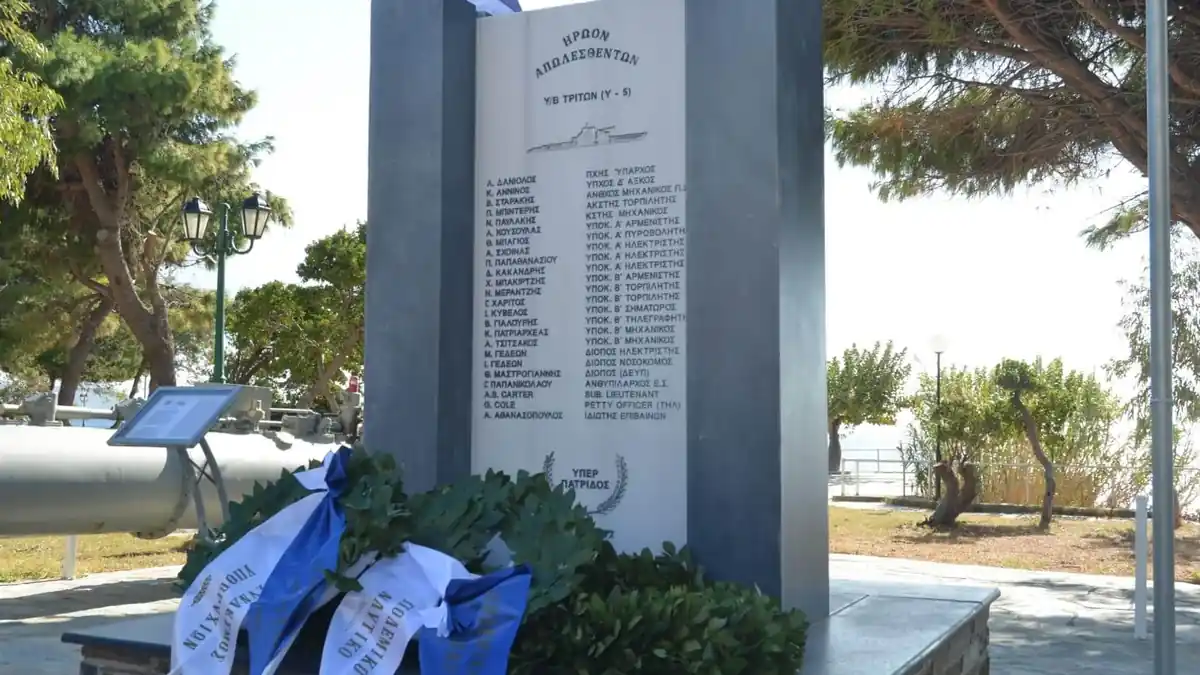
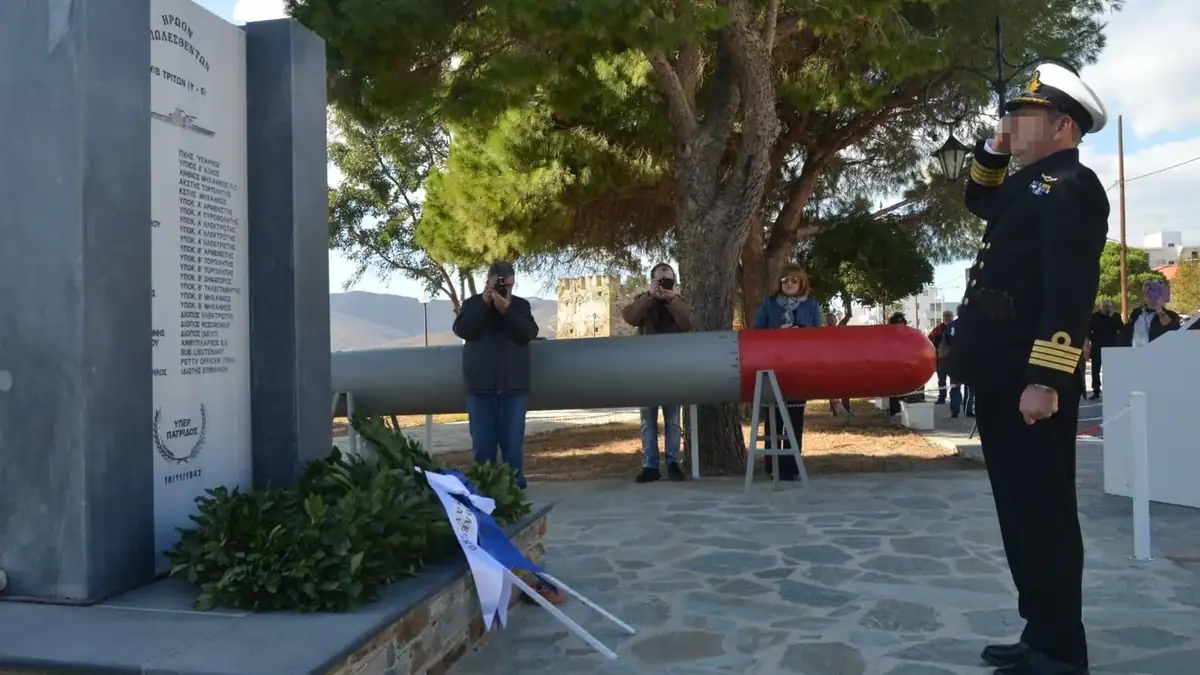
On November 16, 1942 the Hellenic Navy submarine Triton (Y-5) fought her last battle in the Kafireas strait, between Euboea and Andros. She attacked an Axis convoy, endured five hours of depth-charge attacks from a German anti-submarine vessel and, when she could no longer manoeuvre underwater, her commander ordered her to surface to fight with the gun. Triton sank at 22:35, taking 24 men with her, and became the third Greek submarine lost in the Second World War, after Proteus and Glafkos. Since November 2023 the crew members who were lost have had a memorial at Karystos, as the Navy General Staff announced.
The French Proteus-class submarines and their weaknesses
Triton was one of four Proteus-class submarines that Greece ordered from France in 1927, with Glafkos, Nereus and Proteus. She was built at Nantes by Ateliers et Chantiers de la Loire, launched on April 4, 1928 and delivered on December 1, 1930. She was 68.6 metres long, displaced 790 tonnes on the surface and 960 tonnes submerged, and had eight 533 mm torpedo tubes, six forward and two aft, and a 100 mm gun. By 1940 these boats had exceeded the ten years of service foreseen by the builder and had known problems: a maximum diving depth of only 50 to 60 metres, tanks outside the pressure hull that made them vulnerable to depth charges, and no radar or torpedo fire-control computer. Together with Katsonis and Papanikolis, however, they were the only submarines of the Hellenic Navy.
In the Greek-Italian war Triton made six war patrols in the Adriatic and the Ionian, with the mission of striking the supply lines of the Italian army in Albania. The most successful was the sixth. On the morning of March 23, 1941, under Lieutenant Commander Georgios Zepos, she spotted a convoy of troopships from Bari to Durrës, fired four torpedoes from 750 metres and hit the 5,451-ton steamer Carnia, which sank at 21:45 when the tow line parted. Zepos was promoted for gallantry to commander and awarded the War Cross First Class. It was one of the few confirmed successes of Greek submarines against the supply lines to Durrës and Vlorë that fed the 1940-41 front.
From Alexandria to the occupied waters of the Aegean
After the German invasion in April 1941 the Greek fleet escaped to Alexandria and the submarines continued the war from Middle East bases under Allied operational control. From July 1941 Triton’s commander was Lieutenant Epameinondas Kontogiannis. Her patrols were not only ship hunting. The submarine carried supplies and passengers to Malta during its siege, in November 1941 landed a Greek guide and supplies at Tsoutsouras Bay in southern Crete and took on board eight Greeks and eight Britons. In June 1942 she landed the party of Briton George Jellicoe and French Major Georges Bergé, with Free French soldiers and Greek Sub-Lieutenant K. Petrakis, for sabotage at Heraklion airfield. On the same patrol she sank the motor tanker Agia Aikaterini with her gun near Santorini and, on June 13, rammed and sank in the Kafireas area the requisitioned Ioannis, which was carrying 210 tonnes of coal for the Germans from Kymi to Piraeus. She knew, in other words, the waters where she would fight her last battle.
On November 10, 1942 Triton set out on her 15th and last patrol. The plan called for landing five Greek agents and 340 kilograms of supplies on the south-eastern coast of Euboea and then patrolling the central Aegean. On November 16 the submarine arrived off Cape Kafireas, but the sea was rough and the commander postponed the landing to the following night.
Five hours of depth charges and a sortie “by gun”
Shortly after 16:00 (operational time, as with all times that follow), after diving to 30 metres to avoid an enemy seaplane, Triton spotted through the periscope a convoy heading for the Dardanelles: the Romanian steamer Alba Julia and the Italian Celeno, escorted by the destroyer Hermes, which was the Greek Vasilefs Georgios in German hands, and two auxiliary anti-submarine vessels, UJ-2101, the former Greek minelayer Strymon, and UJ-2102, the former yacht Birgitta of the shipowner Eugenides. The UJ boats (Unterseebootsjäger) were submarine hunters armed with guns, machine guns and depth charges and fitted with detection gear. At 16:30 Kontogiannis fired one torpedo from 5,500 metres, because the others were set for shorter ranges. In his post-war report he said the torpedo hit Alba Julia, but the records of the time do not confirm a hit.
UJ-2102 had already detected the submarine at 16:10 and stayed behind to hunt it while the convoy continued. At 16:40 she dropped 13 depth charges and at 17:00 another 11, with no serious result. The submarine moved north to leave the Kafireas strait (Cavo Doro) and for about three hours was safe, because UJ-2102’s anti-submarine gear had broken down. As soon as it was repaired, at 19:35, the German vessel found her again at a range of three kilometres, evaded another torpedo by manoeuvring and at 20:05 attacked with a new series of charges. Triton’s external fuel tanks were ruptured and fuel slicks on the surface betrayed her position. After the attack of 20:30 the submarine had lost her depth and steering rudders, depth gauges, pumps and gyrocompass. At 21:00 she rose to periscope depth to find her position, saw UJ-2102 coming at her and dived again, to take another nine charges. The starboard engine stopped, the port shaft fell and chlorine began to escape from the flooded batteries.
The commander had two options: surface and surrender, or surface and fight. At 22:00, five and a half hours after the first attack, he ordered the boat to surface and “sortie by gun”. He came out of the hatch first with a revolver in his hand. Water began to enter through the open hatch and the men below temporarily closed it, leaving Kontogiannis alone on deck. He emptied the revolver at the German vessel and tried to reach the 100 mm gun. UJ-2102 raked the submarine with gunfire and machine guns and rammed her. The commander fell unconscious into the sea, while the surface gun crew came out on deck and replied with machine guns from 40 to 80 metres, the crews even exchanging hand grenades. At 22:14 came a second ramming and the abandonment of the boat began.
The dead, the prisoners and the flag that came home in 1972
Killed were the executive officer, Lieutenant Antonios Daniolos, and the whole surface gun crew. Sub-Lieutenant Christos Soliotis stayed last inside and opened the vents so that the submarine would sink faster and not fall into enemy hands. In the sea he kept afloat Petty Officer D. Kakandris, who had lost a leg, until both were picked up by a boat from UJ-2102. Triton sank at 22:35 with 24 dead, at the approximate position 38°07′N 24°39′E. Twenty-eight men, among them Kontogiannis, were taken prisoner. After interrogation at Piraeus they were taken to the Marlag prisoner-of-war camp near Bremen, where they stayed until liberated by the Allies on April 28, 1945. Two electricians, Chief Petty Officer Nikolaos Maroulas and rating D. Papadimitriou, swam to Euboea, hid in the village of Thymiani and escaped to the Middle East.
Triton’s war ensign stayed as a souvenir with the German commander of UJ-2102, Gero Kleiner. Thirty years later, on September 20, 1972, Kleiner handed it over at a ceremony at the Mürwik naval school in Flensburg to Commander Ioannis Maniatis, who had gone to Germany to take delivery of the new submarine Triton, one of four Type 209 submarines Greece had ordered. The flag is displayed today at the submarine base at Salamis Naval Base.
On November 19, 2023 the memorial to the men lost with Triton was unveiled at Karystos, at a ceremony at which the Chief of the Navy General Staff was represented by the Submarine Commander, Captain Christos Alogaris, and attended by the mayor of Karystos, representatives of the Region of Central Greece, MPs and members of the Hellenic Submariners’ Association.
The old Triton operated for two years in waters controlled by the enemy, and when she could no longer hide, her crew came up to the surface to fight.
Frequently asked questions
When and where was the submarine Triton sunk? Triton (Y-5) sank on November 16, 1942 at 22:35 in the area of Cape Kafireas, between Euboea and Andros, after a battle with the German anti-submarine vessel UJ-2102.
How many of Triton’s crew died? Twenty-four men were killed, among them the executive officer, Lieutenant Antonios Daniolos. Twenty-eight were captured, with commander Epameinondas Kontogiannis, and two escaped by swimming to Euboea.
What was Triton’s greatest success? On March 23, 1941, under Lieutenant Commander Georgios Zepos, she torpedoed the 5,451-ton Italian steamer Carnia in a convoy from Bari to Durrës. The ship sank the same evening when the tow line parted.
Where is Triton’s flag today? The German commander of UJ-2102 returned it to the Hellenic Navy on September 20, 1972. It is displayed at the submarine base at Salamis Naval Base.