Middle East & North Africa
A third US aircraft carrier in the Middle East: USS Theodore Roosevelt joins the George Washington and George H.W. Bush, sources say
A US official says USS Theodore Roosevelt has arrived in the Middle East, giving the US three carrier strike groups in the CENTCOM area as Tehran rejects a state of "neither war nor peace". The Pentagon has not confirmed.

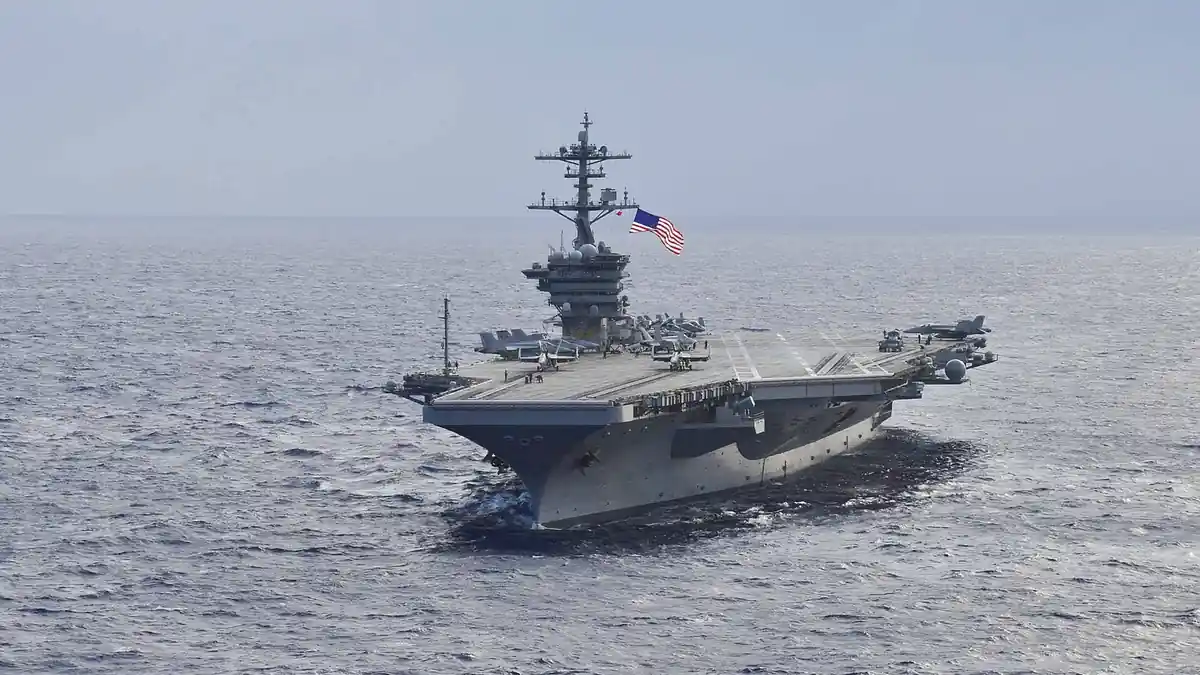
The United States now has three aircraft carrier strike groups in the area of responsibility of US Central Command (CENTCOM). The nuclear-powered carrier USS Theodore Roosevelt (CVN-71) has arrived in the Middle East, a US official told Al Jazeera on Monday, November 16. A second official places the arrival on Sunday, November 15. Neither the Pentagon nor CENTCOM has officially confirmed the deployment.
The Theodore Roosevelt joins the carriers USS George Washington and USS George H.W. Bush, which are already operating in the region. She left her base in San Diego in September, when we reported that the US was sending the carrier toward Iran as Trump weighed renewed strikes. A US official said in October that she is followed by an Amphibious Ready Group (ARG) with more than 2,000 Marines. That move has not been officially announced either.
The Nimitz-class carrier entered service in 1986. She has a crew of more than 5,000 and an air wing of more than 60 aircraft, among them F/A-18 fighters. In the 1990-91 Gulf War she operated in the Mediterranean and the Red Sea, and in 2003 she supported US strikes in the Iraq war.
The reinforcement comes as Tehran says it will no longer accept the “neither war nor peace” situation with Washington. Last week President Donald Trump, after meeting Qatar’s prime minister, called new military strikes “rather unlikely” and said the military part of the war “is essentially over”, adding that the US military remains fully ready if conditions change. A US intelligence assessment reported at the same time that Iran still has up to 2,500 ballistic missiles, which contradicts Trump’s claims. The US naval blockade in the Strait of Hormuz and on Iranian ports remains in force. Secretary of State Marco Rubio assessed that economic pressure is working and that it “will get even worse” for Iran.
On the Iranian side, Deputy Foreign Minister Kazem Gharibabadi told state television that his country “will not wait for the US to attack first” and suggested Washington may be abusing diplomacy to buy time and prepare a new attack. “Iran is not Cuba to be put under a blockade, nor Venezuela to be forced to surrender,” he said, adding that the Revolutionary Guards are producing missiles with “new ranges”.
Negotiations via Qatar and Pakistan have stalled. The speaker of Iran’s parliament and chief negotiator Mohammad Bagher Ghalibaf told Al Jazeera last week that Tehran has conveyed seven conditions through a Qatari mediator and is awaiting a formal US reply. Among them are lifting the naval blockade and sanctions, releasing frozen Iranian funds, ending hostilities on all fronts and formally declaring the end of the war. Since early February, before the war broke out, the US has sent more than 120 aircraft to the region, according to open-source analysts and flight-tracking data, the biggest build-up of US air power in the Middle East since the Iraq war. It was preceded by transport airlifts and air-defence shipments to Israel, as we covered in our report on the second US airlift to Israel.