Air Force
Frecce Tricolori unveil first of 15 new M-346s as Italy’s air force weighs the M-346F against drones
Leonardo presented the first aircraft in Venegono Superiore; the air force chief says the fighter version could suit counter-drone missions but there is no requirement yet.

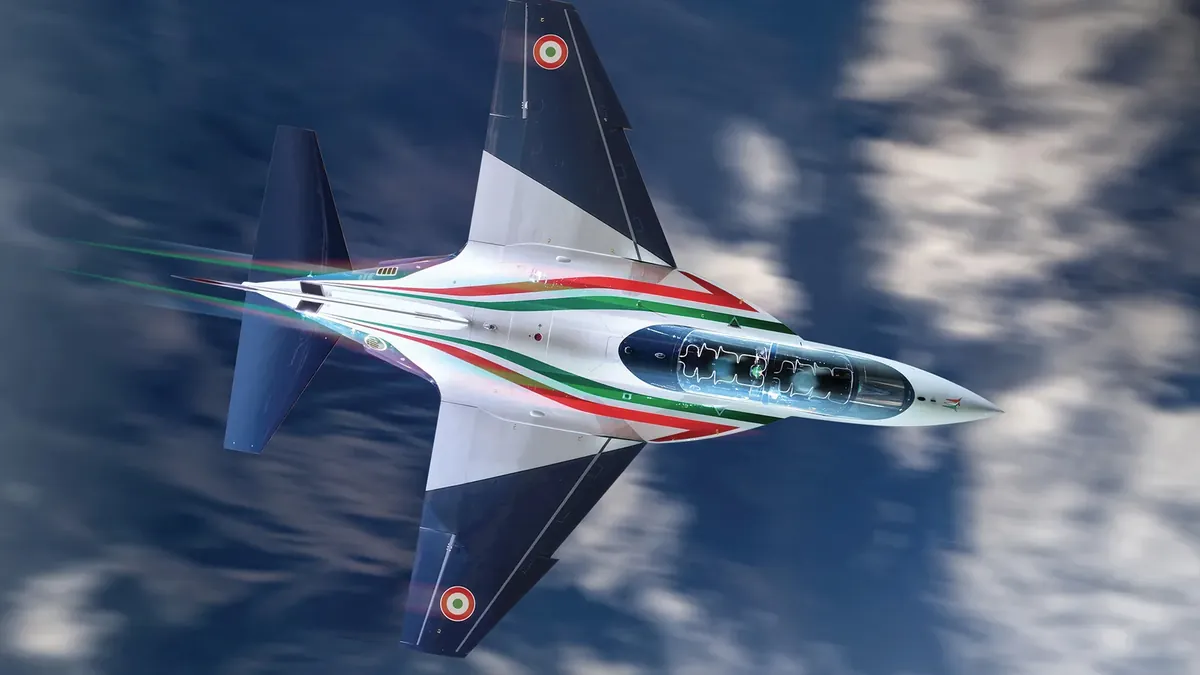
Leonardo has presented the first of 15 M-346 aircraft for the aerobatic team of the Italian Air Force (Aeronautica Militare), the Frecce Tricolori. The new aircraft will replace the MB-339s the team has flown for more than 40 years. At the same event, the Italian air force chief opened a discussion on using the combat version, the M-346F, against drones.
The presentation took place on Thursday, November 26, at Leonardo’s plant in Venegono Superiore, in the province of Varese in northern Italy. The first aircraft, in white and blue with the Italian tricolor, designed by Pininfarina, made its first flight on October 29 with company test pilot Giacomo Ianelli and Emiliano Battistelli in the back seat.
Leonardo says the program is on schedule and moving on to pilot and technician training and the creation of a new display program with new maneuvers and formations. The aircraft will be fitted with a smoke system, video transmission capability, changed avionics and auxiliary fuel tanks. Deliveries will take place in 2027 and 2028, and according to the Italian magazine RID the first display with the new aircraft is planned for May 1, 2028. The contract covers 20 aircraft in total: the other five are trainers to be added to the 18 M-346 trainers already in air force service. Milano Finanza, citing Court of Auditors documents, puts the total cost at €1.1 billion.
The news of greater operational interest came from the Italian air force chief, Lt. Gen. Antonio Conserva. According to the AGI agency, he said there is not yet an operational requirement for the combat and strike version, but the aircraft’s flexibility could suit above all counter-drone work. Cost-benefit studies are under way, because the M-346 “costs far less than the Eurofighter” and for some missions could be the cheaper option. The Eurofighter, he added, “remains the backbone of national air defense.” On a possible purchase, he said that when the air force is ready it will present the program to Parliament, which “may be premature.”
The M-346F Block 20, the light fighter version, has an AESA radar, a Link 16 data link, electronic countermeasures and new weapons. It has been sold to Turkmenistan, Nigeria, Austria and Indonesia.
Italy is not alone in looking at light aircraft for drones. Poland has assigned its FA-50s to counter jet-powered drones, while the Czech Republic agreed to give Ukraine four L-39 Skyfox, with another 12 possible if funding is found. The issue has two parts: the cost of the weapon and the cost of the flight hour. In August the State Department approved a possible sale to Italy of 5,031 APKWS II guidance kits for air-to-air use, worth $364 million (about €310 million), around the time an Italian Eurofighter shot down a drone over Latvia. Night-time NATO fighter scrambles for drones in the Baltic, as in the recent alerts in Latvia and Estonia or in Lithuania, where fighters missed, show why the cost of each interception has become a central question.