


Ground Master Family
In addition to the long-range Ground Master 400, Thales offers 2 other radars of the same family.
The first and “smallest” of them is the Ground Master 60. Its design is centered around the agility it offers. With a range of 80-150 kilometers, it is light weight, short deployment time and can be mounted on 4×4 or 6×6 vehicles.
With this data it becomes ideal for covering formations, as it can provide targeting of very short (VSHORAD) or short (SHORAD) range anti-aircraft weapons, as well as gaps in air defenses.
The “middle” member of the family is the Ground Master 200.
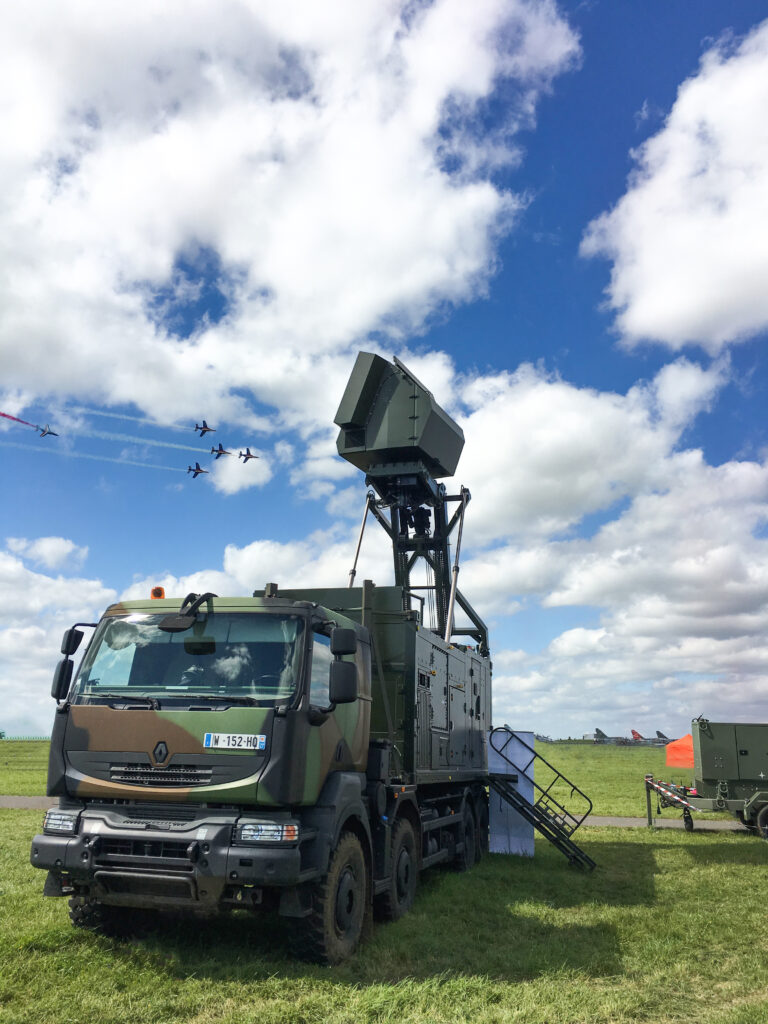
The GM200 shares several elements with the larger Ground Master 400. It is capable of “seeing” targets at a distance of 250 kilometers while the maximum range at which it can “lock” them is in the order of 100 kilometers.
Based on the above, the GM200 is ideal to complement longer-range radars and can be combined very satisfactorily with medium-range anti-aircraft.
Ground Master 400a
The Ground Master 400a is the latest addition to the Ground Master series and is an evolution of the Ground Master 400.
The development of the GM400a was deemed necessary by Thales so that it would be possible for the “biggest” member of the family to cope in the field.
Five times the computing power
The main upgrade we notice comes in the computing power of the system. With this increased fivefold, the performance of the GM400a increases.
Initially, the range was increased by about 10%. The range of the previous versions was 470 kilometers, while in the “alpha” version it exceeds 500 kilometers and reaches 515 kilometers.
The second positive that results from the GM400 upgrade is the ability to “see” in dense environments. Compared to the previous GM400s, the GM400a offers a better “image” to the user even against small targets such as UAVs which are still flying at a fairly low altitude.
Technical characteristics of the GM400a

The GM400a is a three-dimensional (3D) AESA technology radar. It is capable of locating and engaging targets from small UAVs to ballistic missiles.
It operates in the S-band frequency and like most modern radars incorporates GaN technology semiconductors.
At the same time, it utilizes stacked beam technology making it more accurate in locating low and fast flying targets.
The radar offers 40 degree elevation coverage. As mentioned above, the maximum range reaches 515 kilometers and the “ceiling” is at 100,000 feet (30.5 kilometers).
It performs 10 rotations per minute (10 RPM), refreshing the entire image every 6 seconds.
The total area it covers has increased by 20% compared to the previous generation GM400.
It incorporates IFF (Identification Friend or Foe) Mode 5.
Compared to its predecessor, it incorporates advanced artificial intelligence algorithms and is more secure against cyber attacks.
It requires 4 people to man and operate it.
The company sets the bar high in everything it has to do with system availability and reliability. It is stated that the maintenance time needed within one year of operation is 30 hours and that critical failure will occur after approximately 3,000-3,500 hours of use.
Finally, the GM400a comes in two versions. With the size to meet the requirements of the ISO 20-foot container, it can operate normally on a 6×6 or 8×8 vehicle in the form of a container with an integrated lifting mechanism.
Obviously, it’s also offered as part of a fully stable platform.
The Greek interest
As mentioned in the previous days, this radar was presented by Thales at the Hellenic Air Force General Staff. It seems that the Hellenic Air Force is planning to upgrade the air defense radars that it has at its disposal, after all, a similar meeting was held with the Italian company Leonardo for the ground version of the Kronos radars.
Back to the GM400a, it is certainly a very worthy solution in this field. It is an international “best-seller” with a large number of systems (>80) in service in France, Germany and several other countries.
Read More from Basilis K.
Copyright: It is forbidden to copy the text without permission from GEOPOLITIKI