Greece
The Israeli weapons of the parade: PULS, Barak MX, SPYDER, Drone Dome, Spike NLOS, Rampage and SPICE in photographs
If the Thessaloniki parade had a leading supplier, it was Israel: PULS, Barak MX, SPYDER, Python-5, Derby, Stunner, Drone Dome, Spike NLOS, Rampage and SPICE. A tour of the systems and what the Israeli “stamp” means.

If the Thessaloniki parade had a leading supplier, it was Israel. In the military parade of October 28, 2026 there passed down Megalou Alexandrou Avenue the PULS multiple launcher, the Barak MX and the SPYDER of the Achilles Shield, the Python-5, Derby and Stunner missiles, the Drone Dome counter-drone system, the Spike NLOS launcher with the Orbiter 3 UAV, the Rampage supersonic missile and the SPICE guidance kits. It is not merely a shopping list. It is the picture of a strategic choice: within a few years Israel has become Greece’s main supplier in air defence, long-range fires and guided weapons, with packages totalling about €3.8 billion, the largest part being the Achilles Shield at about €3 billion, the PULS at €690 million, the SPICE at €130 million and the Drone Dome at €26 million. Here is a tour of them all.
PULS: the multiple launcher that brings 300 kilometres
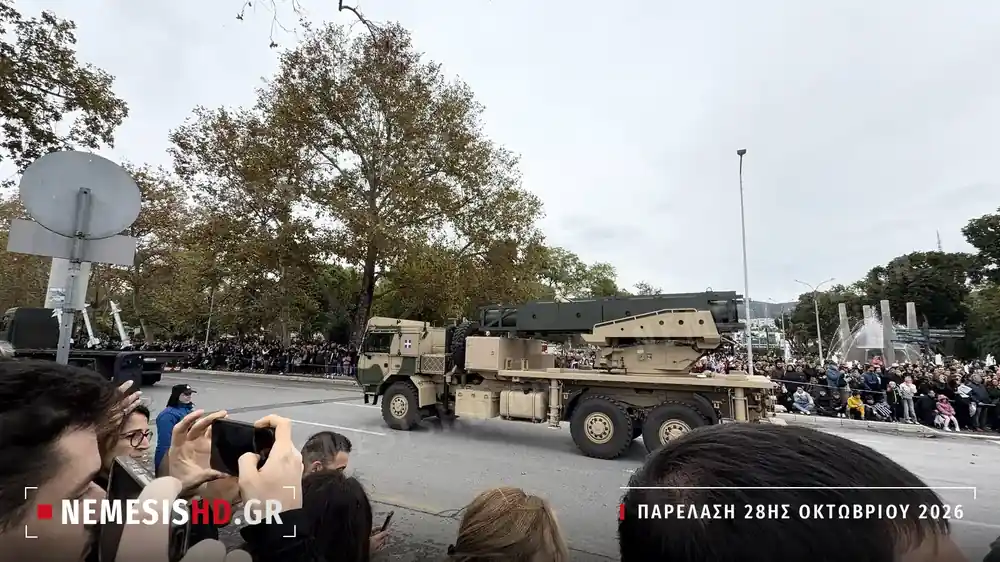
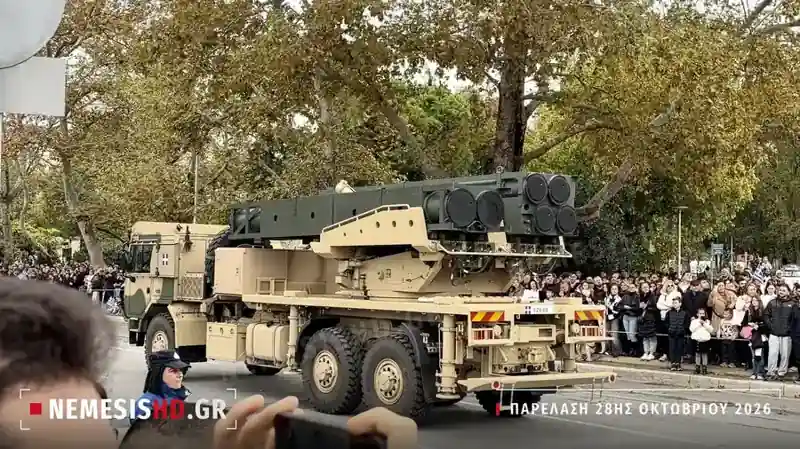
The PULS (Precise and Universal Launching System) of Elbit Systems was one of the systems that stood out in the parade. With intergovernmental agreement 009A/26 of April 6, 2026, Greece is buying 36 launchers for €690 million. The system’s philosophy is clear in the photographs: behind the armoured cab are two independent launchers, loaded sealed from the factory, which can carry different munitions. According to Elbit’s official data, each launcher carries 18 rockets of 122 mm for 35 km, or 10 of 160 mm for 40 km, or 4 EXTRA rockets for 150 km, or 2 Predator Hawk missiles for 300 km. The same launcher can support a brigade at Evros and, with a different load, strike targets in depth. A detailed presentation is in our PULS article.
Barak MX: the backbone of the Achilles Shield
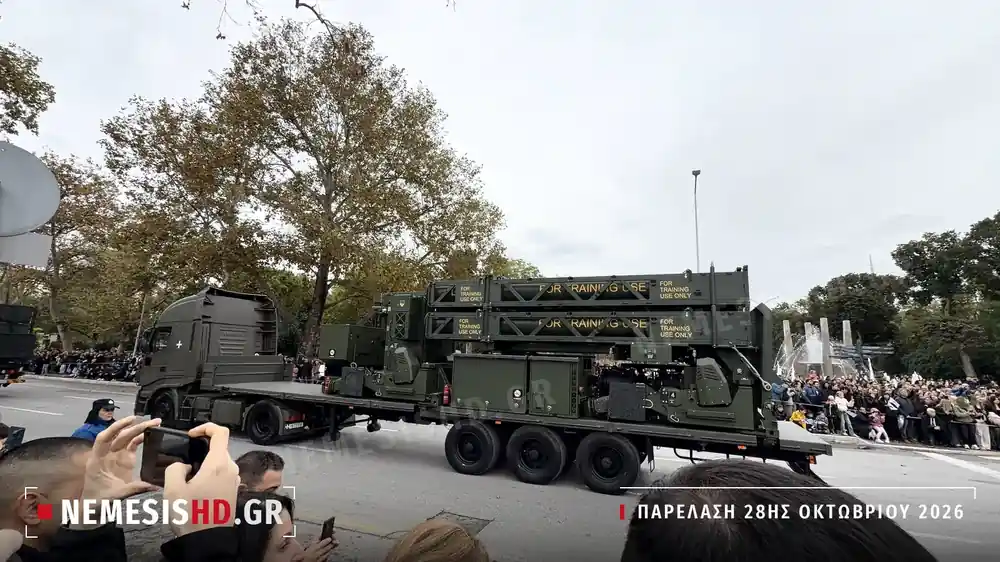
The launcher of Israel Aerospace Industries’ Barak MX passed on a semi-trailer towed by a tractor unit, with the missile canisters marked “FOR TRAINING USE ONLY”, in training configuration. The Barak MX is the medium-tier system of the Achilles Shield, where fighters, cruise missiles and large drones move. The Greek configuration uses missiles for ranges of 35, 70 and 150 km, all with an active radar seeker in the nose and vertical launch, so that one battery covers 360 degrees without turning its launchers. Cyprus has also acquired the same system.
SPYDER AIO, Python-5, Derby and Stunner
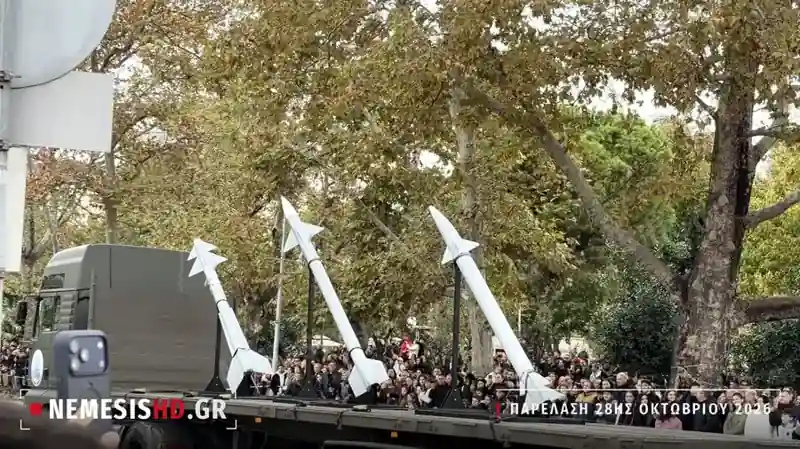
Rafael’s SPYDER launcher passed with the programme emblem, “SPYDER | ACHILLES’ SHIELD”, on the door of the eight-wheel Mercedes-Benz Actros, with its canisters in transport position. Greece is buying the SPYDER AIO (All-in-One) version, where an AESA radar, an electro-optical sensor, a command system and a launcher of up to eight missiles are in a single vehicle that sets up in minutes to protect an island, a radar or a battery. On a separate truck, with the Shield emblem on the door, passed the SPYDER’s two missiles: the Python-5, with an infrared seeker, and the Derby, with a radar seeker, both derived from fighters’ air-to-air missiles. With them was a Stunner, the missile of David’s Sling, which destroys its target by direct impact (hit-to-kill) and forms the upper layer of the Shield. The David’s Sling system itself did not take part in the parade.
Drone Dome: the counter-drone system with the Shield emblem
Rafael’s Drone Dome also passed with the same emblem, for which Greece signed a separate €26 million contract on the same day as the Achilles Shield. It is not a missile system but a system for countering small drones: an AESA radar for detection, a passive radio-frequency sensor that finds the drone and its operator, an electro-optical camera with thermal imaging for identification and jammers that cut the control link, the video link and satellite navigation. Its role is to guard airports, radars and batteries, complementary to the Greek systems of the Hellenic Aerospace Industry, such as the “Centaur”.

Spike NLOS and Orbiter 3: a strike from behind the horizon
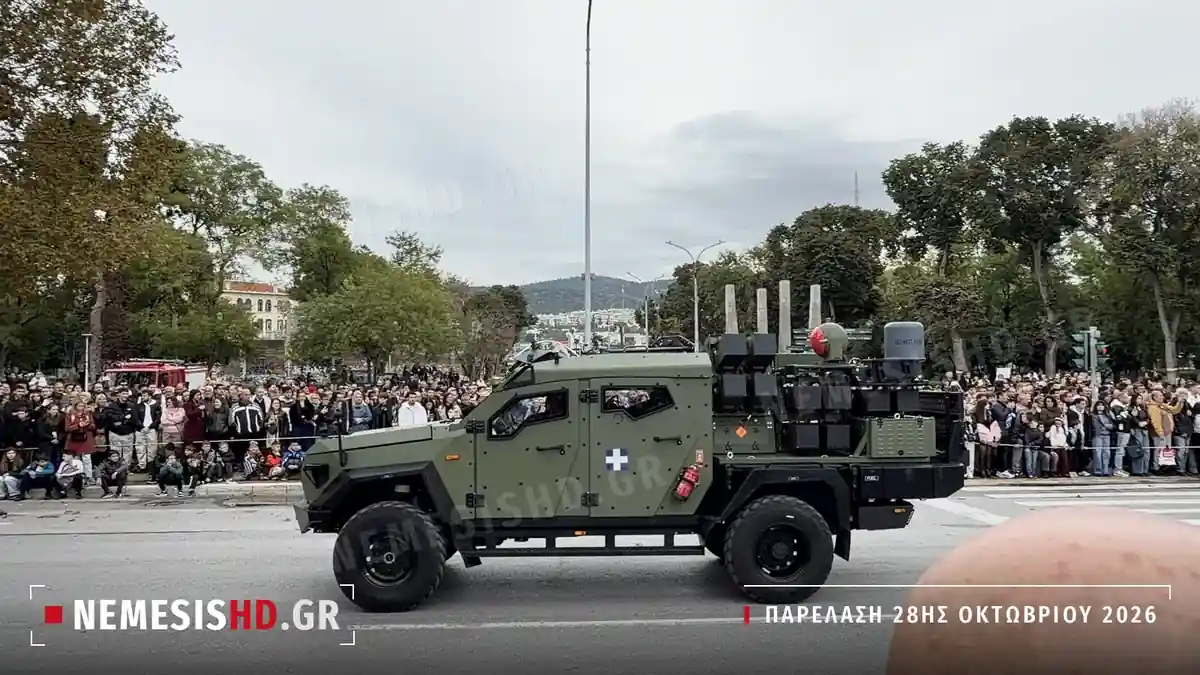
A new armoured 4×4 passed with a Spike NLOS launcher on its bed. Rafael’s Spike NLOS is a guided missile that fires without line of sight to the target: the operator steers it through the camera in its head, over a two-way encrypted link, and can change target or abort the attack in flight. From land and naval platforms it reaches up to 32 km. The Navy carried out acceptance firings of the Spike NLOS and ER on October 21 from a gunboat and a Mark V craft in the Sea of Crete. To fire at such a range the launcher needs “eyes” ahead of it, and that role is played by Aeronautics’ Orbiter 3, a small flying-wing UAV which, according to the parade’s official description, is operationally linked with the Spike NLOS for surveillance, reconnaissance and support of strike missions.
Rampage and SPICE: the Air Force’s Israeli weapons
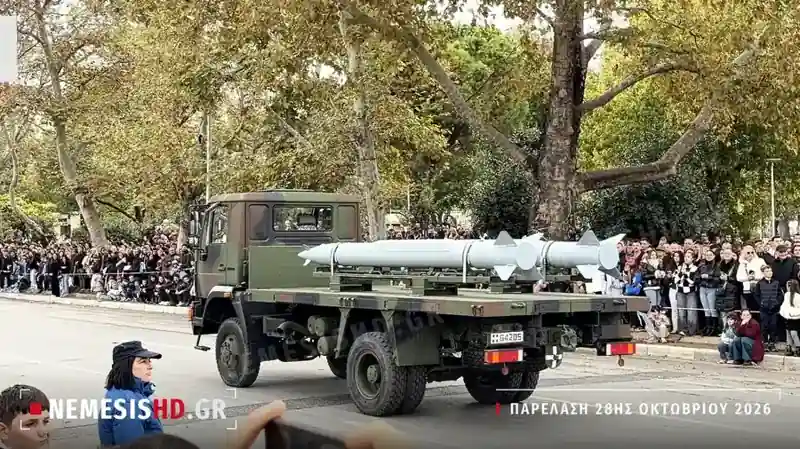
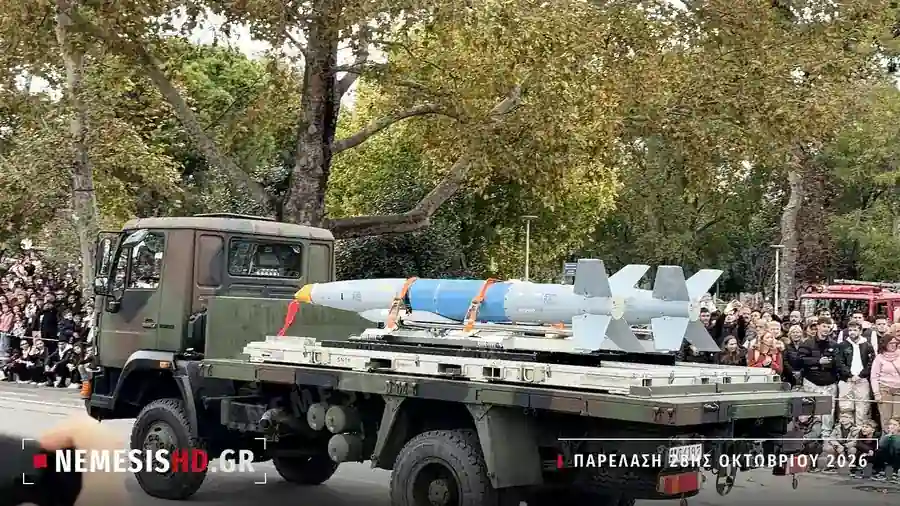
The Air Force presented on trucks two Israeli weapons that change the strike capability of the F-16. The Rampage, developed by IAI and IMI (now part of Elbit), is a supersonic air-to-ground missile derived from the 306 mm EXTRA artillery rocket: about 4.7 metres long, weighing around 570 kg and flying at Mach 1 to 1.6 after release, it hits command centres, air-defence batteries and other high-value targets from a safe distance. Rafael’s SPICE guidance kits turn conventional bombs into precision weapons with their own target-recognition seeker, which compares the terrain picture with a stored image and does not depend on GPS. The contract 009G/23 for SPICE 1000 and 2000 for the F-16, worth €130 million, has had an inspection and acceptance committee since September 2026. The bomb with the SPICE kit in the parade was painted blue, the colour of an inert training weapon.
What the Israeli “stamp” means for the Armed Forces
The concentration of so many Israeli systems in one parade has two sides. The positive one is that Greece is quickly acquiring combat-proven systems in areas where it lagged for decades, from the anti-aircraft umbrella to long-range fires, and that Greece and Cyprus now use common systems, such as the Barak MX. The other side is dependence on one supplier in critical areas, which makes the issues of source code, co-production and munitions stocks even more important. The Achilles Shield, the PULS and the SPICE will be judged not only on their performance but on whether Greek industry enters their support and production, so that in a crisis the missiles and spare parts do not depend on the production lines and priorities of a country that is itself at war.