Europe
UK defence intelligence chief: Russia does not seek war with NATO, but miscalculation is his “greatest fear”
Lt Gen Matthew Jones says Russia is not actively seeking war with NATO, but warns that a significant miscalculation is the risk he fears most, citing sabotage and proxy attacks in Europe.

The head of UK Defence Intelligence has said Russia does not actively seek war with NATO, but that his “greatest fear” is a significant miscalculation as President Vladimir Putin comes under pressure and turns more assertive. Lt Gen Matthew Jones made the remarks in a speech at the Cambridge Intelligence Seminar on 20 November, the transcript of which the Ministry of Defence published on 21 November.
The warning: miscalculation, not intent
Jones, who has led the organisation of nearly 4,000 tri-service and civil service specialists since July, said he could say “with some confidence” that Russia does not actively seek war with NATO. He then pointed to the risk that a reckless Russian act could go wrong: in his words, there are too many recent examples where a slightly different outcome “could have been extremely serious”.
He named several incidents: the drone attack at Leipzig in Germany in August, which he attributed to Russian proxies; a spate of merchant ships sinking in the territorial waters of NATO member Romania, which Defence Intelligence is following closely; a Russia-backed arson attack on a Ukrainian-owned business in east London; and the 2022 near shoot-down of an RAF Rivet Joint aircraft over the Black Sea. He also cited what he called an attempted attack in Estonia last weekend as an example of rising sabotage. Estonia has announced that it will close all its road border crossings with Russia from 1 December, as Geopolitiki reported in Estonia to close all road border crossings with Russia from December 1.
The UK, he said, does not seek conflict or confrontation with Russia but “will robustly defend” its national security and that of its allies.
Russian losses and capabilities
On the war in Ukraine, Jones said Russia’s ground forces are fixed there and suffering heavy losses, “often over 2000 men a day in recent weeks, over 50,000 a month”. This is a figure given by the UK official in his speech and not independently verified here. He added that the Russian military is adapting rapidly, and that its long-range aviation, sub-surface and underwater reconnaissance, cyber, special forces, military intelligence, ballistic missile and nuclear forces all continue to pose a substantial threat.
Spies and sabotage at home
Jones referred to recent threats at RAF Fairford and to the arrest last week of an officer assigned to the NATO Allied Rapid Reaction Corps, as well as an arrest in Gloucestershire earlier this month, and said Defence Counter Intelligence had played a considerable role in the arrest of “the US service person”. The Defence Counter Intelligence Unit was formed earlier this year under the Strategic Defence Review. He said developing the approach to homeland and national defence is one of his top priorities.
Targeting web and NATO links
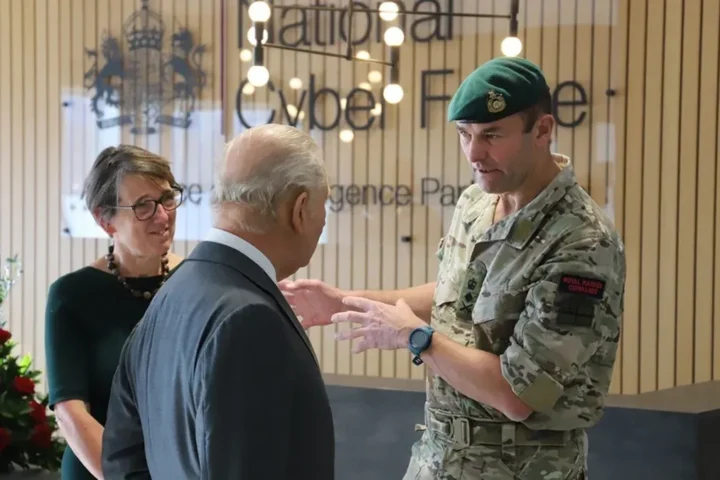
He said the Digital Targeting Web, which connects sensors with the armed forces’ weapons through a common intelligence picture, is the underpinning capability of the Strategic Defence Review and the Defence Investment Plan. Later this month, he said, the Cyber and Specialist Operations Command, of which Defence Intelligence is a part, will bring into operation a new sensitive capability that will improve the acquisition of targets and give frontline forces more precise data. The same command includes the National Cyber Force, whose commander recently described offensive operations against Russia, China, Iran and North Korea, as covered in UK cyber commander: offensive operations are under way against Russia, China, Iran and North Korea.
Jones said he had spent two days in Brussels earlier in the week with intelligence chiefs from across the Alliance, with 83 military and civilian agencies represented, and that Defence Intelligence has projects under way to deepen intelligence cooperation with NATO partners, including the ten-member Joint Expeditionary Force of northern European nations that the UK leads. He also said the secretary of state, Mr Streeting, has set the goal of getting Britain and its allies more ready to fight and win a war in Europe by 2030, which Jones stressed is not a prediction of when an attack would come.
Wider threats
Beyond Russia, Jones described a deteriorating global security environment, listing the war in Ukraine, a wider risk of escalation in Europe, conflict across the Horn of Africa, the Arabian Peninsula and the Middle East, a military build-up in East Asia whose scale and pace he called “mind-boggling”, and a rise in AI-driven offensive cyber-attacks.