Asia-Pacific
US 25th Infantry Division: C-17 airlift of HIMARS and live fire in the Marshall Islands for deep strikes
The 25th Infantry Division flew HIMARS launchers by C-17 from Hawaii to the Marshall Islands, ending with live fire at Kwajalein on November 13 against maritime targets in the JPMRC 27-01 exercise.

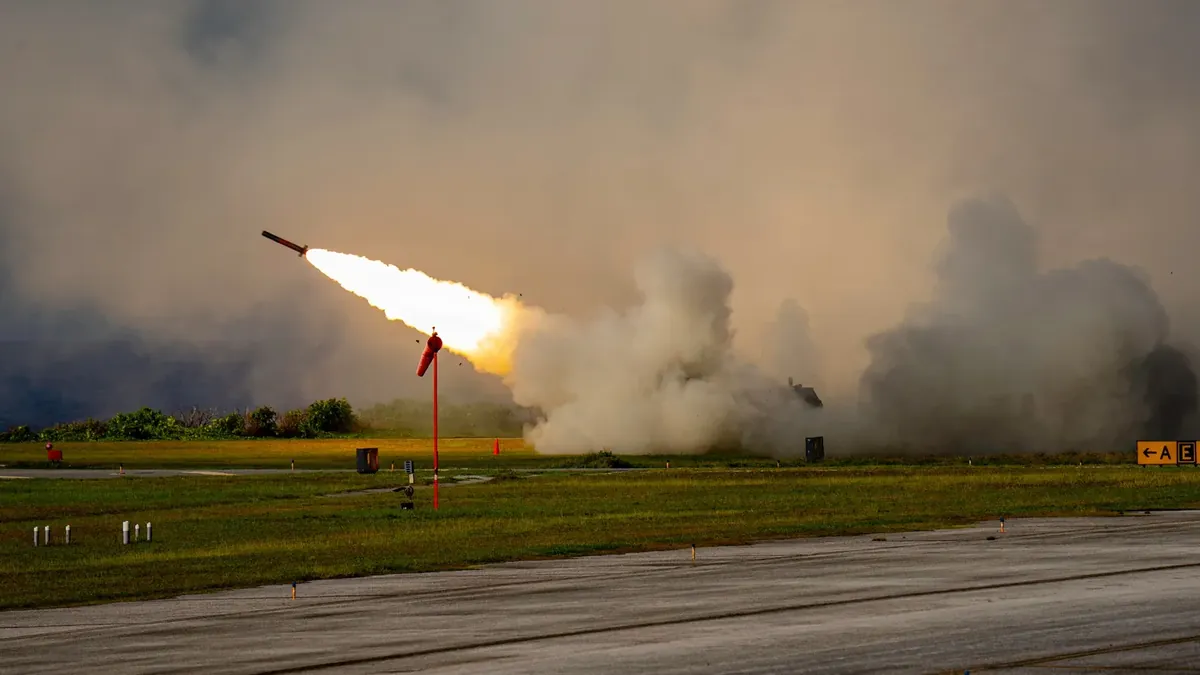
The US Army’s 25th Infantry Division carried out successive “rapid infiltration” missions with multiple HIMARS (High Mobility Artillery Rocket System) launchers, from the Hawaiian islands to the Marshall Islands, culminating in live fire on Kwajalein atoll on Friday, November 13. The US Department of War presented the missions on Monday, November 16 as validating the division’s deep-strike capability. They took place within exercise JPMRC 27-01 of the Joint Pacific Multinational Readiness Center, the main combat training centre of US Army Pacific.
The HIRAIN (HIMARS Rapid Infiltration) mission relies on speed and survivability. The launcher is flown to a remote site with limited infrastructure, unloaded, fires and is immediately loaded back onto the aircraft, so as to strike enemy systems without remaining a stationary target for counter-battery fire. The HIMARS belong to the 2nd Battalion, 11th Field Artillery Regiment of the 25th Division Artillery. Their transport was handled by C-17 crews of the US Air Force’s 15th Wing. The division had first tested the procedure with a complex dry-fire exercise on Kauai in Hawaii, as we reported in our coverage of the Kauai rehearsal.
“On these missions we focus on speed and maintaining communications. The landing strips here are usually very limited,” said 1st Lt. Cameron Richardson, a platoon leader in Battery B of the 2-11. Richardson noted that loading and securing the launchers requires close coordination between Army crews and Air Force loadmasters so that the vehicles are ready for action immediately after landing. The combination of heavy airlift and precision weapons, the Army writes, shows that US forces can change position quickly and keep their fires going in a contested environment, regardless of the distances in the Pacific.
Live fire against maritime targets at Kwajalein
At Kwajalein, US unmanned aircraft provided continuous aerial surveillance and the 2-11 successfully struck targets “deep in the maritime domain”. Commanders processed sensor data and confirmed targets via encrypted networks and decision-support tools the Army calls Super-Intelligence (SI). After the shots the launchers were immediately secured for their next moves. “With these missions we practise our ability to bring long-range fires quickly even to the most isolated points of the region,” said Col. Brian Fanning, commander of the 25th Division Artillery. “That capability ensures we can quickly deliver lethal fires to deter and defeat threats deep in the maritime domain,” added Maj. Andrea Swett, the division artillery’s operations officer.
The 25th Division, known as “Tropic Lightning”, is based at Schofield Barracks in Hawaii. The Army links the test to planned deployments of division elements to the Philippines in the spring and summer, under Operation Pathways, where they will operate alongside allied forces. JPMRC 27-01 involves, besides US forces, troops from South Korea, Singapore, France and New Zealand. The Philippines is meanwhile strengthening its partnerships, most recently with the new defence agreement with Australia over the South China Sea, which we covered in this report. On developments in the system itself, Lockheed Martin presented in October the HIMARS FLEX with double the firepower; see our report on GMLRS production.