Greece
Gerapetritis after meeting Guterres: “Maritime zones are not a field for auctions”
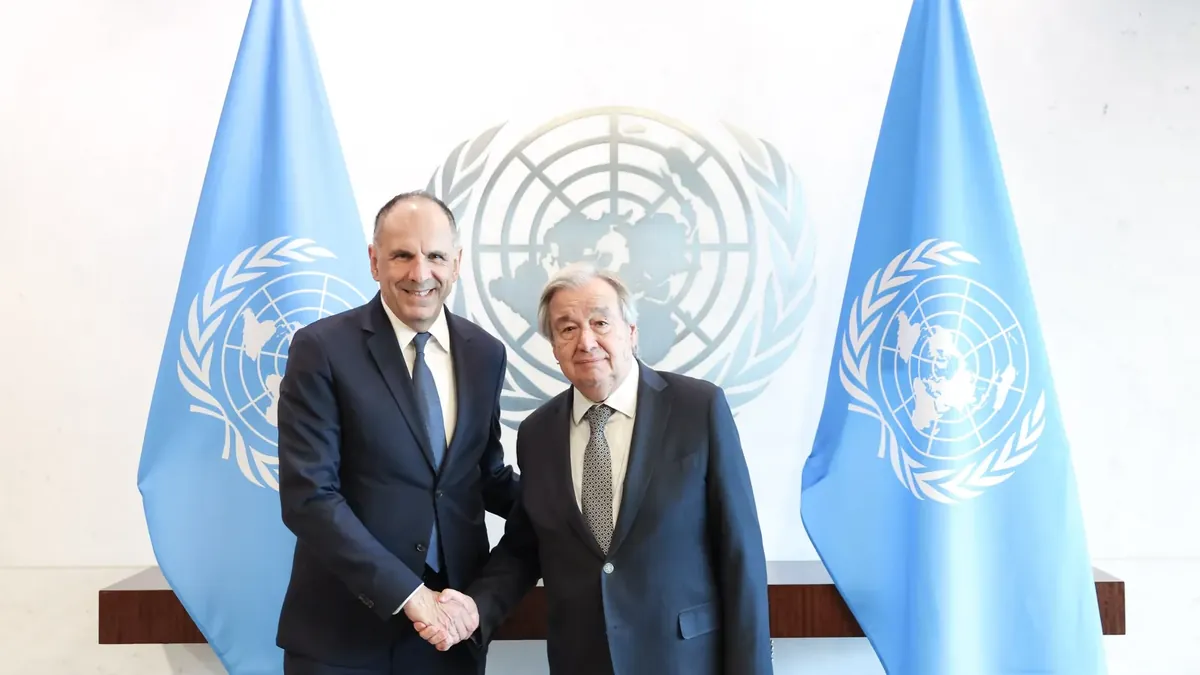
After meeting UN Secretary-General António Guterres in New York, Foreign Minister George Gerapetritis said maritime zones are “not a field for auctions”, called Greece’s relationship with Egypt “brotherly” and said Greece will not tolerate any illegality at sea.

Asked about Turkish moves toward Egypt, Foreign Minister George Gerapetritis answered: “We must all understand that maritime zones are not a field for auctions. It is a field in which international law must prevail.” He spoke on Wednesday, October 28, at United Nations headquarters, shortly after seeing Secretary-General António Guterres. The Foreign Ministry published the full text of the statement.
The question that prompted the answer concerned the day’s contacts. Earlier on Wednesday Gerapetritis had spoken by phone with Egypt’s Foreign Minister Badr Abdelatty, centred on the two countries’ Strategic Partnership. They also discussed regional developments, security and stability in the Eastern Mediterranean, and the workings of the UN, on the occasion of Greece’s presidency of the Security Council. The question also referred to contact between Turkish Foreign Minister Hakan Fidan and Abdelatty, while Ankara keeps repeating that an agreement with it would give Cairo more sea, as Yaşar Güler argued with his “15,000 square kilometres”.
“A very strong, strategic, brotherly” relationship with Cairo
The minister began with the relationship with Cairo, which he called “very strong, strategic, brotherly”, noting that it “is developing in all fields”. He recalled that Egypt’s ambassador to the UN stood beside him when the joint statement on the illegal Turkish-Libyan memorandum was announced in New York. “We have a very common conviction regarding the universal application of international law with Egypt,” he added.
If the rules are not observed, he warned, there will be “a situation of extremes” with heavy consequences that, as he explained, would not be confined to the coastal states of the Mediterranean and other seas but would touch global trade, food and energy security and the protection of the oceans.
What he told Guterres
Gerapetritis said he raised maritime security with Guterres himself, with specific reference, as he put it, to illegal delimitations. “We must all realise that the seas, the oceans, are neither the privilege nor the plot of anyone,” he said, recalling that the majority of UN member states have accepted the rules of the Law of the Sea. Athens’ position was stated without room for misreading: “Greece is not going to tolerate any illegality regarding maritime zones.” The country, he explained, wants neighbours to settle their differences among themselves, but that does not mean tolerance of “aggressive actions contrary to international law”.
The conversation with the Secretary-General also covered the future of the Organization and the election of the next Secretary-General, Ukraine, Libya, the Eastern Mediterranean, the wider Middle East and Africa, topics listed in the Foreign Ministry’s post on X. The Greek minister said the two sides agreed the world is at “the most critical juncture since the Second World War” for peace and prosperity, and called for “bold decisions” to de-escalate crises and find a way out of the energy and food crisis.
Cyprus: do not lose the momentum
On the Cyprus problem, Gerapetritis asked for the talks to move to a more formal phase, on the substance of the problem. “The momentum built during the term of António Guterres must not be lost,” he said, stressing that Security Council resolutions are “imprescriptible” and must be respected by all so that the island can be reunified.
The statements came during the minister’s stay in New York, where he chaired Security Council meetings as part of Greece’s October presidency. On Thursday, October 29, at 16:00 Greece time, Prime Minister Kyriakos Mitsotakis was due to preside over the Council’s open debate on emerging technologies and maritime security.