Cyprus
Gerapetritis to Parliament on the GSI cable: an operational response if Turkey obstructs the laying, sources say
Foreign Minister George Gerapetritis reportedly told MPs behind closed doors that the Greece-Cyprus cable will go ahead and that the government will respond operationally if Turkey creates obstacles. Prime Minister Mitsotakis sent a similar message.

Athens does not intend to back down on the GSI electricity interconnection cable, even if Ankara tries to stop the work at sea. This is reportedly the message Foreign Minister George Gerapetritis sent on Tuesday, November 3, to MPs on Parliament’s Foreign Affairs and Defence Committee. The session was held behind closed doors, so what is attributed to the minister comes exclusively from information.
According to that information, the foreign minister made clear that the laying of the submarine cable linking Greece and Cyprus will go ahead. If the Turkish side creates obstacles, the government will respond with the necessary operational moves so that the project is completed. The briefing was given on his own initiative, with transatlantic relations and developments at the UN as its subjects.
The assessment of Ankara
Gerapetritis reportedly also told MPs that he does not expect Turkey to cause a standoff over a project funded by the European Union and involving French interests. Ankara has nevertheless already reacted with a counter-NAVTEX from its Antalya station, which it presents as the authority responsible for the area.
The Greek side stresses that the applications for a works permit have been submitted exclusively to the Greek authorities and that permission will not be requested from any other country. The government draws a clear distinction between the permit, on which there is no issue, and the notification, which is made as provided for and produces no legal effects.
Mitsotakis: “I will not go into any operational detail”
The same day Prime Minister Kyriakos Mitsotakis sent a similar message, speaking on Alpha radio. “The cable will go ahead. The permit for the cable will be given by the Greek authorities and we will discuss the rest in due course,” he said, avoiding further details. “I will say nothing more on this issue, nor will I go into any operational detail, for reasons you understand,” he added.
Gerapetritis had already described the government’s position in a recent interview. He said that under international law “electricity interconnections of this type are free and cannot be obstructed by any country”, and that Greece, “in full cooperation with France”, will itself grant the permit and issue the relevant NAVTEX for the survey and the laying. For the background, see also our opinion piece on what Greece would do if Turkey obstructs the work.
Abeille Marengo waits in Heraklion
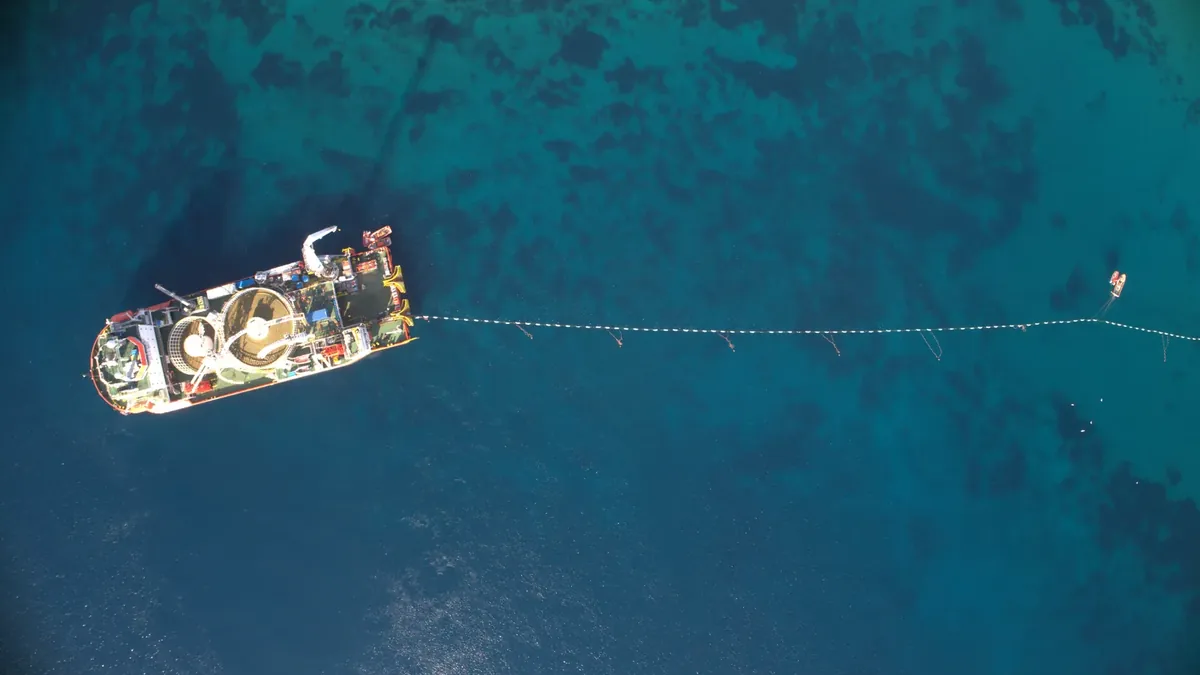
The Abeille Marengo, the French vessel assigned to the surveys, arrived in Heraklion, Crete, last Tuesday. Once the request for the works permit passes through the interministerial committee, the process can begin within November. The next step will show whether Turkey limits itself to statements and NAVTEX messages or attempts to intervene at sea.