Analysis Air Force
How the Hellenic Air Force is preparing for the F-35: a new doctrine, training in the US, Andravida and networking with the Rafale and F-16
The 20 Greek F-35As are due at Andravida from November 2029, but preparation has begun: pilots and technicians trained in the US, a base certified to US security standards, a data network linking the F-35 to the Rafale, F-16 Viper and air defence, and a global support model.

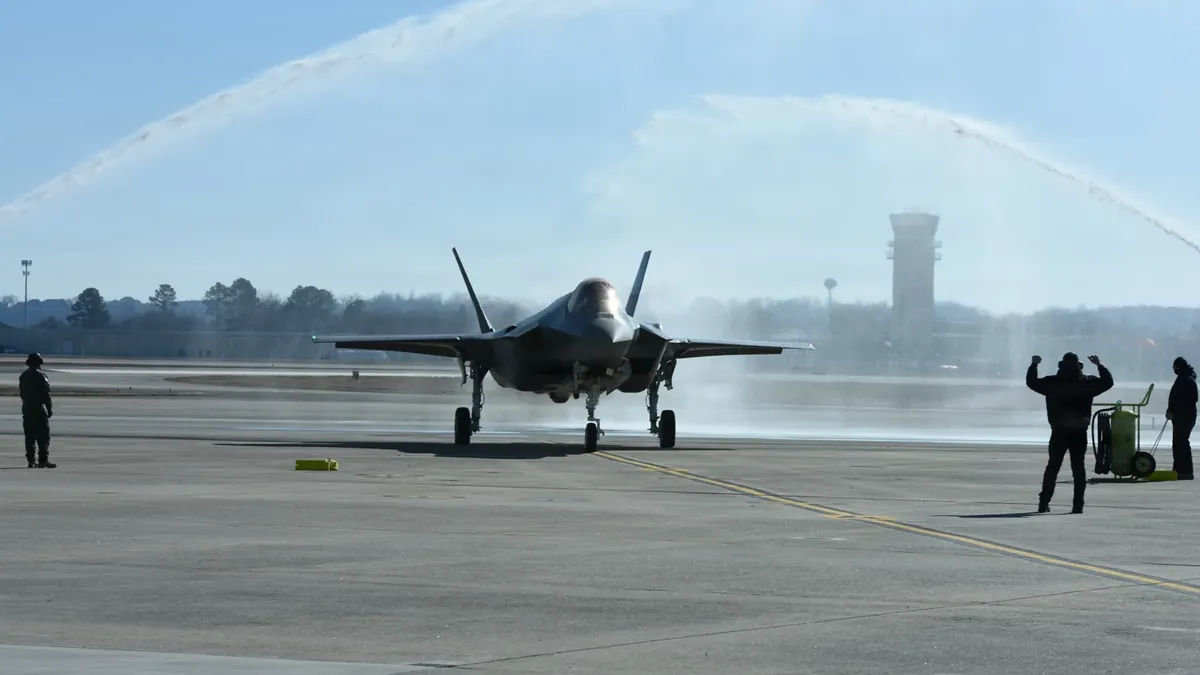
For the Hellenic Air Force, the F-35 is not just a new fighter. It is a change in how air operations are planned and carried out. That is the message of the Order of the Day issued by the Air Force chief, Lt. Gen. Dimosthenis Grigoriadis, on November 8, 2026, which describes the introduction of the F-35 as a “transition to a different operational philosophy.” The 20 Greek F-35As are expected to arrive at Andravida from November 2029, but preparation has already begun and covers four fields: pilots and technicians trained in the US, a base certified to US security specifications, a network that will carry F-35 data to the Rafale, the F-16 Viper and the air-defence system, and a support model built on the programme’s global supply chain. The contract, cost, deliveries and weapons are covered in detail in our guide to Greece’s F-35s.
What the Air Force has said officially about the transition
No operational doctrine for the F-35 has been made public. The leadership’s directions are public, however. In the November 8, 2026 Order of the Day, the Air Force chief wrote that the introduction of the F-35 “is not limited to acquiring a new air platform” but leads to an environment where “the use of advanced technologies, the interconnection of operational assets and the strengthening of their cooperation shape new capabilities in the planning and execution of air operations.” In the same text he defined the Air Force’s strategic goal as a force that is “flexible, network-centric, resilient,” and noted that on the future battlefield superiority will be decided by the ability to combine different assets “into a single decision-making and action mechanism.” According to the chief, the effectiveness of air power now depends on the speed at which information is exploited and on the interoperability and resilience of systems, not only on the quality of the aircraft.
That line did not appear this year. In the corresponding Order of the Day in November 2025, Grigoriadis called participation in the programme a “decisive milestone that changes the operational and geopolitical landscape of the Southeastern Mediterranean” and tied the F-35 to the spread of the Link 16 data link across the whole fleet and to Collaborative Combat Aircraft (CCA). National Defence Minister Nikos Dendias supplied the political framework. On October 20, 2026, presenting Phase C of the New Force Structure, he said each F-35 will be accompanied in the air by up to six collaborative drones. At the Hellenic Air Force Academy on November 8 he spoke of an air force of “200 modern combat platforms that will surround and direct hundreds of unmanned vehicles,” with aerial refuelling “for the first time in our history,” a Space Directorate and an Inter-Service Unmanned Aircraft Training Centre. No CCA contract has been signed, and the Air Force is still examining options (see our analysis). The official line, however, clearly links the F-35 to a network of manned and unmanned assets.
Training in the US: Ebbing, Eglin and the first 70
The practical side of the preparation began in May 2025, with the Air Force chief’s visit to the US. At the Pentagon, Grigoriadis met the then US Air Force Chief of Staff, Gen. David Allvin, and in Fort Worth he was briefed on the programme and visited the production line. According to the briefing given to the Greek delegation, the first Greek F-35s enter the production line in early 2027 and are expected to be delivered in the second half of 2028. Greek pilots will train at Ebbing Air National Guard Base in Fort Smith, Arkansas, while ground technicians will start at Eglin Air Force Base in Florida and then join the pilots at Fort Smith. In total, 70 Air Force personnel, pilots and technicians, will go to the US in 2027. On May 21, 2025 the Air Force chief visited Ebbing, where, according to the US Air Force, the commander of the US 19th Air Force, Lt. Gen. Gregory Kreuder, and the commander of the 85th Fighter Group, Col. Nick Ihde, briefed him on the training of Greek pilots and technicians and on the deliveries of the Greek F-35As.
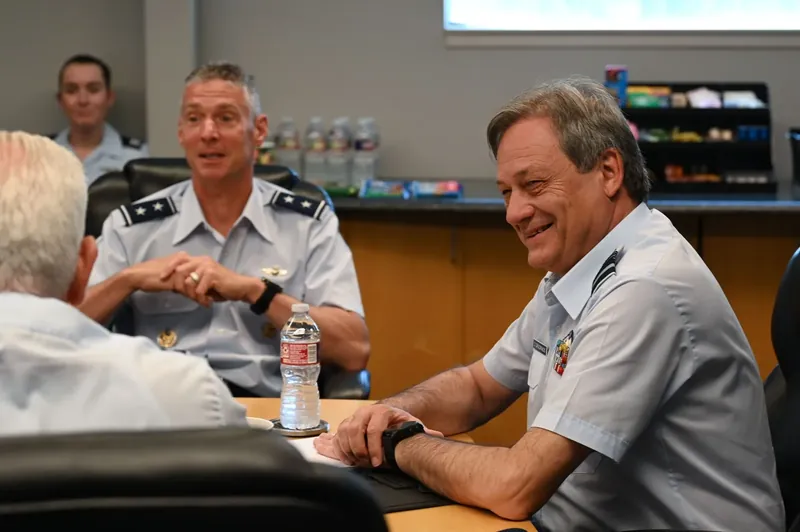
Ebbing is the centre where the US trains users of the F-35 who buy it through the Foreign Military Sales (FMS) programme. The Poles passed through before Greece, the first Finnish aircraft arrived in January 2026 and the first German one in October (DVIDS). Finland’s case gives a good indication of the Greek path. According to US Air Education and Training Command, the Finns train with the 57th Fighter Squadron, the US Air Force unit dedicated to FMS customers. Pilots complete academics and simulators at Eglin and fly in the Fort Smith airspace, while technicians train at Ebbing under manufacturer technicians, as part of Interim Contract Support. For about 20 Finnish pilots the programme runs from May 2026 to February 2028, almost two years. The first Finnish pilots had trained in the US before the first F-35As reached Rovaniemi.
Two dates circulate in the Greek timetable. Prime Minister Kyriakos Mitsotakis said on July 8, 2026 that Greek pilots will begin training on the F-35 in 2027, and government spokesman Pavlos Marinakis said on October 8, 2026 that from early 2029 training will begin “on our own aircraft in America.” In our reading, based on the Finnish model, the two dates describe different stages of the same process: academics and simulators come first, while flying a Greek aircraft presupposes its delivery. The US side has already contracted the preparation. On May 5, 2025 the Naval Air Systems Command (NAVAIR), which manages F-35 contracts, awarded Lockheed Martin a $17.19 million contract (N00019-25-C-0012) for technical support, programme management, special non-recurring cost requirements and training, with the aim of bringing Greece into the programme as an FMS customer. The contract is funded with Greek FMS money and expires in May 2028, shortly before the first deliveries.
In Greece the preparation passes through basic and advanced training. The Air Force chief has referred to the International Flight Training Centre in Kalamata and to synthetic training, and since 2025 the Air Force, through the Operational Synthetic Training Squadron, has been aiming at a network of virtual-reality simulators at the Combat Wings, linked to the air-defence network. The first F-35 pilots will come from experienced members of combat squadrons, but later generations will start, like all fighter pilots, from advanced training in Kalamata. The F-35, however, demands something the Air Force has not needed to the same degree in the past: a large part of the training takes place in simulators, because that is where sensors, electronic warfare and tactics that cannot be fully practised in open airspace can be tested to the full.
Andravida: a fifth-generation base under US security rules
The F-35s will be based with the 117 Combat Wing at Andravida, where 338 Squadron currently flies the last Greek F-4E Phantoms. The US notification to Congress of January 2024 spells out the new aircraft’s role: the F-35 will offset the growing obsolescence of the Air Force’s F-4s and Mirage 2000s. The Government Council for National Security (KYSEA) has approved €290 million for the base works, which include hardened shelters, maintenance hangars, facilities for repairing the low-observable coating, areas for handling classified information, and physical and cyber security infrastructure. The tender has not yet been issued. The base must be ready and certified before it receives the aircraft, which is why the works are the most sensitive point of the timetable: if they are delayed, the Greek F-35s will stay longer in the US.
Security is not only about buildings. The same notification says the highest classification level of the material and services sold is SECRET, and that the US judged Greece able to provide “substantially the same degree of protection” to the sensitive technology as the US government. The package includes KGV-135A cryptographic modules, AN/PYQ-10 simple key loaders, an identification friend or foe (IFF) system and classified software. In practice, key management, personnel vetting and controlled areas become part of the daily operation of an entire Wing, not of a single office. The change affects everything from how pilots are briefed before a mission to who may enter a hangar.
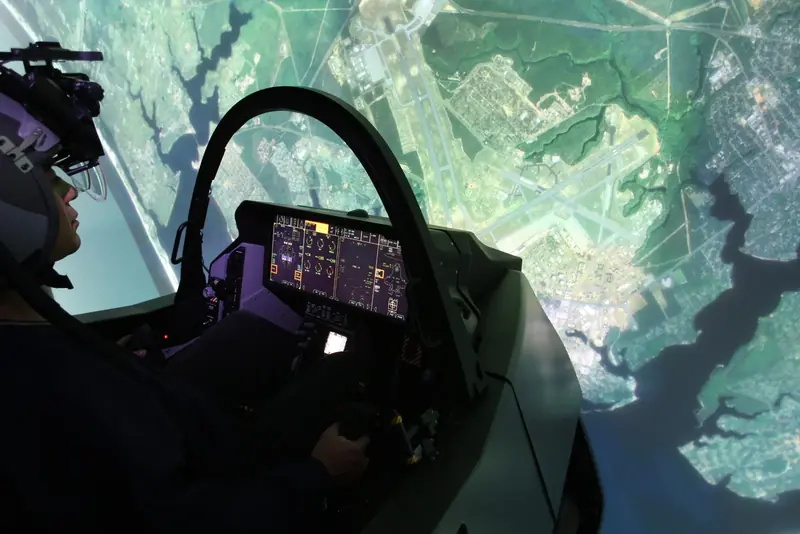
The same notification describes the training system bought with the aircraft. For pilots it includes Full Mission Simulators and a Deployable Mission Rehearsal Trainer. For technicians it includes training devices for the aircraft’s systems, the ejection seat, the F135 engine and weapons loading, as well as an Outer Mold Line laboratory for the low-observable coating. These assets can be installed in a single Integrated Training Center or in separate centres for pilots and technicians. Where they will be installed in Greece has not been announced, but the choice will determine how quickly the Air Force can train new pilots on its own without sending them to the US.
A network with the Rafale, F-16 Viper and air defence: MADL, Link 16 and mission data
The central issue is how F-35 information will reach the rest of the fleet. The US notification says the aircraft has two data links. The Multi-Function Advanced Data Link (MADL) is designed exclusively for the F-35 and allows low-probability-of-detection communication between F-35s. Link 16 allows communication with older aircraft, with the J-series messages used by NATO and US forces. The Air Force’s Rafale and F-16 Viper use Link 16, and the Air Force chief has set its spread across the whole fleet as a goal. The Hellenic Aerospace Industry (EAB) designed and built a transportable communications station linked to the Link 16 network and the air-defence network. But Link 16 transmits in all directions, so for a low-observable aircraft its use is a tactical decision: when to transmit, what to transmit and from what distance. A gateway system that would translate MADL data for the other assets has not been announced for Greece. How F-35 targets can reach the F-16s and ground forces is examined in the analysis of the Sniper NTP pod.
The second issue is Mission Data Files. They are the aircraft’s “threat library,” telling the sensors and the electronic-warfare system which radar or emitter is hostile and how it should be countered. The notification to Congress includes “reprogramming-lab support” for Greece and clarifies that the electronic-warfare laboratory is used by US government engineers to create common mission data files for foreign users. Partner countries in the programme have their own facilities: Italy and Norway share a laboratory at Eglin, where the Italians produced their first file in October 2022. On the basis of the notification, Greece as an FMS customer will rely on the US laboratory. The F-35’s effectiveness in the Aegean and the Eastern Mediterranean depends on how quickly the files are updated with the region’s threats.
The third issue is range. The F-35A is refuelled in the air with a rigid boom, like the F-16. The KC-390s (programme file) being acquired by the Air Force refuel, in the configuration announced, with a probe-and-drogue system, meaning they can serve the Rafale and Mirage 2000-5 but not the F-35A and F-16. Dendias referred to “airtankers” separately from the new transports, without a type being announced. In our reading, without a boom-equipped refuelling aircraft, long-range missions by Greek F-35s will depend on allied aircraft, something that will have to be resolved in the same timeframe as their introduction.
Support and maintenance: ALIS/ODIN, spare parts and Greek technicians
The F-35 also changes how the Air Force maintains its aircraft. The notification to Congress describes the Autonomic Logistics Global Sustainment (ALGS) worldwide support system, which unifies the supply chain, repairs, support equipment, engines and training, and the ALIS information system, which the programme is gradually replacing with the newer ODIN. The aircraft continuously records the condition of its subsystems so that maintenance is done preventively, before a failure. The Greek package includes Contractor Logistics Support, spare parts, an F135 engine component improvement programme and technical manuals. For an air force with a long tradition of self-reliant maintenance, joining a shared international spare-parts pool means greater dependence on the system’s reliability. The recent report by the US Government Accountability Office (GAO), which found spare parts worth billions of dollars without accurate records (our report), shows the system still has weaknesses.
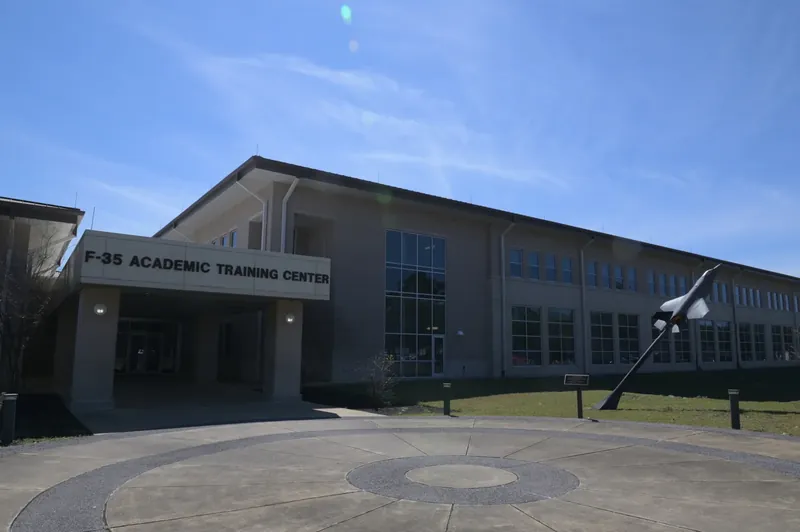
Training the technicians is as important as training the pilots. Greek technicians will start at the F-35 Academic Training Center at Eglin, the programme’s central maintenance school, and continue with hands-on training at Ebbing. There they will work alongside manufacturer technicians, as the Finns do, so that when the aircraft move to Andravida there is Greek personnel able to keep availability high. Three elements will show whether the transition is on schedule. The first is the issuing and execution of the Andravida works. The second is sending the 70 personnel to the US in 2027. The third is the signing of the weapons contracts, for which no Letter of Offer and Acceptance (LOA) has yet been signed.
The steps of the transition to the F-35
| Date | Step | Source |
|---|---|---|
| Jan 26, 2024 | DSCA notifies Congress of up to 40 F-35As with simulators, reprogramming-lab support and cryptographic equipment | DSCA |
| Jul 25, 2024 | Letter of Offer and Acceptance (LOA) signed for 20 F-35As | Greek MoD, Lockheed Martin |
| May 5, 2025 | $17.19 million contract to Lockheed Martin for Greece’s entry into the programme, running to May 2028 | US Department of Defense |
| May 21, 2025 | Hellenic Air Force chief at Ebbing on the training of pilots and technicians | US Air Force |
| Nov 8, 2026 | Air Force chief describes the F-35 as a “transition to a different operational philosophy” | Hellenic Air Force General Staff |
| 2027 | Start of production; 70 Air Force personnel to the US for training | HAF General Staff, Prime Minister |
| H2 2028 | First deliveries in the US | HAF General Staff |
| Early 2029 | Training on a Greek F-35 in the US | Government spokesman |
| Nov 2029 | First arrival at Andravida | Government |
Frequently asked questions about the Air Force’s F-35 preparation
Where will the Greek F-35 pilots train?
At Ebbing Air National Guard Base in Fort Smith, Arkansas, where FMS users are trained, according to the Air Force General Staff. Technicians start at Eglin Air Force Base in Florida and continue at Ebbing. For other FMS users, such as Finland, academics and simulators are done at Eglin.
How many Air Force personnel will be trained in the US?
According to what was announced during the Air Force chief’s visit in May 2025, 70 Air Force personnel, pilots and technicians, will go to the US in 2027.
Where will the Greek F-35s be based?
With the 117 Combat Wing at Andravida, where F-4Es fly today. KYSEA has approved €290 million for the infrastructure works, and the tender has not yet been issued.
Can the F-35 exchange data with the Rafale and F-16 Viper?
Through the Link 16 data link, which all three aircraft use, target tracks and J-series messages are exchanged, not the full picture from the F-35’s sensors. The low-probability-of-detection MADL link works only between F-35s.
What are the F-35’s mission data files?
They are the aircraft’s threat library, which lets the sensors and the electronic-warfare system recognise hostile radars and emitters. For FMS customers such as Greece, they are created by US government engineers in a reprogramming laboratory.