Greece
Greece’s 2027 defense budget: €8.1 billion, with €4 billion for armaments and €3.1 billion for payroll
The 2027 State Budget gives Greece's Ministry of National Defence €8.1 billion, more than half of its regular budget going to fixed assets, mainly payments on armament programs.

The Ministry of National Defence will have €8.1 billion in appropriations in 2027. More than half of its regular budget goes to fixed assets, mainly payments for armament programs. In the 2027 State Budget submitted to Parliament, the Ministry (entity 1011) appears with €7,996.5 million in the regular budget and €105 million in the Public Investment Budget (PIB), of which €40 million is the national component and €65 million co-financed. The Explanatory Report separately lists, within the regular budget, €4,000 million for the implementation of armament programs, €800 million more than the €3,200 million planned for 2026.
The comparison with 2026 can be made in two ways. The voted 2026 budget gave the Ministry €6,955.3 million in the regular budget and €108 million in the PIB, a total of €7,063 million. On that basis, the 2027 regular budget is up €1,041 million, or 15%. But 2026 will end higher than voted. The 2027 Explanatory Report estimates this year’s spending from the Ministry’s regular budget at €7,488 million, €533 million above the voted figure, while payments for armaments stay at the €3,200 million that had been planned. The Report says that during execution about €277 million more was allocated for maintenance of naval, air and ground assets, for the special allowance for personnel on special missions, for food, travel, fuel and for fire prevention and response. It does not break down the remaining €256 million or so of the overrun. The same happened in 2025, when €185 million more was allocated during execution. Against the 2026 estimate, the 2027 increase is about €509 million, or 6.8%, and comes entirely from armaments. Without payments for armaments, the rest of the regular budget is €3,997 million in 2027 against €4,288 million in the 2026 estimate, about €291 million less. If the picture of 2025 and 2026 repeats, supplementary appropriations will be needed again during the year.
Where the money goes: spending by category
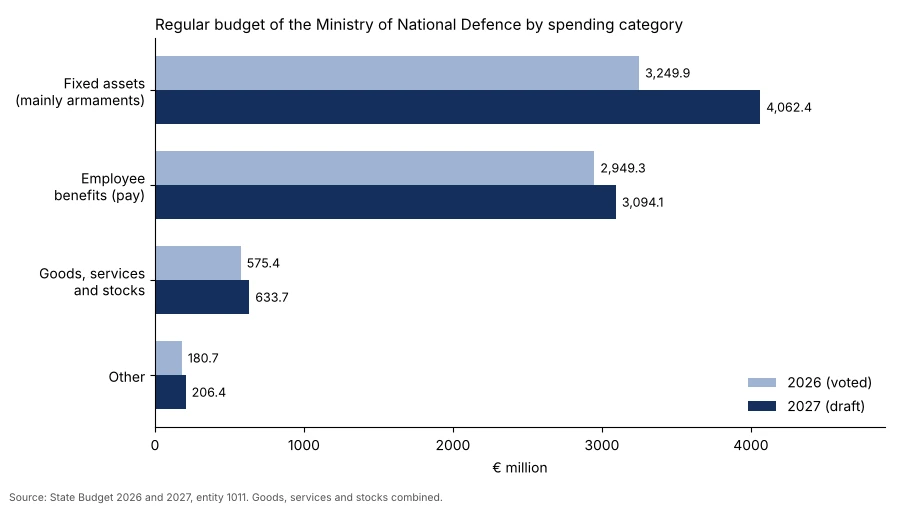
In the table of appropriations by major spending category, the largest item is fixed assets, at €4,062.4 million or 50.8% of the regular budget, against €3,249.9 million in 2026, an increase of 25%. Of this, €4,002.5 million is booked under special entity 1011-501, the independent and other units of the Ministry’s central service, an amount almost equal to the €4,000 million the Explanatory Report assigns to armament programs. In all other special entities together, from the General Staffs to the hospitals and the National Intelligence Service (EYP), fixed assets are about €60 million. The Report itself says most appropriations will cover personnel pay and operating costs, but the table shows that most now goes to fixed assets. Second comes payroll (employee benefits), at €3,094.1 million or 38.7%, up €144.8 million or 4.9%.
| Spending category | 2026 (€ million) | 2027 (€ million) | Change |
|---|---|---|---|
| 21 Employee benefits | 2,949.3 | 3,094.1 | +4.9% |
| 22 Social benefits | 64.5 | 69.0 | +7.0% |
| 23 Transfers | 54.6 | 56.1 | +2.7% |
| 24 Goods and services | 575.4 | 400.0 | −30.5% |
| 27 Other expenses | 1.0 | 0.8 | −22.2% |
| 29 Appropriations to be allocated | 60.6 | 80.5 | +32.8% |
| 31 Fixed assets | 3,249.9 | 4,062.4 | +25.0% |
| 32 Stocks | – | 233.6 | new line |
| Total regular budget | 6,955.3 | 7,996.5 | +15.0% |
The 30.5% drop in “goods and services” appears to stem from a new classification of spending and not from a cut. In the 2026 budget the entity had no line 32 “Stocks” at all, while in 2027 it appears with €233.6 million. In the State Budget as a whole, stocks, zero in 2025 and 2026, appear in 2027 at €402 million, of which €233.6 million (58%) belong to the Ministry. At the Air Force General Staff (HAF), for example, the €188.2 million of purchases of goods and services in 2026 become €104.8 million in goods and services and €100.1 million in stocks in 2027, and at the military hospitals too part of purchases is moved to the new line. If the two categories are added together, the €633.7 million of 2027 is 10.1% above the €575.4 million of 2026. Social benefits rise to €69 million, transfers, which at the Hellenic National Defence General Staff (HNDGS) reach €37.6 million, to €56.1 million, and appropriations to be allocated to €80.5 million.
On payroll, the human resources tables of the two Explanatory Reports, which include the Ministry and the supervised General Government bodies, record 85,486 people in the 2027 Report against 88,126 in the 2026 Report, about 3% fewer. At the same time hiring continues: the Ministry made 2,669 appointments in 2025 and 2,735 up to 30 September 2026. Spending on employee benefits rises 4.9%, and one explanation is pay raises. In December 2025, in the debate on the 2026 budget in Parliament, Defence Minister Nikos Dendias had announced average raises of 13%–24% for officers and NCOs, retroactive from 1 October 2025, funded by savings such as closing camps and structural changes. The Ministry remains the second largest in payroll spending, with about 19% of total employee-benefit spending in the State Budget.

Army, Navy, Air Force: what each General Staff gets
The budgets of the three General Staffs are essentially personnel and operating budgets, because the major armaments are booked centrally, under entity 1011-501. The Army General Staff (HAGS) gets €1,981.5 million (+6.8%), of which €1,705.9 million is payroll. The Air Force General Staff (HAF) gets €1,037.3 million (+5.2%), with €772.9 million of payroll, €104.8 million of goods and services and the largest stocks of any branch, €100.1 million. The Navy General Staff (HNGS) gets €703.8 million (+4.9%), with €564.9 million of payroll. Among the staffs, the largest percentage increase goes to the Hellenic National Defence General Staff (HNDGS), from €51.6 million to €63.2 million (+22.5%), while the National Intelligence Service (EYP) rises from €36.9 million to €40.8 million (+10.5%). Special entity 1011-501, which gathers the armaments, reaches €4,106.1 million, €817.5 million more than in 2026.
| Special entity | 2026 (€ million) | 2027 (€ million) | Change |
|---|---|---|---|
| Independent/other Ministry units (1011-501) | 3,288.7 | 4,106.1 | +24.9% |
| Army General Staff | 1,856.0 | 1,981.5 | +6.8% |
| Air Force General Staff | 985.6 | 1,037.3 | +5.2% |
| Navy General Staff | 670.9 | 703.8 | +4.9% |
| National Defence General Staff | 51.6 | 63.2 | +22.5% |
| National Intelligence Service | 36.9 | 40.8 | +10.5% |
Regular budget, 2026 and 2027. The military hospitals and the Hellenic Force in Cyprus (ELDYK) have separate lines and are not included in the staffs’ amounts. Source: State Budget 2026 and 2027.
In the Performance Budget, which allocates the same appropriations to programs, the program “Deterrence of external threats – Guaranteeing the security and defense of the country” absorbs €7,240 million of the €8,101.5 million, almost 90%. It is followed by health care for the Armed Forces with €352.1 million, international relations and the Ministry’s actions abroad with €166.1 million, personnel training with €101.1 million and the Armed Forces’ contribution to civil protection with €96.5 million.
Payments of €4 billion, deliveries of €2.4 billion for armaments
In the Explanatory Report the Ministry of Finance separates payments for armament programs from physical deliveries, the value of material received within the year. For 2027 it forecasts payments of €4,000 million and physical deliveries of €2,400 million. For 2026 the estimates are €3,200 million and €2,300 million, the same as the forecasts the budget gave last year, while for 2025 €2,496 million and €1,700 million had been estimated. Payments exceed deliveries by a growing margin: in 2027 the annual gap reaches €1.6 billion and cumulatively for 2025–2027 about €3.3 billion. The Report does not break down its composition, nor how much concerns advance payments for material to be delivered later.
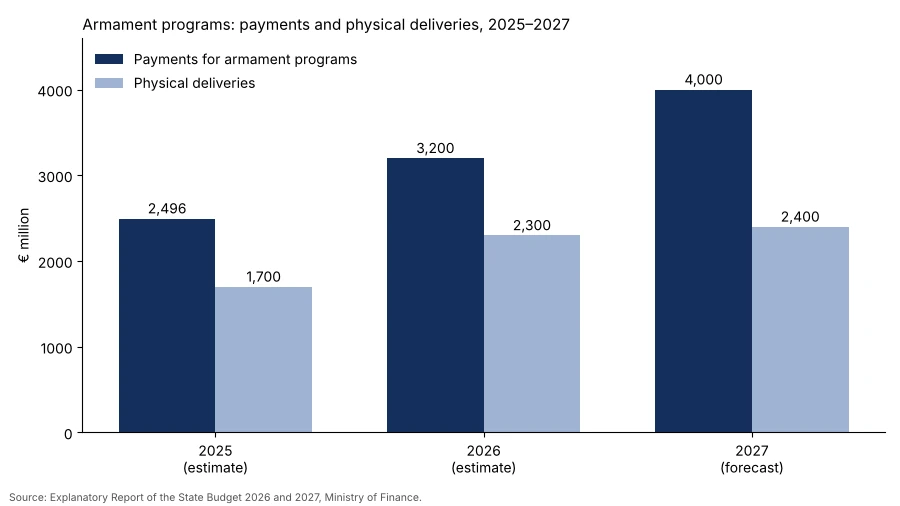
The distinction matters for the fiscal accounts. Under ESA accounts, which measure the deficit, military equipment is recorded when it is delivered, and the Explanatory Report notes in its General Government tables that defense spending is calculated on the basis of physical deliveries. In the analysis of fixed-asset purchases of the State Budget under ESA for 2027 (€2,548 million), the Report says the Ministry’s physical deliveries of weapon systems rise by €100 million against 2026, that is, to €2,400 million, and not the €4 billion of payments. In the functional classification of the General Government, “Defense” for 2027 is €6,088 million. The national escape clause for defense spending follows the same logic. Net nationally financed primary expenditure rises 8.9% in 2026 and 3.7% in 2027, above the targets of 3.6% and 3.1% of the Medium-Term Fiscal-Structural Plan. According to the Report, with the flexibility of the clause for defense and its extension to energy resilience, and counting 2024 and 2025 when spending stayed below target, the cumulative increase does not exceed the spending limit. The 2027 revenues also include €290 million from loans of the European SAFE program.
Part of the payments of the coming years is already committed. On 22 October 2026, ten certificates of multi-year commitments of the Ministry, totaling about €6.95 billion for the years 2027 to 2039, were posted on the Diavgeia transparency portal. The largest is €2.93 billion for contracts of the Army and Air Force General Staffs, while €2.02 billion is intended for new contracts of the Navy and the Air Force, with €202 million falling in 2027. The approval of the General Accounting Office for the €2.02 billion also rested on a decision of 29 September 2026 to raise the Ministry’s spending ceilings. Neither the documents nor the budget name programs.
Compared with GDP, the Ministry’s €8.1 billion corresponds to 2.94% of the nominal GDP of €275.9 billion that the budget forecasts for 2027, against 2.87% in 2026 (€7,560 million in the execution estimate, against GDP of €263.4 billion). These percentages concern the Ministry’s cash appropriations. “Defense” in the functional classification, based on deliveries, corresponds to about 2.2% of GDP. NATO applies its own common definition, which includes military pensions among other items, and for 2026 estimates Greece’s core defence expenditure at 3.65% of GDP. For comparison with Turkey, where the Defense Ministry’s budget for 2027 rises 86%, see the Turkish budget coverage.
Public investment: housing programs and energy upgrades
The Ministry’s Public Investment Budget is small compared with the regular one. For 2027 €105 million is planned, against €108 million in the voted 2026 budget, of which only €72 million is estimated to be executed. Of the national component of €40 million, €38.98 million is fixed assets, €1 million appropriations to be allocated and €20,000 goods and services, with the Army General Staff getting €26 million and the Air Force General Staff €10.9 million. Of the co-financed component of €65 million, the Air Force General Staff gets €25.8 million, the Navy General Staff €19.9 million and the Army General Staff €19.2 million, with €36.4 million still appropriations to be allocated. According to the Explanatory Report, a significant part of the appropriations will go to the Ministry’s housing programs and to the energy upgrading of buildings. Separately, two energy modernization investments of the Ministry have been approved in the Modernisation Fund, with interventions at, among others, the 700 Military Factory, the Salamis Naval Base and the State Aircraft Factory in Elefsina.
Overall, against the voted 2026 budget, of the €1,041 million increase about three quarters go to fixed assets (+€812.5 million), about 14% to payroll (+€144.8 million) and about €84 million to the remaining categories, mainly goods, services and stocks (+€58 million) and appropriations to be allocated (+€20 million). Against the 2026 execution estimate, the whole increase goes to armaments. Their payments exceed physical deliveries by €1.6 billion in 2027 alone, and the cumulative gap for 2025–2027 reaches about €3.3 billion.
Frequently asked questions about the 2027 Defence Ministry budget
How much money does the Ministry get in 2027? A total of €8,101.5 million: €7,996.5 million from the regular budget and €105 million from the Public Investment Budget (€40 million national component and €65 million co-financed).
How much is for armament programs? The budget’s Explanatory Report forecasts €4,000 million for the implementation of armament programs in 2027, against €3,200 million in 2026. Physical deliveries of material are forecast at €2,400 million.
How much does the budget increase against 2026? The regular budget rises 15% against the voted 2026 budget (€6,955.3 million). Against the 2026 execution estimate (€7,488 million), the increase is about 6.8% and comes entirely from armaments.
Why are “goods and services” falling? Mainly because in 2027, unlike 2026, the category “Stocks” appears in the entity with €233.6 million. Added together, goods, services and stocks reach €633.7 million, 10.1% above 2026.