Analysis
Global Firepower 2026: Why the ranking does not show the real balance between Greece and Turkey in the Aegean
Global Firepower 2026 puts Turkey 9th and Greece 30th, but the index counts men and machines, not how a conflict in the Aegean would unfold, and its economic data for the two countries diverge from the IMF, SIPRI and the World Bank.

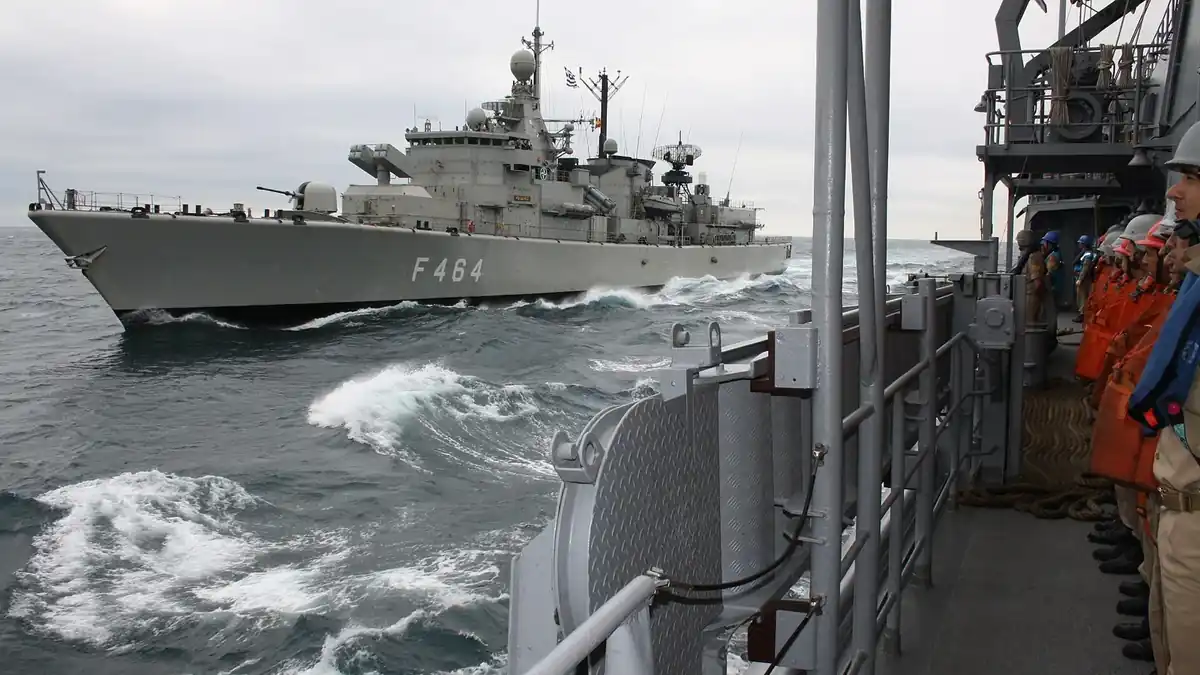
The frigate Kanaris (F464) of the Hellenic Navy and the Turkish frigate TCG Oruçreis in a personnel-transfer drill during Exercise Breeze 2011, on 21 July 2011, with NATO's Standing Maritime Group 2. Photo: NATO Maritime Command Naples / public domain
The Global Firepower 2026 ranking places Turkey 9th and Greece 30th among 145 countries, and every year the 21-place gap is read in Greece as a verdict on the Aegean. That reading is wrong, and the reason is not national pride. The index adds up people, vehicles, ships, money and raw materials to estimate how much a state can fight conventionally over time, not how a conflict in one specific theater would unfold. In addition, in the economic data for Greece and Turkey it contains deviations from the figures of the IMF, SIPRI and the World Bank that widen the gap between the two countries more than reality justifies.
For the Greek reader the distinction has practical meaning. The balance in the Aegean is decided by how many forces each side can concentrate on the same front, by the quality of sensors and weapons, by crew training and by the geography of the islands, that is, by factors a global table cannot capture. Below we examine how the index is calculated, what it says about the two countries, where its data diverge from official sources, why the ranking changes year after year without the armies changing, and where the index itself underestimates Turkey.
The Hellenic National Defence General Staff’s official footage from the large-scale national joint exercise “Parmenion 25”, held from 26 September to 3 October 2025, shows exactly what does not fit in a table: the coordination of the Army, the Navy and the Air Force in a joint scenario, under unified command and control. In Global Firepower the same assets appear only as numbers in inventory, with no information on how well they work together.
What Global Firepower measures and how the PwrIndx is produced
Global Firepower is a private website that has published an annual military power ranking since 2005 and belongs to the Military Factory network of sites. The 2026 edition covers 145 countries, and Greece’s page gives 20 January 2026 as the date of its last check. For each country an index, the PwrIndx (Power Index), is computed from more than 60 factors covering manpower, equipment, natural resources, finances, logistics and geography. The lower the number, the stronger the country is considered, with zero the “perfect” score that, as the site itself notes, cannot realistically be achieved.
The formula is described as “unique” and internal. According to the site, it allows smaller but technologically advanced countries to compete with larger and less developed ones, while special factors, in the form of bonuses and penalties, further correct the ranking. The site does not, however, present the weight each factor carries in the final result, so no one outside the team that compiles it can check why a country rises or falls. For finances, manpower, geography and natural resources the values come “in part” from the CIA World Factbook, while for aircraft, tanks and ships they come from “multiple sources”. In both cases the site says estimates are made where no official figures exist.
The site’s own explanations also reveal its methodological choices. Unmanned aircraft (UAVs) are not included in the aircraft fleet, while trainers are. The “patrol” category lumps together offshore patrol vessels (OPVs), corvettes and missile boats, and for submarines no distinction is made between conventional, nuclear attack and ballistic-missile boats. The “readiness” of the aircraft fleet and of vehicles is not measured: it is estimated by reference to the averages of the US Air Force (75%) and the US Army (80%) and marked with an asterisk as an estimate. Mobilization potential is calculated with models from the two world wars, for a war lasting four years, while a new factor for 2026 is the share of the population with internet access.
The most telling sentence, however, is on the disclaimer page. It says that Global Firepower has no endorsement from any government body or industry organization and that its content is presented “for entertainment and historical value, and as a general reference”. The source itself, in other words, does not claim the role attributed to it every January, when the ranking is reproduced as an official assessment of the states’ military power.
Greece 30th, Turkey 9th: what the Global Firepower 2026 numbers show
In the 2026 ranking Turkey is 9th with a PwrIndx of 0.1975, between the United Kingdom (8th, 0.1881) and Italy (10th, 0.2211). The rest of the top ten are the US, Russia, China, India, South Korea, France and Japan. Greece is 30th with 0.5484, behind Saudi Arabia (25th), Sweden (26th), Algeria (27th), Canada (28th) and Singapore (29th) and ahead of North Korea (31st) and the Netherlands (34th). The data the index assigns to the two countries, as published, are summarized in the table.
| Category (Global Firepower 2026) | Greece | Turkey |
|---|---|---|
| Rank / PwrIndx | 30th / 0.5484 | 9th / 0.1975 |
| Population | 10,461,091 | 84,119,531 |
| Active personnel | 142,700 | 481,000 |
| Reserves | 221,350 | 380,000 |
| Paramilitary forces | 55,000 | 150,000 |
| Aircraft (total) | 560 | 1,101 |
| Fighters | 178 | 201 |
| Trainers | 86 | 301 |
| Aerial tankers | 0 | 7 |
| Helicopters / attack helicopters | 285 / 28 | 509 / 111 |
| Main battle tanks | 1,344 | 2,284 |
| Self-propelled guns | 589 | 1,045 |
| Multiple rocket launchers | 152 | 237 |
| Ships (total) | 186 | 192 |
| Frigates / corvettes | 14 / 0 | 17 / 9 |
| Submarines | 9 | 14 |
| Mine warfare | 3 | 11 |
| Defense budget | $8.24 billion | $51.4 billion |
The big difference in personnel mainly reflects demographics. By the index’s own figures, Turkey has eight times the population but about 3.4 times as many active personnel, and the index calculates that 1.4% of Greeks serve on active duty, against 0.6% of Turks. Greece, in other words, mobilizes proportionally far more of its citizens than its neighbor, yet the PwrIndx gives weight to absolute size, and there the result is predetermined. The same applies to mobilization potential: the index calculates that at the end of a four-year war Greece will have reached a cumulative 832,211 people and Turkey 6,658,915, a scenario that has nothing to do with a crisis in the Aegean.
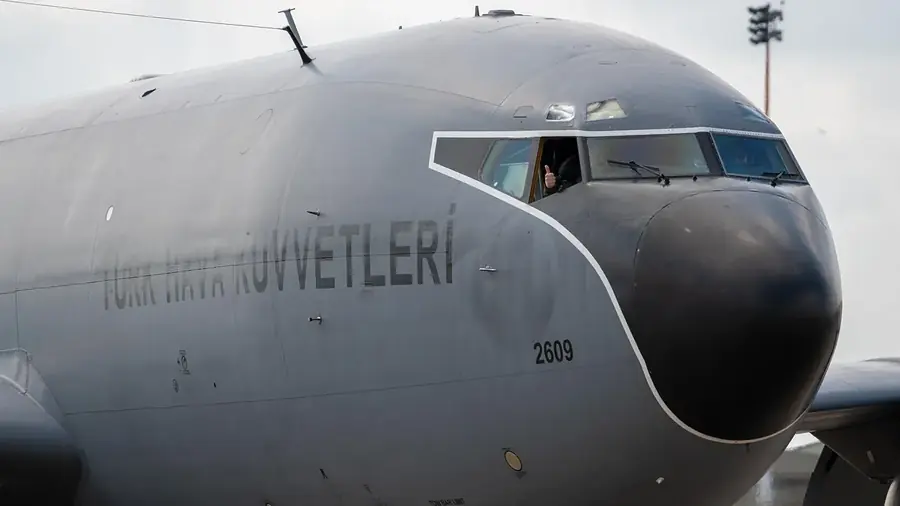
In aircraft the picture is more complex than the total suggests. The gap in fighters is small, 178 against 201, and most of the difference in the totals of 560 and 1,101 aircraft comes from trainers, transports and helicopters. One point where the table captures a real gap is aerial refueling: the index records seven Turkish flying tankers and no Greek ones, which concerns the ability to operate at long range, for example in the Eastern Mediterranean, far more than fighting over the Aegean, where Greek bases are a few minutes’ flight away.
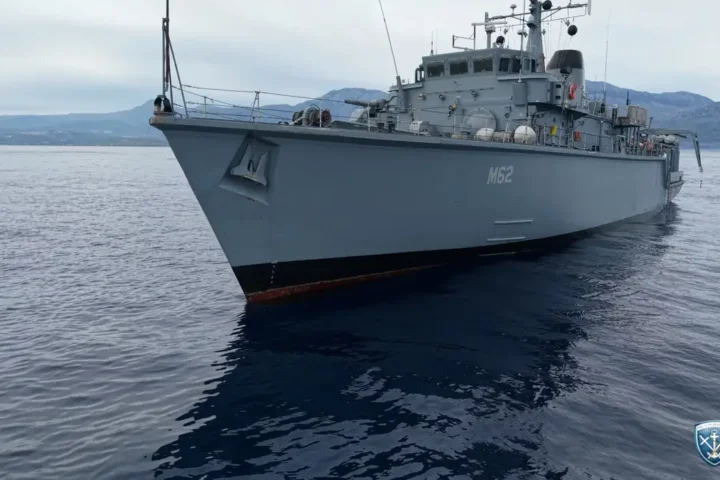
At sea the two countries are almost tied in total ships, 186 against 192, with Turkey ahead in frigates, corvettes, submarines and mine warfare vessels. The categorization, however, is crude. The Hellenic Navy’s missile boats, which carry anti-ship missiles, count in the same “patrol” group as a coastal surveillance craft, and frigates count regardless of age, armament and their combat systems and sensors. The differences in quality, which decide who sees first and who fires first, simply do not exist in the calculation. The table also ages fast: the frigate Kanaris of the lead photo, one of the former Dutch Kortenaer class, bid farewell to the Fleet on 5 November 2026, a few days after the second FDI frigate, Nearchos, raised the Greek flag on 30 October. In the index such a renewal appears, at best, as zero change in the number of frigates.
Economic data that widen the gap between Greece and Turkey
The index’s most serious problem for the two countries lies in the economics, which Global Firepower considers critical because, as it writes, a prolonged war demands a huge financial commitment. For Greece the index gives gross product at purchasing power parity (PPP, a measure that corrects for price differences between countries) of $192.2 billion. The International Monetary Fund’s database puts the same figure for 2025 at about $466 billion, more than double. For Turkey the index writes $3.02 trillion, when the IMF estimates about $3.79 trillion. With Global Firepower’s numbers the Turkish economy is 15.7 times larger than the Greek one, with the IMF’s about 8.1 times.
The second deviation concerns the defense budget. The index credits Turkey with $51.4 billion, an amount that ranks it 12th in the world, and Greece with $8.24 billion. SIPRI (the Stockholm International Peace Research Institute), in its April 2026 fact sheet, puts Turkish military spending in 2025 at $30.0 billion and Greek at $8.4 billion. The Greek figure of Global Firepower is close to SIPRI’s, while the Turkish one is about 70% higher. As a result the ratio between the two countries rises from about 3.6 to 1 in SIPRI to 6.2 to 1 in the index.
The third deviation is perhaps the most paradoxical. Global Firepower writes external debt of $605 billion for Greece and just $149.7 billion for Turkey, while World Bank data record total Turkish external debt of about $510 billion in 2024 and $573 billion in 2025. Debt works in the index as a negative factor, and Greece ranks 124th out of 145 countries in this category, while Turkey ranks 105th. Because the weights of the formula are not published, it cannot be calculated how many places these deviations cost, but their direction is clear: all three favor Turkey.
| Quantity | Global Firepower 2026 | Official figure | Source |
|---|---|---|---|
| GDP at PPP, Greece | $192.2 billion | about $466 billion (2025) | IMF |
| GDP at PPP, Turkey | $3,018 billion | about $3,794 billion (2025) | IMF |
| Military spending, Turkey | $51.4 billion | $30.0 billion (2025) | SIPRI |
| Military spending, Greece | $8.24 billion | $8.4 billion (2025) | SIPRI |
| External debt, Turkey | $149.7 billion | about $573 billion (2025) | World Bank |
| Population, Greece | 10,461,091 | 10,405,134 (2024) | World Bank |
Population, added to the table for comparison, shows that the index does not make mistakes everywhere. Its demographic data are close to the official ones, and the errors are concentrated in quantities where definitions differ and sources must be cross-checked. The same holds for defense spending, where NATO’s figures follow a common definition for all allies. In the July 2026 release, Greece’s core defence expenditure is estimated at 3.65% of GDP and Turkey’s at 2.85%. Global Firepower uses neither percentage and does not explain where the Turkish amount of $51.4 billion comes from, which matches neither SIPRI nor the picture given by NATO data in the comparison of Greek and Turkish defense spending.
From 13th place to outside the top 25: the ranking changes without the armies changing
The history of the ranking itself is the strongest argument against using it as a measure of balance. In the first editions, in 2005 and 2006, Greece appeared 13th in the world and Turkey 20th. In 2007 Turkey was 8th, while Greece was not even in the top 25, behind Mexico (14th) and Argentina (24th). Nothing in the armed forces of the two countries changed so radically within a year, so the explanation most likely lies in the way of calculation. In 2010 Greece reappeared 22nd, and since then it has not been in the top-25 lists the site publishes for earlier years.
| Year | Turkey | Greece |
|---|---|---|
| 2005 | 20th | 13th |
| 2006 | 20th | 13th |
| 2007 | 8th | outside top 25 |
| 2010 | 10th | 22nd |
| 2011 | 6th | outside top 25 |
| 2016 | 8th | outside top 25 |
| 2022 | 13th | outside top 25 |
| 2024 | 8th | outside top 25 |
| 2025 | 9th | outside top 25 |
| 2026 | 9th | 30th |
Turkey’s course is equally instructive. From 6th in 2011 it fell to 11th in 2012, was 13th in 2022 and rose again to 8th in 2024, without these changes corresponding to similar changes in its army. Global Firepower itself admits it on its page of earlier rankings: it writes that the formula changes from year to year, with new factors added and old ones removed, that at the start it examined only 25 countries while it now examines 145, and that direct comparisons between years “become difficult”. On the page of the current ranking it adds that changes in positions do not necessarily show a decline in power, because they may be due to changes in the formula.
That admission removes from the ranking its most common use. When a country “rises” or “falls” two places, the news may be about the method of calculation and not about its armed forces. And when the distance between two countries grows or shrinks, the change may come from a new source for external debt or from a new factor, such as the internet access added this year. For the Greek public debate this means that the annual changes in the ranking should not be read as an indication of the course of the balance in the Aegean.
What the index does not see in the Aegean: geography, quality, alliances and Turkish drones
The first missing factor is the geography of a specific front. Global Firepower measures the length of coastlines and borders, not where the threats are. By its data Turkey has 2,816 kilometers of land borders and, as SIPRI notes, its military spending is rising in part because of continuing operations in Iraq, Somalia and Syria. Only a part of that total is directly available against Greece, the main formation being the 4th Army (Aegean Army), headquartered in Izmir. Greece, by contrast, has one main direction of threat and can concentrate most of its force there.
Greece’s own coastline of 13,676 kilometers, which counts as an advantage in the index, has two sides. The islands give depth and positions for radars, missiles and airfields in front of the mainland, and limit the routes by which a fleet can move. At the same time they demand garrisons, supply and air defense at dozens of points, something no column of the table measures. That burden partly explains why Greece devotes a larger share of its GDP to defense than Turkey, as NATO’s data also show, and why the proposal of the Achilles Shield rests on layered air defense and not on numbers.
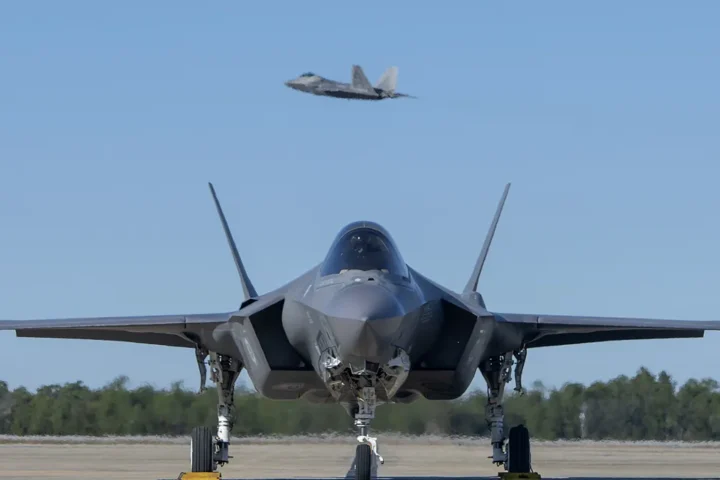
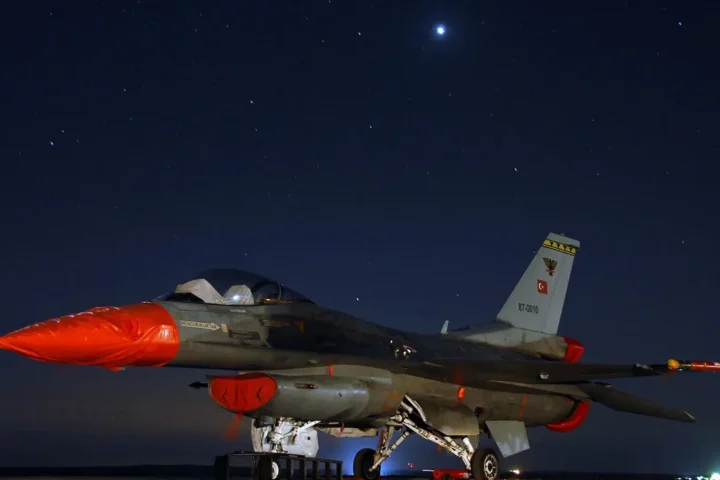
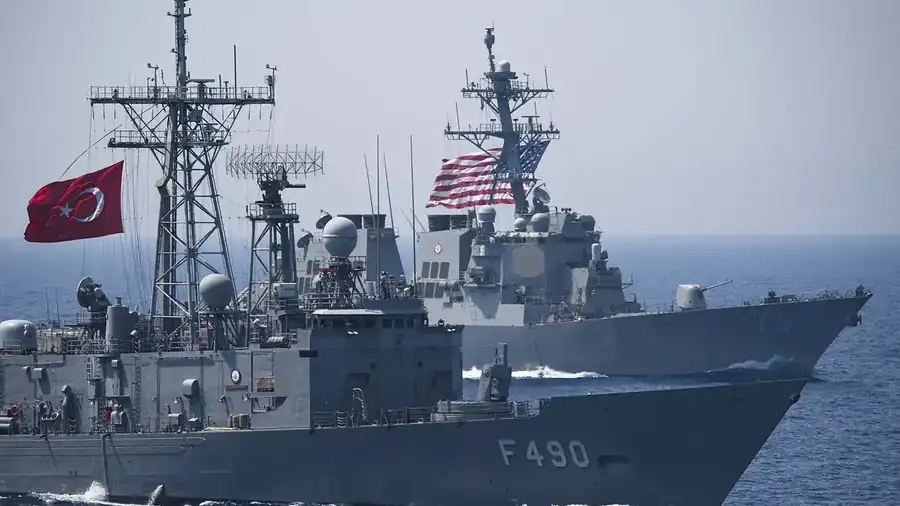
The second factor is quality. In the index a frigate is a frigate, whether it is a former US Oliver Hazard Perry-class ship of the 1980s, like the TCG Gaziantep in the photo, or the new Greek frigate Kimon (FDI HN), delivered in December 2025 and in its full configuration carrying a Sea Fire fixed-array radar and 32 Aster 30 air defense missiles. The same goes for fighters: the Hellenic Air Force’s 24 Rafale F3R with the long-range Meteor air-to-air missile count the same as any other fighter. Turkey, excluded from the F-35 program in 2019, signed with the United Kingdom on 27 October 2025 a contract for 20 new Eurofighter Typhoons, with the first delivery expected, according to the British government, in 2030. Greece has signed since July 2024 the Letter of Offer and Acceptance (LOA) for 20 F-35As, with the first arrival in Greece scheduled by the government for November 2029.
Long-range weapons are missing entirely. The index counts multiple rocket launchers as a simple number of vehicles, so it does not distinguish an old launcher of unguided rockets from the system the Army is now buying. With the government-to-government agreement of 6 April 2026, Greece acquires 36 PULS systems for €690 million, with munitions reaching up to 300 kilometers. Neither Turkish ballistic missiles nor Greek air defense missiles appear anywhere in the table, even though they would determine the first hours of any conflict in the Aegean.
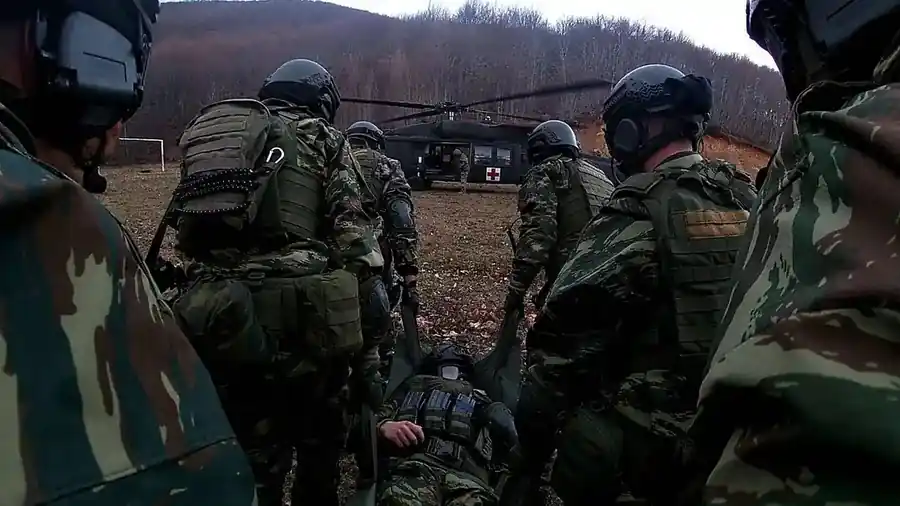
The third factor is training. Global Firepower counts how many people wear a uniform, not how many hours pilots fly, how many days ships sail or how often units train with live fire and with allies. These data are largely classified, and no public index can capture them accurately. Multinational exercises, like the one in the photo with American helicopters, and large joint exercises, like “Parmenion”, give an indication of the level of readiness, but none converts into a number in a table.
The fourth factor is alliances. The index notes that Greece and Turkey are both NATO members and that Greece is a member of the European Union, without explaining whether and how this affects the calculation. It does not capture the mutual assistance clause of Article 42.7 of the Treaty on European Union, the Greece–France strategic agreement of September 2021 with its mutual assistance clause, or the revised defense cooperation agreement with the US of 2021. Nor does it capture the cost Turkey paid for buying the S-400: exclusion from the F-35 and the US CAATSA sanctions of December 2020 on the Defense Industries Presidency (SSB). Alliances are political commitments and not automatic mechanisms, but they change each side’s calculations before a crisis.
An honest reading of Global Firepower must recognize that its gaps do not favor only Turkey. The most significant gap of this kind is unmanned aircraft, in which Turkey has built a real advantage. The Bayraktar TB2, the Akıncı and the TB3 that has operated from the TCG Anadolu do not appear in the index’s aircraft fleet, although Turkey also uses them for surveillance in the Aegean and although they are the best-known product of its defense industry. For the Greek side this issue is more urgent than any position in a table, which is why the development of domestic solutions such as the EAB “Kentavros” matters.
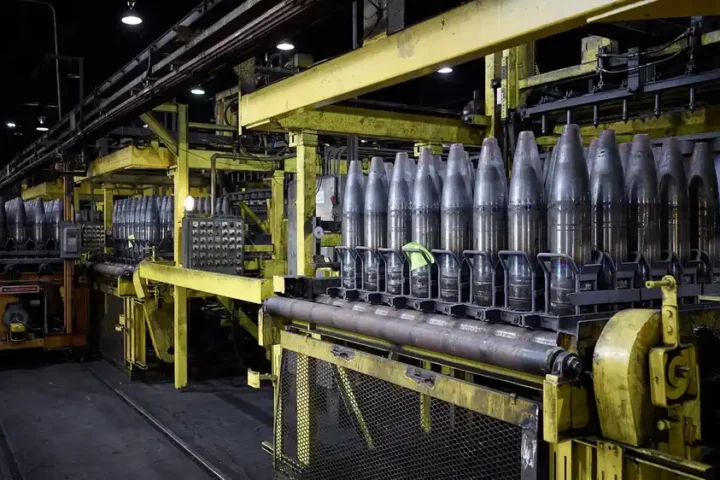
A second gap that works in Turkey’s favor is the defense industry. SIPRI notes that funds of Turkey’s special defense industry support fund rose 25% in 2025 and accounted for 22% of Turkish military spending. In its arms transfers data for 2021–2025 Turkey is the world’s 11th largest arms exporter, while France and the US together account for 85% of Greek arms imports. A country that itself produces ammunition, missiles and drones can replace losses in a war much faster, and Global Firepower does not measure that capacity at all.
The third is speed. According to the explanatory memorandum of the budget bill the Turkish government submitted in October, the appropriations of the Ministry of National Defense rise 86.2% in 2027, from 822.9 billion to 1.53 trillion Turkish lira. Part of the increase is due to high inflation, but Vice President Cevdet Yılmaz said the funds for purchases of weapons and ammunition rise far more. The new Typhoons, Turkish air defense systems and new ships built in Turkish shipyards will change the composition of Turkish forces by the early part of the next decade. If Greece reads the index to reassure itself, because its figures for Turkey are exaggerated in economics, it will make the same mistake in the opposite direction: it will lose sight of the real Turkish capabilities the table does not record.
Conclusion: the balance in the Aegean does not come from a global table
Global Firepower is useful as a first, rough picture of the size of a state’s armed forces, and nothing more. The site itself states that it presents its content for entertainment and historical value, its formula changes every year without its weights being published, and for Greece and Turkey it contains economic data that diverge significantly from those of the IMF, SIPRI and the World Bank. The 21-place gap, therefore, is not a measure of the balance in the Aegean and should be used neither for panic nor for complacency.
The Greek public debate needs other tools: NATO’s figures on spending, the delivery schedules of each program, with a clear distinction between approval, contract and delivery, and an honest assessment of readiness. By these measures the picture is more complex than the table shows. Greece for now has a qualitative lead in the air, with Rafales armed with Meteor, while the new Turkish Typhoons will begin to be delivered in 2030, and it is strengthening its air defense and long-range fires, paying for that a larger share of its GDP. Turkey has the volume, the industry and the drones, and is increasing its spending at a pace Athens cannot follow in absolute amounts.
Athens does not need to climb places on a private table. It needs to maintain its qualitative lead after 2030, when the new Turkish fighters will have arrived and Turkish drones will have matured, and to turn the geography of the Aegean into an advantage with sensors, missiles and anti-drone defense on the islands. That is the measure by which the balance will be judged, and no global index can calculate it on its behalf.
Frequently asked questions about Global Firepower 2026
Where is Greece in Global Firepower 2026? Greece is 30th among 145 countries, with a PwrIndx of 0.5484. In the first editions of the ranking, in 2005 and 2006, it appeared 13th, and in 2010 it was 22nd. These changes are largely due to changes in the calculation formula.
Where is Turkey in Global Firepower 2026? Turkey is 9th with a PwrIndx of 0.1975, between the United Kingdom (8th) and Italy (10th). It was also 9th in 2025 and 8th in 2024, while in the first editions of 2005 and 2006 it was 20th.
How is the Global Firepower PwrIndx calculated? From more than 60 factors for manpower, equipment, natural resources, finances, logistics and geography, with bonuses and penalties. The lower the number, the stronger the country is considered. The weights of each factor are not published and many values are estimates.
Is Global Firepower reliable? It is a private website that, as it states itself, has no endorsement from any government body and presents its content for entertainment and historical value and as a general reference. For Greece and Turkey it contains economic data that diverge from those of the IMF, SIPRI and the World Bank.
Does Global Firepower count drones? No. The site states that unmanned aircraft are not included in the aircraft fleet. That is why the index does not record a field where Turkey has a real advantage, such as the Bayraktar TB2, Akıncı and TB3.
How much do Greece and Turkey spend on defense? According to SIPRI, Turkey spent $30.0 billion in 2025 and Greece $8.4 billion. As a share of GDP Greece spends more: NATO estimates for 2026 core defence expenditure of 3.65% of GDP for Greece and 2.85% for Turkey.