Air Force
NORAD flies F-16s from remote Eareckson Air Station in Alaska, joined by F-35s and Canadian CF-18s in a binational homeland defense mission
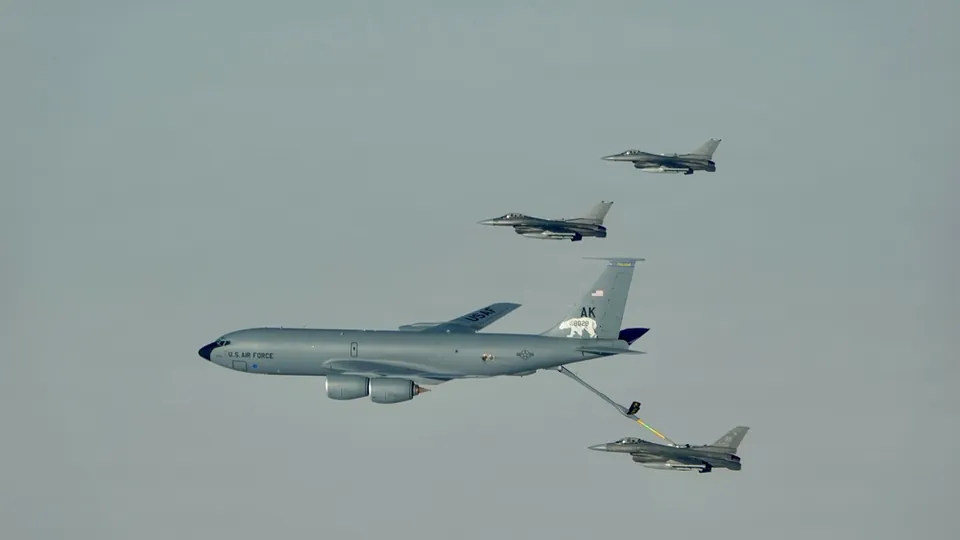
NORAD kept U.S. Air Force F-16s on alert at Eareckson Air Station from 18 to 26 October and used them on 25 October in a binational mission with F-35s, an E-3 and Canadian CF-18s.

The North American Aerospace Defense Command (NORAD) deployed U.S. Air Force F-16 Fighting Falcons to Eareckson Air Station in Alaska from 18 to 26 October, kept them on air defense alert there, and on 25 October used them in a homeland defense mission that also drew in American and Canadian aircraft flying from bases up to 2,600 miles away. The Alaskan NORAD Region described the exercise in a release published on 29 October.
From Noble Defender to Noble Eagle
The F-16s launched under Operation NOBLE DEFENDER, which the command describes as a recurring NORAD air defense operation designed to show it can defend the United States and Canada against threats from any approach. As the mission developed it moved into Operation NOBLE EAGLE, in support of northern sovereignty operations, and became what NORAD called a coordinated, binational response.
According to the release, the force on 25 October included two F-16s, F-35 Lightning II fighters from Eielson Air Force Base, an E-3 Sentry airborne warning aircraft from Joint Base Elmendorf-Richardson, and Royal Canadian Air Force CF-18 Hornets from Cold Lake, Alberta. Several KC-135 Stratotanker tankers and a CC-150 Polaris provided aerial refuelling, while an HC-130 Combat King II covered search and rescue and personnel recovery.
NORAD gave the distances involved: Eareckson is roughly 1,600 miles from Eielson and 2,600 miles from Cold Lake. The command said this showed the scale across which it synchronised the force.
How the coverage was divided
The release says NORAD presented a layered fighter package across the Alaska theatre. F-16s from Eareckson covered the southern part of the theatre, F-35s and further F-16s from Eielson operated in the northwest, and the Canadian CF-18s covered the northern approaches.
Lt. Gen. Robert D. Davis, commander of the Alaskan NORAD Region, said: “Operating from Eareckson Air Station proved we can deploy to an austere location, maintain alert, launch on short notice, and seamlessly integrate U.S. and Canadian forces to defend the northern approaches.”
The deployment also included a successful F-16 certification of the arresting system at Eareckson, which NORAD said validates the station as a viable site for future fighter operations from an austere airfield.
What the release does not say
The Alaskan NORAD Region did not name a specific threat or say whether the 25 October mission was a scripted training event or a response to a real track. It framed the deployment as a demonstration of the ability to position and sustain forces rapidly, integrate defensive capabilities and deter potential threats to North America.
NORAD’s fighters have been in the news at home as well: earlier this month a NORAD F-16 intercepted an aircraft that had entered restricted airspace, as reported in NORAD F-16 intercepts aircraft that entered restricted airspace over Mar-a-Lago in Palm Beach.