Greece
Turkish Foreign Ministry: Fidan gave no interview to a Greek newspaper, and there is “no change” in Ankara’s line on the Aegean
Turkey’s Foreign Ministry says Hakan Fidan gave no interview to a Greek newspaper and that his remarks in Brussels were taken out of context, while insisting Ankara’s positions on the Aegean and the Eastern Mediterranean have not changed.

Turkey’s Foreign Ministry came out to defend Hakan Fidan against statements by a party leader. In a statement published on its website (No. 208), it claims that, contrary to what “the chairman of a political party” said, the Turkish foreign minister gave no interview to any Greek newspaper. The statement does not name the party leader. These are Ankara’s claims, reported here as such.
The ministry says that what was attributed to Fidan were his answers to questions at a think-tank event in Brussels, which, it writes, were “distorted” and taken “entirely out of context”. As a result, it adds, Turkey’s policy in the Aegean and the Eastern Mediterranean became the subject of a domestic political dispute. The positions Ankara defends “in all forums” have not changed, it concludes, and the country will go on protecting “without any concession” its legitimate rights and interests in the two seas.
What Fidan actually said in Brussels
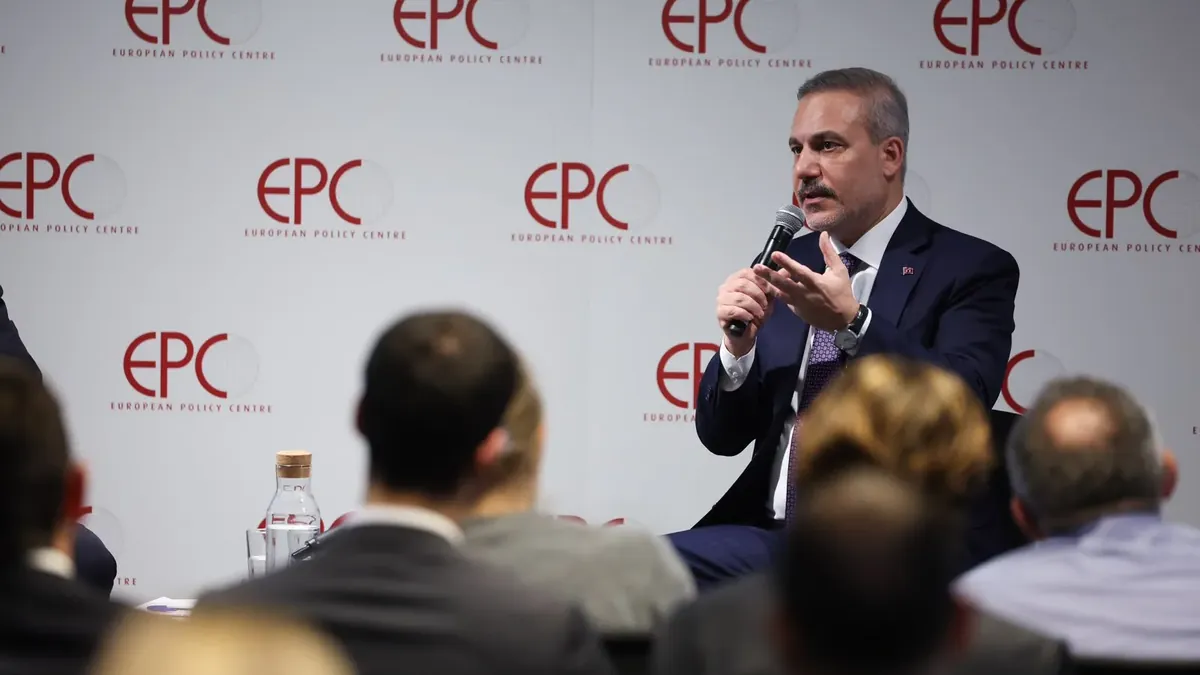
The event the Turkish ministry refers to was Fidan’s discussion at the European Policy Centre on Tuesday, October 20, during his visit to Brussels for the fourth meeting of the Turkish and Belgian foreign, justice and interior ministers. On the same trip he saw NATO Secretary General Mark Rutte and EU High Representative Kaja Kallas, who raised with him the issue of the illegal Turkish-Libyan memorandum.
His answers on the sidelines of the event were published and caused a stir. Fidan had likened anti-Turkish rhetoric in Greek politics to an “aspirin”, defended the casus belli of the Turkish Grand National Assembly of 1995, which Greece regards as an unlawful threat of war, and said that for the GSI Ankara asks for written notification of surveys. He had also spoken of Turkey’s intention to sell electricity, water and natural gas to Cyprus “from a distance of just 70 miles”.
In Turkey the same statements were presented differently. The pro-government Yeni Şafak presented them on October 22 as an interview Fidan gave to a Greek newspaper, under a headline about an Erdoğan “70-mile offer” to Kyriakos Mitsotakis. A few days later the Foreign Ministry had to clarify publicly that it was not an interview.
The clarification comes in a new period of tension over maritime zones, with Turkey promoting the illegal Turkish-Libyan memorandum and proposing to Egypt a separate EEZ delimitation agreement, while Athens insists on the application of the Law of the Sea.