Drones
Quanta-D: Navier’s unmanned hydrofoil vessel claims 2,100 nautical miles of range
The US startup says its 30-foot hybrid-electric USV flies above the waves on active hydrofoils; the figures come from the company and are unverified.

A small 9-meter unmanned surface vessel (USV) pushes water aside with every mile it travels, and that limits its range however much its engine and sensors improve. US company Navier says it has overcome that limit by lifting the boat above the water. On Monday, November 23, founder and CEO Sampriti Bhattacharyya published the first video of the unmanned Quanta-D, a 30-foot (about 9.1 m) hydrofoil vessel with hybrid-electric propulsion. According to the company, it covers over 2,100 nautical miles (about 3,890 km) at 20 knots and over 3,000 nautical miles (about 5,560 km) in a mixed mission profile.
What the first video shows
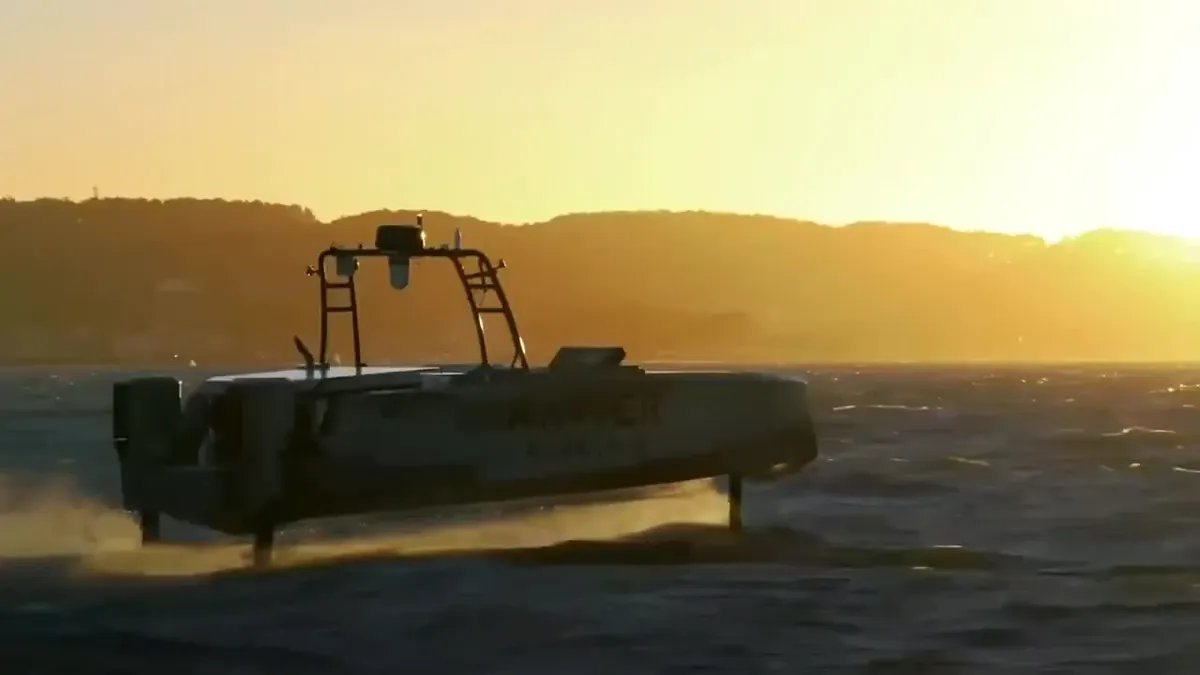
The 41-second video was shot in San Francisco Bay. It shows the Quanta-D, painted gray, moving on its hydrofoils with the hull out of the water and a sensor mast at the center of the deck. Navier cites over 2,100 nautical miles at 20 knots on foils, over 3,000 in mixed mode combining fast transit and slow-speed patrol, and 105 hours of continuous foilborne running; 105 hours at 20 knots is indeed 2,100 nautical miles. The company claims the vessel can stay on station four to five times longer than a conventional boat of the same size.
The second claim concerns stability: 94% fewer hull slams and 73% less vertical acceleration in sea state 4, with waves of roughly 1.25 to 2.5 meters, versus a conventional 28-foot patrol boat. On an unmanned vessel, stability means a steady base for sensors, antennas and weapons. Missions the company lists include surveillance and reconnaissance (ISR), counter-drone work, small-boat interception, and fast resupply under hostile threat, with modular payloads.
Why hydrofoils change a small USV’s range
A hydrofoil works like an aircraft wing underwater. As speed rises, the foils generate lift and raise the hull above the surface, so the vessel no longer displaces a volume of water and drag falls sharply. Navier cites a reduction of about 90% for its N30 platform. The hard part is control: the N30 relies on three actively controlled hydrofoils whose flaps adjust up to 50 times a second to the waves, and on flight computers the company likens to a fighter’s. The hull is carbon fiber, and the electric motors, foils and flight computers are duplicated so one failure does not immobilize the boat.
The all-electric N30, from which the family derives, has a range of 70 nautical miles and a top speed of 30 knots, per the company, and is promoted mainly as a leisure and passenger craft. For the hybrid Quanta-R, unveiled in late 2025, Navier cited over 700 nautical miles at 20 knots. For the unmanned Quanta-D it now cites 2,100. The company does not say how much of the gain comes from the hybrid system and how much from removing the crew, though on any unmanned vessel the space and weight of crew and helm are freed for fuel and payload. As a benchmark it cites about 400 nautical miles for a typical gasoline-powered 30-foot boat.
US defense tests and the Atlantic crossing
Navier is a San Francisco Bay Area startup. Ms. Bhattacharyya developed at MIT, for her doctorate, a swarm of small underwater drones later adapted for mine countermeasures. In late 2025 the company unveiled a common vessel-and-software architecture, the Generalized Marine Vessel Platform, in three sizes: the 30-foot Quanta, the 80-foot (about 24 m) Valkyrie and the 120-foot (about 36.6 m) Morpheus, for which it cites over 4,000 nautical miles of foilborne range in sea state 5.
On the military side, the company announced in August that the Quanta-D completed Technical Experimentation 26-3 with US Department of War customers, running mission profiles before Special Operations Forces evaluators. According to Navier, the craft held roll and pitch under 1 degree in sea state 4 and hull height above water to within 2 centimeters. Its next announced step is an unmanned Atlantic crossing without refueling, about 2,000 nautical miles. If completed, it would be the first practical check of the video’s numbers, though on a crossing organized by the company itself.
What it means for the Aegean
The Quanta-D is not a Hellenic Navy program. But it shows the direction of a category in which the Navy is already moving: the vessel it evaluated and for which Greece submitted a request to the US is Saronic’s Corsair, a 24-foot (about 7.3 m) autonomous boat with over 1,000 nautical miles of range and over 35 knots, per its maker. On each company’s own published figures, not from joint trials, the Corsair is faster, while for the Quanta-D Navier cites about double the range at 20 knots. The two serve different priorities, speed and endurance.
In the Aegean, what matters most is time on station. A vessel with 105 hours of endurance at 20 knots, as Navier says, could, after subtracting transit from Souda or Salamis, patrol for days around a group of islets and provide a continuous picture without tying up a crewed patrol boat. But the summer meltemi often reaches 6 to 7 Beaufort and raises waves larger than Navier’s tests, which stop at sea state 4 for the Quanta-D. Hydrofoils also have drawbacks: they increase draft when extended, need maintenance and are vulnerable to striking floating objects. Naval-drone strikes in the Black Sea and, recently, at Benghazi in Libya show small USVs are now used offensively far from their bases, which is why passive detection systems for them matter more and more.