

Analysis
Analysis: HAMMER munitions on Greek Rafale, the “hammers” that could change the Hellenic Air Force’s French-built strike capability against Turkey
Analysis: Greece’s 24 Rafale lack the AASM HAMMER guided bomb that French, Indian and Egyptian Rafale fleets take for granted. What it would give the Hellenic Air Force, why it suits the geography of the Aegean, and where its limits lie.

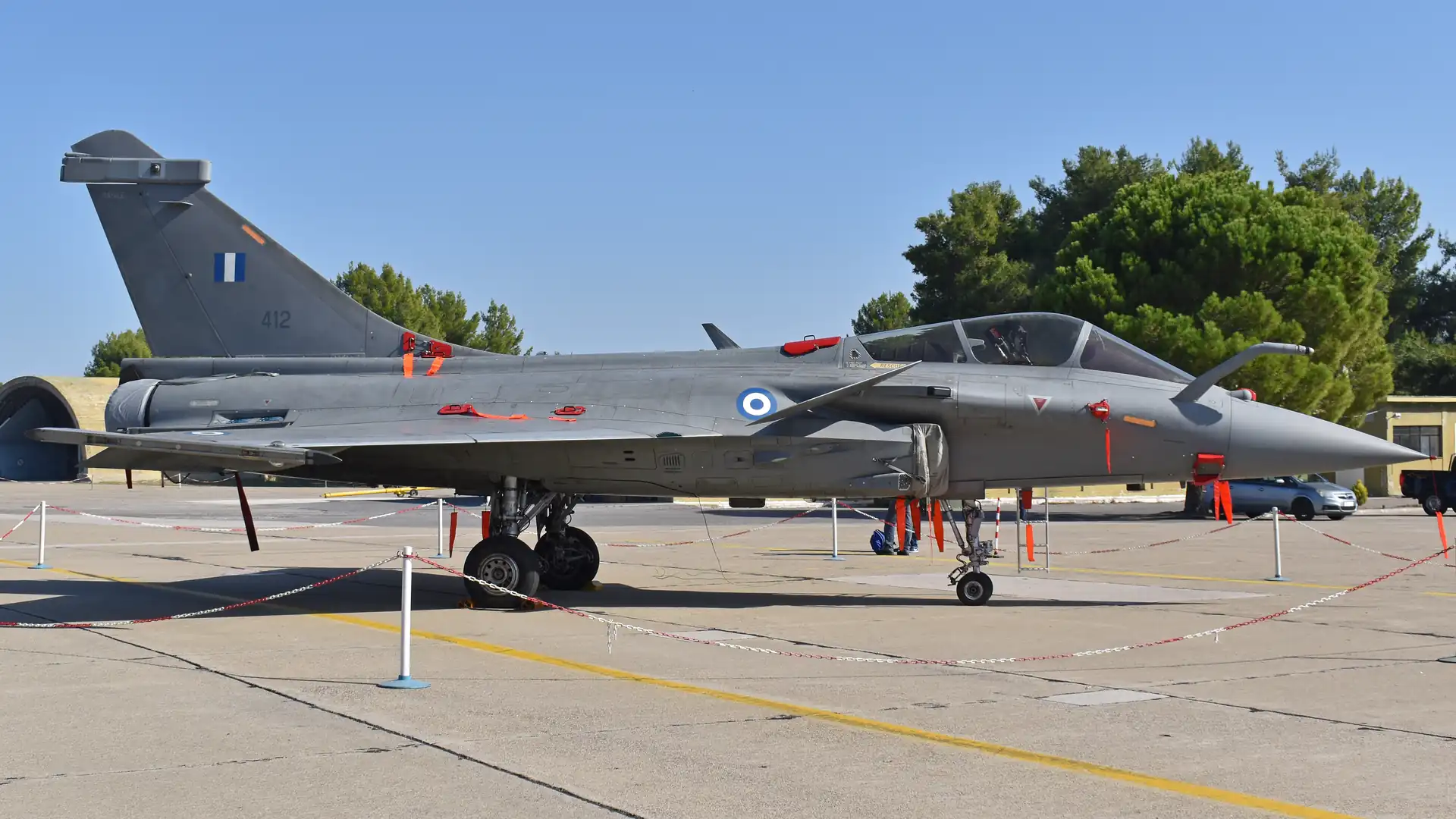
The Hellenic Air Force’s 24 Rafale are today the most capable fighter in the Aegean for air combat, armed with Meteor and MICA missiles. For striking targets on the ground and at sea, however, they lack a weapon that the French, Indian and Egyptian Rafale fleets take for granted: Safran’s AASM HAMMER guided bomb. The Hellenic Air Force General Staff (GEA) has examined it since at least 2020, and Safran formally presented it to the Staff in 2022. To date, however, no procurement contract has been announced. The analysis that follows explains what HAMMER would give the Greek Rafale and why it suits the geography of the Aegean in particular.
In brief
- What it is: a guidance and propulsion kit that turns ordinary 125 to 1,000 kg bombs into precision weapons, with a rocket motor in the tail.
- What it offers: strikes from 15 to over 70 kilometres, depending on release altitude and speed, accurate to a few metres and usable in any weather.
- Why it matters in the Aegean: targets on the Turkish coast lie 10 to 30 kilometres from the Greek islands, so a Rafale could fire without entering Turkish airspace.
- What it is not: it does not replace SCALP for deep strikes inland and cannot on its own overcome Turkish long-range air defences.
- Where things stand: under study and presentations, with no announced contract.
What the AASM HAMMER is
The AASM (Armement Air-Sol Modulaire), known in export markets as HAMMER (Highly Agile Modular Munition Extended Range), is not a single bomb. It is a set of two sections fitted to conventional general-purpose bombs:
- A front guidance kit, in three versions: inertial navigation with GPS (SBU-38), GPS with an imaging infrared seeker (SBU-64) and GPS with a semi-active laser (SBU-54).
- A rear kit with wings and a rocket motor, which gives the bomb far greater range than a simple glide bomb.

The basic version carries a 250 kg bomb and weighs about 340 kg. Safran also offers 125, 500 and 1,000 kg versions. The 1,000 kg (2,000 lb) version is integrated in the Rafale F4 standard. Accuracy reaches about 10 metres with GPS-only guidance and about 1 metre with the infrared or laser seeker.
The weapon has combat experience. French Rafale used it in Afghanistan in 2008, in Libya in 2011 and in Syria and Iraq. Ukraine has used it since 2024 on Soviet-designed MiG-29 and Su-25 aircraft, and India used it with Rafale in May 2025. Egypt, Qatar, Morocco, Croatia and Indonesia are also users.
Three characteristics that count in combat
Standoff range. Fired from low altitude, HAMMER reaches about 15 kilometres. From high altitude and at high speed it exceeds 60 to 70 kilometres. The rocket motor makes it faster and more agile than JDAM-type glide bombs, which in their basic form are released at much shorter distances.
Off-axis release and many targets in one pass. The weapon can be fired at a target up to 90 degrees to the side of the aircraft. A Rafale can release up to six HAMMER against six different targets in the same pass. That means fewer sorties and less time exposed to enemy air defences.
Resistance to jamming and weather. The guidance combines an inertial system with GPS, so it does not depend on the satellite signal alone. The infrared seeker recognises the target in the final phase without needing illumination from the aircraft, and the pilot can turn away immediately after release.
Why it fits the geography of the Aegean
In the Aegean, distances are short. Chios is about 8 kilometres from Çeşme (Krini), Lesbos is about 10 to 15 kilometres from the opposite coast, and Rhodes is less than 20 kilometres from Marmaris. With a range of 15 to 70 kilometres, a Rafale flying over Greek territory or international waters could hit targets along the whole narrow strip of the Turkish coast without crossing Turkish airspace.
In a crisis scenario, the targets of interest to the Air Force in this strip are known from analyses of recent years:
- Concentrations of landing craft and vessels in ports and coves on the Asia Minor coast, opposite the islands of the Eastern Aegean.
- Coastal radars and surveillance centres, which feed the picture to Turkish ships and to ground-based anti-ship missile launchers.
- Mobile launchers and drone control stations, where the infrared or laser version can also hit a moving target.
- Ships close to the coast, with the versions that have terminal guidance.
HAMMER would thus fill a gap among the weapons the Air Force already has. The SCALP cruise missile reaches hundreds of kilometres deep, but it is expensive and stocks are limited, so it is reserved for a few strategically important targets. The laser and GPS bombs of the F-16s are released from shorter distances, with the exception of the new SPICE kits acquired from Israel. HAMMER provides standoff strike at a fraction of the cost of a cruise missile, and therefore in quantities that allow sustained operations rather than a single blow.
Why not SPICE on the Rafale?
India is the most telling example of the dilemma over using SPICE bombs on Rafale fighters. The country has a long history with these weapons, but its final decision on arming its Rafale was shaped by geopolitical developments and by time pressure.
The Indian Air Force (IAF) holds a huge stock of SPICE bombs (mainly the SPICE 2000 version). They became known worldwide when India used them with complete success in 2019 in the Balakot air strikes against terrorist camps in Pakistan. Those bombs, however, were released from older French Mirage 2000 fighters, for which India had already paid for and completed their integration.
When India bought and received its new Rafale, a serious border crisis with China broke out in the Ladakh region (2020). India wanted to make the Rafale combat-ready with SPICE immediately. But the integration process (software, wiring, electronics) and the necessary certification tests by the French manufacturer (Dassault) would have required a great deal of time and high cost. So India cancelled the plan for SPICE on the Rafale and proceeded to an urgent purchase of the French AASM HAMMER, which were already “ready” and fully integrated into the aircraft at the factory.
As in India’s case, France’s Dassault does not deliver Rafale with the software for the Israeli SPICE weapons integrated. For that, Greece would have to fund a very expensive and time-consuming programme of tests and modification of the aircraft’s avionics.
What it would mean for the 24 Greek Rafale
Integration with the aircraft is not a problem. The AASM was designed together with the Rafale and has been in its arsenal since the first operational versions, so the Air Force would not pay for software development or certification tests.
With HAMMER, each Rafale could carry six strike weapons in one sortie together with air-to-air missiles for self-protection. A formation of four aircraft could thus hit up to 24 different targets in a single pass. For an Air Force that would have to neutralise a landing quickly before it set foot on a Greek island, the difference is substantial.
There is also a political and operational benefit. Today the Rafale are devoted mainly to air defence, while the F-16s and, in the future, the F-35s carry the burden of strike missions. HAMMER would make the Rafale genuine strike fighters, as they are in every other air force that operates them. This becomes even more important if the acquisition of additional Rafale to the F4-F5 standard goes ahead, for which there have been reports of Greek interest since spring 2026.
The limits: what HAMMER cannot do
A sober analysis must also say what does not change.
Turkish air defence. HAMMER stays outside the range of short-range systems such as the HİSAR-A and the Korkut guns. It does not stay outside the range of long-range systems such as the SİPER, which Turkey is developing as part of its layered “Steel Dome”. Against such systems, HAMMER needs support from electronic warfare, suppression of air defences and SCALP strikes. The Rafale’s SPECTRA self-protection suite helps, but does not solve the problem on its own.
Range. Seventy kilometres is enough for the coast, not for targets in the interior of Asia Minor. That could change with the HAMMER XLR version, which Safran unveiled in Paris in 2025, with a small turbojet engine and a range of 150 to 200 kilometres. The XLR is still in development.
Laser target designation. The laser version needs a targeting pod to illuminate the target. Thales’s new TALIOS pod has been presented to the GEA, but no procurement has been announced. The GPS and infrared versions do not need it.
Turkey is not standing still. The Turkish defence industry already has its own guidance kits for F-16s, such as TÜBİTAK SAGE’s HGK and KGK and Roketsan’s Teber, with the KGK exceeding 100 kilometres.
Where the procurement stands
The discussion is not new. In 2020, when the first contract for 18 Rafale was signed, Greek and foreign reports said Greece would also acquire HAMMER. This was never confirmed by an official announcement. In May 2022, GEA officers met Safran, which presented the weapon’s capabilities. Since then the subject has returned in analyses and meetings, without a decision by KYSEA (the Government Council for Foreign Affairs and Defence) or approval from the Parliament’s armaments committee.
The purchase is not difficult for production either. Safran has substantially increased its production rate because of demand from Ukraine and France, and Norway has already funded HAMMER on behalf of Kyiv. The issue for Athens is priority within the Twelve-Year Programme, which already includes the F-35s, the modernisation of the F-16s and the “Achilles Shield”. As NemesisHD has also argued, modern munitions and pods are what turn a capable aircraft into a real strike force.
Conclusion
HAMMER is not the most spectacular weapon the Air Force could acquire. It is, however, among the most logical. It is already integrated in the Rafale, it has been tested in war, it costs far less than a cruise missile and it fits the distances of the Aegean exactly. With it, the 24 Rafale would gain a real ability to strike, accurately and from a safe distance, the assets that would threaten the islands. Until a contract exists, however, that capability remains on paper.
For more, see NemesisHD’s analyses of the Dassault Rafale’s capabilities and of the Rafale F4/F5 as the future of the Hellenic Air Force’s fighters.


.jpg)