“Wasp” and “America” ​​class: The mini aircraft carriers of the US Navy

A “tool” of the US Navy that many forget are the Wasp and America class “mini aircraft carriers”. Perhaps when we think of the US Navy our mind goes to the large surface combatants like the Arleigh Burke, the Ticonderoga or the aircraft carriers like the Nimitz and now the Gerald R. Ford class, but we should not underestimate amphibious operations ships with the ability to use fighter jets.

Aircraft carriers of amphibious operations

The “dual use” of amphibious assault ships is not a doctrine that began with the use of Wasp or America but has existed in the Navy for many decades. The first ships in the role designed to initially carry helicopters were the Iwo Jima-class LPH (Landing Platform Helicopter).

"Wasp" and "America" ​​class: The "mini aircraft carriers" of the US Navy - GEOPOLITIKI
Photo By TECH. SGT. REYNOLDS – DoD Media, Public Domain, https://commons.wikimedia.org/w/index.php?curid=1042815

They served in the Navy from 1961 to 2002 and were capable of carrying up to 25 helicopters while one ship of the class, the LPH-12 Inchon, was the testbed for intergrading AV-8 Harriers on it.

About a decade later, the Tarawa-class LHAs (Landing Helicopter Assault) began to enter service. They were better equipped to carry aircraft allowing a number of AV-8 Harriers to be carried and could also carry more helicopters than Iwo Jima Class ships. The ships of the class were fully retired by 2015.

"Wasp" and "America" ​​class: The "mini aircraft carriers" of the US Navy - GEOPOLITIKI
081101-N-5148B-008 PACIFIC OCEAN (Nov. 1, 2008) The Tarawa-class amphibious assault ship USS Peleliu (LHA 5) steams through the Pacific Ocean with more than 250 guests for a scheduled Tiger Cruise. (U.S. Navy photo by Mass Communication Specialist 3rd Class Sarah E. Bitter/Released)

The Navy now has two classes of amphibious assault ships capable of carrying combat aircraft, the Wasp-class LHD (Landing Helicopter Dock) and the America-class LHA (Landing Helicopter Assault).

LHD Wasp

Based on the LHA Tarawa, they were the first ships ready to support fighter aircraft from the start. The Wasps have a longer deck, with the overall length of the ship reaching 257 meters, but maintaining the same width. Two obvious differences between the two ships are the Wasp’s more “square” deck and its “shorter” bridge.

At the same time, the Wasps have a larger hangar as well as suitable maintenance facilities for fighter aircraft and have the ability to carry a larger amount of fuel for the aircraft that operate from it.

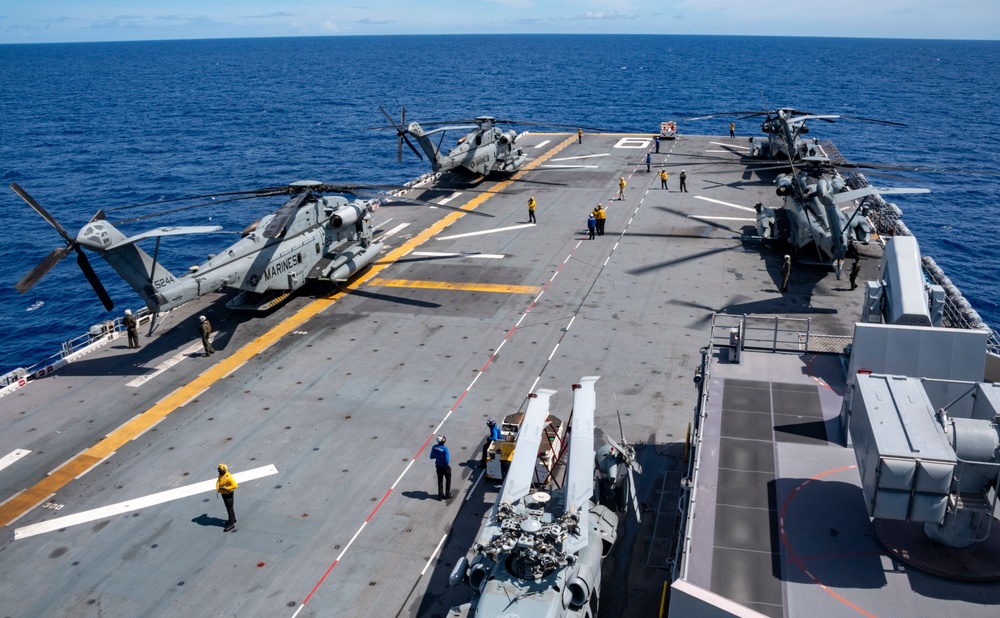
In total they can carry up to 42 helicopters and planes. On them usually is a “mix” of helicopters such as AH-1W/Z Super Cobra/Viper, CH-46 Sea Knight, CH-53 Sea Stallion, SH-60 Sea Hawk, UH-1N/Y Huey, MV-22B Osprey while they can operate up to 20 fighters, either AV-8 Harrier or F-35B.

"Wasp" and "America" ​​class: The "mini aircraft carriers" of the US Navy
Photo By Matthew Fern from Squaw Valley, CA, United States – USS Essex (LHD-2) – Port Bow viewUploaded by oxyman, CC BY-SA 2.0, https://commons.wikimedia.org/w/index.php?curid=10134045

The Wasp did not only have improvements related to their aviation facilities. They made use of LCAC landing aircraft while having a maximum transport capacity of 61 AAV-7s, of course for the needs of the Marines a “load” of 5 M1A1 Abrams tanks, 25 AAV-7s as well as the necessary number of accompanying trucks and other vehicles is more common.

Obviously, due to their high value, Wasps must also have the appropriate means of self-protection. These include, 2 Mk29 launchers (NSSM/ESSM), 2 RAM launchers, 3 Phalanx and 4 Mk28 RWS 25mm. At the same time, they have countermeasures, Flares and Chaff (SARBOC, AN/SLQ-49), torpedo countermeasures AN/SLQ-25 as well as the electronic warfare (ECM) suite AN/SLQ-32.

LHA America

The America class ships are the most modern amphibious assault ships in the Navy. Like the Wasp, they were designed from the start based on specifications to be able to host AV-8s as well as F-35Bs.

They entered service in 2014, replacing LHA Tarawa Class. They have an even greater displacement, of 45,000 tons, surpassing even some “classic” aircraft carriers.
The design was based on a modified Wasp-class ship, the USS Makin Island, with the goal of having even larger infrastructure for hosting and maintaining aircraft. This was done by “removing” the space (well-deck) from which the amphibious AAV-7 and LCAC operate.

This limits the first two ships (Block 0) of the class, LHA-6 America and LHA-7 Tripoli, to air insertion operations only, mainly using the OV-22 Osprey and CH-53 King Stalion. For the next ships (Block 1), LHA-8 Bougainville, LHA-9 Fellujah as well as the next ships to follow, the well-deck will be “installed” again.

"Wasp" and "America" ​​class: The "mini aircraft carriers" of the US Navy - GEOPOLITIKI
Photo By Alan Hinkel – Own work, CC BY-SA 4.0, https://commons.wikimedia.org/w/index.php?curid=37465725

One of the reasons why it was decided to install the well-deck back on the ships was based on the lessons learned from the Marines’ intervention in Lebanon where it was judged that the use of only aerial means left them exposed.

At the same time, for the Block 1s, to compensate for the further reduction of space below the deck for the aircraft, the space available on the ship’s deck was increased by 20%.

For Block 0s a typical airwing might include 12 Ospreys, 6 F-35Bs, 4 CH-53s, 2 MH-60s, 3-4 AH-1s and as many UH-1s. Obviously depending on the mission the ship’s airwing can be modified accordingly, one example being the extensive use of fighters, allowing up to 20 F-35Bs to operate from LHA America.

Finally, their weaponry is similar to that of the Wasp. They have 2 Mk29 (NSSM/ESSM), 2 RAM, 2 Phalanx as well as 3 Mk28 RWS of 25mm. They also have the AN/SLQ-32 electronic warfare suite, as well as Nulka countermeasures.

The value of Wasp and America

The value of ships of both classes cannot be understated for the US Navy. Both are capable of landing a Marine Expeditionary Unit (MEU) in a hostile environment as well as supporting this force with aircraft that will operate from the ship itself.

"Wasp" and "America" ​​class: The "mini aircraft carriers" of the US Navy
Photo By Jonathan Webb – RAF F35B Lightning II, CC BY 2.0, https://commons.wikimedia.org/w/index.php?curid=71189749

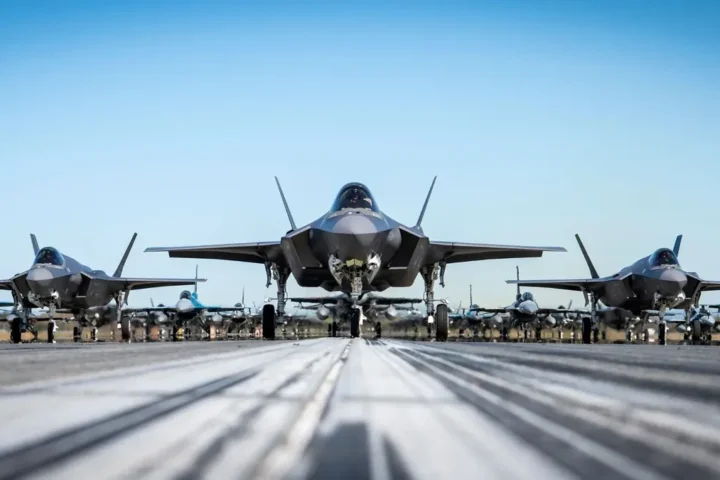
Even during amphibious operations, the number of “only” 8 F-35Bs available should not be underestimated, while in the “Lightning Carrier” configuration, the ability to operate with 20 F-35Bs, roughly a squadron of 5th generation fighters, makes them serious threat under almost any circumstances.

Tell us what you think in the comments!
For more articles by Bill K.
Unauthorized copying of GEOPOLITIKI is prohibited

Latest

Chikli Frames Israel–Greece–Cyprus Partnership as Counterweight to Turkey

Israeli Diaspora Affairs Minister Amichai Chikli has portrayed cooperation with Greece and Cyprus as a united front against regional extremism that he attributes to Turkey. The remarks reflect widening tensions between Israel and Ankara.

d-Matrix Brings Raptor AI Chips Into Nvidia’s NVLink Fusion Ecosystem

d-Matrix plans to integrate its Raptor AI inference processors with Nvidia’s NVLink Fusion and MGX rack architecture. The move illustrates how strategic competition in AI hardware is shifting from individual chips to tightly connected systems.

BRICS Summit Faces Iran War Test as UAE-Tehran Rift Deepens

The BRICS summit in New Delhi will test whether the expanded bloc can maintain consensus amid the Iran war and a widening UAE-Tehran rift. Energy security and disruption around the Strait of Hormuz are raising the stakes.

Canada Commits C$350 Million for Ukraine Air-Defence Interceptors

Canada has announced C$350 million for air-defence interceptors as Ukraine faces an intensifying Russian missile and drone campaign. Ottawa also plans to send Kyiv one-third of millions of drones it aims to produce over two years.

Saab Wins SEK 2.9 Billion Order for Sweden’s Future Fighter System

Sweden’s FMV has awarded Saab a SEK 2.9 billion order to develop future fighter-system concepts through 2028. The work covers crewed and uncrewed designs, demonstrators and technologies intended to preserve Stockholm’s strategic options.

Check Also

NASA and IBM Release Open-Source AI Model to Map the Moon

NASA and IBM have released an open-source AI foundation model trained on multiple lunar datasets. It can help scientists map ice, craters and volcanic features as mission planning accelerates around the Moon’s south pole.

NATO Allies Disrupted Russian Undersea Cable Operation Near Svalbard, Report Says

British, Norwegian and US forces disrupted a reported Russian deep-sea exercise near critical cables serving Svalbard. No cable was damaged, but the episode highlights intensifying competition over Arctic infrastructure.

Yemen: Houthis Move on Zuqar and Perim/Mayun in Lightning Attack to ‘Close’ Bab el-Mandeb

Houthi forces advance toward Mayun after capturing Zuqar and Mocha, escalating fears for control of the Bab el-Mandeb and global shipping.

MEDUSA-15: Greece, Cyprus, Egypt, France and Italy Send Message of Strength South of Crete

Greece, Egypt, Cyprus, France and Italy launch MEDUSA-15 south of Crete, combining air, naval, special-operations and unmanned-system training in the Eastern Mediterranean.

IPERION: Greece’s New C-UAS System Against Drone and USV Swarms

The IPERION / ΥΠΕΡΙΩΝ system, developed by the Hellenic Aerospace Industry...

Analysis