Land Forces
GMLRS rocket changes target in flight and destroys a moving target in a US Army test
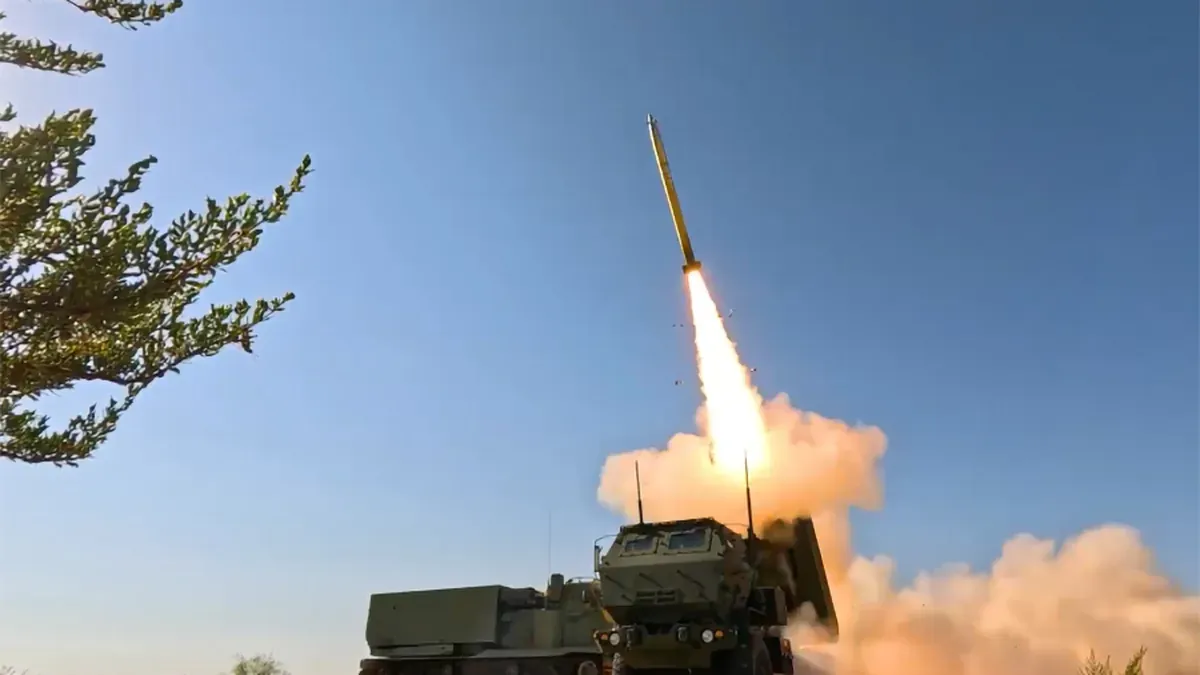
Lockheed Martin said on October 28 that a GMLRS rocket launched from a HIMARS was redirected in flight and destroyed a moving target in a test with the US Army at White Sands, a first for the programme.

A GMLRS rocket that had already been fired at one target received an update of its target during flight and destroyed a moving target. Lockheed Martin announced on Wednesday, October 28 that it achieved this, in cooperation with the US Army, in a recent test at the White Sands range in New Mexico, and calls it a first for the programme.
The rocket was fired from a HIMARS launcher. The retargeting was done through the Strigo data link and the Remote Interceptor Guidance-360 (RIG-360) system, which the company integrated with its own funds. The point of the test is that the GMLRS needed no fundamental changes: the new capability came from interconnecting sensors, launchers and targeting systems that already exist.
The test gives commanders the ability to adjust a planned strike, as a flexible firing option if conditions on the battlefield change. Lockheed Martin places the test within the US Army’s vision for networked precision fires, in which sensors, launchers and targeting are linked in a single kill chain.
The company notes that the data-link package can be applied immediately to other precision-fires rockets and missiles, such as the longer-range ER GMLRS and the Precision Strike Missile (PrSM), so that networked firing can extend across a range of munitions. We reported on the ER GMLRS in Lockheed Martin says ER GMLRS passed operational tests.
“With this level of integration between Lockheed Martin products such as GMLRS, RIG-360 and Strigo, we give our warfighters the confidence and the ability to succeed in the most complex real-world scenarios,” said Randy Kreitz, vice president of Advanced Programs at the company. By accelerating the integration of proven systems, he said, commanders get flexible options against any threat.
The RIG-360 has appeared before, in a demonstration Lockheed Martin presented in October 2023. In a captive-carry test (carrying the equipment inside an aircraft), a prototype RIG-360 sent target updates over a data link carried aboard the aircraft, which reproduced the trajectory of a surface-to-surface rocket. The capability demonstrated then rests on the RIG-360’s ability to provide 360-degree communication in flight for the US Army’s Integrated Air and Missile Defense (IAMD).
The test comes a few weeks after Lockheed Martin unveiled the HIMARS FLEX, which doubles firepower and PAC-3 capacity. For Greece the rocket family matters because the Hellenic Army fires GMLRS from its M270 launchers, which we covered in M270 MLRS: the Hellenic Army’s heavy “hammer”.