Analysis
Analysis: the Stryker 8×8 armoured vehicle, its variants and its combat record
Analysis: the Stryker is not one vehicle but a family. Where it came from, what separates the M1126 from the Double V Hull A1, the Dragoon and the M-SHORAD, how it performed in Iraq, Afghanistan and Ukraine, who uses it, and what it could mean for Greece.

The Stryker is the US Army’s main 8×8 wheeled armoured vehicle. It is made by General Dynamics Land Systems (GDLS) and came out of the Canadian LAV III, which in turn derives from the Swiss MOWAG Piranha. It entered service in 2002 and has fought in Iraq, in Afghanistan and, since 2023, in Ukraine. It is not one vehicle but a family of vehicles: infantry carrier, reconnaissance, mortar carrier, anti-tank, command, medical, with a 30 mm cannon (Dragoon) and anti-aircraft (M-SHORAD). Since October 2026 it also concerns Greece directly, since the US–Greece joint statement refers to the provision of Stryker vehicles to the Hellenic Army.
An existing Geopolitiki analysis, Stryker for Greece: what the US has confirmed, what remains open and what changes for the Army, covers the Greek angle. This article looks at the vehicle itself.
In brief
- What it is: a GDLS 8×8 wheeled armoured vehicle with a crew of two and a squad of nine soldiers in the basic M1126 version.
- How many: according to the available data, more than 4,400 vehicles have been delivered to the US Army.
- The big change: the Double V Hull (from 2011) and the A1 upgrade with a 450 hp engine.
- New armament: the Dragoon with a 30 mm cannon, a weapon station with Javelin, and the M-SHORAD anti-aircraft version.
- War: Iraq from 2003, Afghanistan from 2009, Ukraine from 2023.
- Future: the US Army is taking Strykers out of the National Guard, but keeps them in active units and is still buying new ones.
Where the Stryker came from
In 1999 the then US Army Chief of Staff, General Eric Shinseki, asked for brigades that could move faster than the heavy units with Abrams and Bradley, but with more protection than light infantry. This is how the Interim Brigade Combat Teams (IBCT) were born, later renamed Stryker Brigade Combat Teams (SBCT). To equip them, the Army ran a competition for an “Interim Armored Vehicle”.
In November 2000 the GM GDLS Defense Group, a joint venture of General Motors and General Dynamics Land Systems, won. The contract had an estimated value of about $4 billion for up to 2,131 vehicles, for six brigades. The proposal was based on the Canadian LAV III, itself an evolution of the MOWAG Piranha III. In February 2002 the vehicle was named Stryker, in honour of two American soldiers with the same surname who were posthumously awarded the Medal of Honor: Stuart Stryker (World War II) and Robert Stryker (Vietnam).
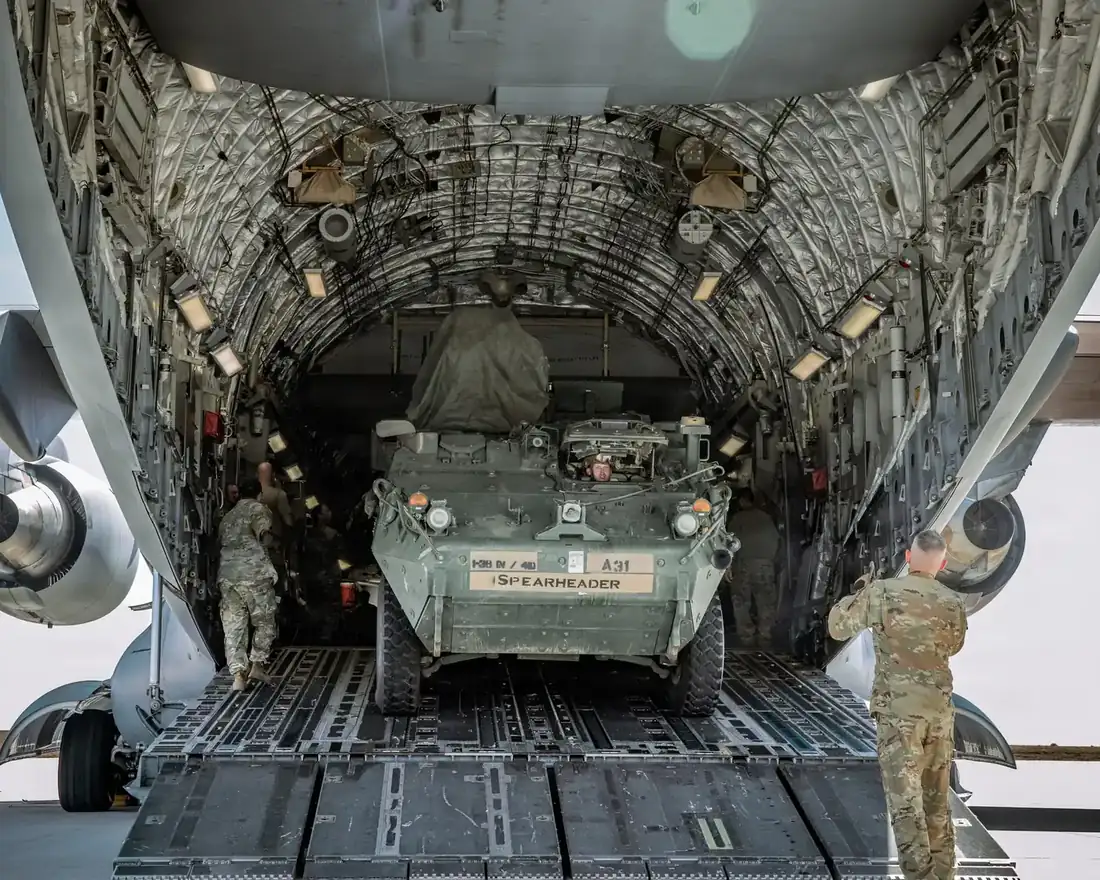
A basic requirement was that the vehicle could be carried by a C-130.
Basic technical data (M1126 ICV)
Original M1126 compared with the Stryker A1 (DVH):
- Layout: 8×8 (with an 8×4 option) / 8×8.
- Crew / passengers: 2 + 9 / 2 + 9.
- Weight: about 16.5 tonnes (basic) / chassis rated for about 28.5 tonnes (63,000 lb).
- Engine: Caterpillar C7, 350 hp / Caterpillar C9, 450 hp.
- Electrical generator: 570 amps / 910 amps.
- Maximum speed: about 97 km/h (original).
- Range: about 500 km (original).
- Armour: basic steel and ceramic, against 14.5 mm all round / Double V mine-protection hull.
- Main armament: 12.7 mm M2 or 40 mm Mk19 on a remote weapon station / the same, or CROWS-J with Javelin.
With slat armour and additional protection, a Stryker exceeds 20 tonnes.
The Stryker variants
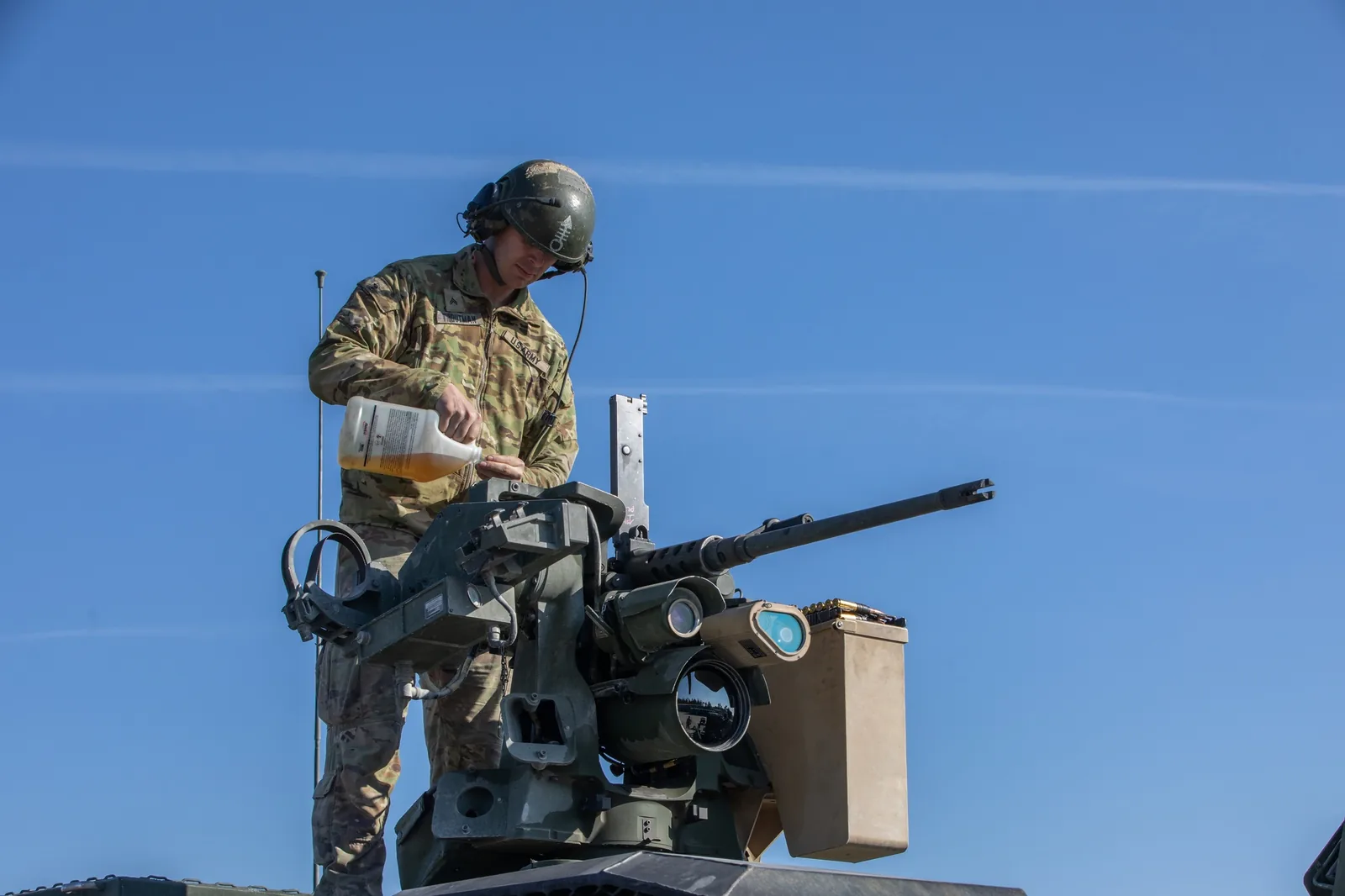
The family was built on a common chassis. Each Stryker brigade has about 300 vehicles from almost all the versions.
- M1126 ICV, infantry carrier (2+9). Armament: 12.7 mm M2 or 40 mm Mk19. In service, the most numerous.
- M1127 RV, reconnaissance. M2 or Mk19, LRAS reconnaissance sensors. In service.
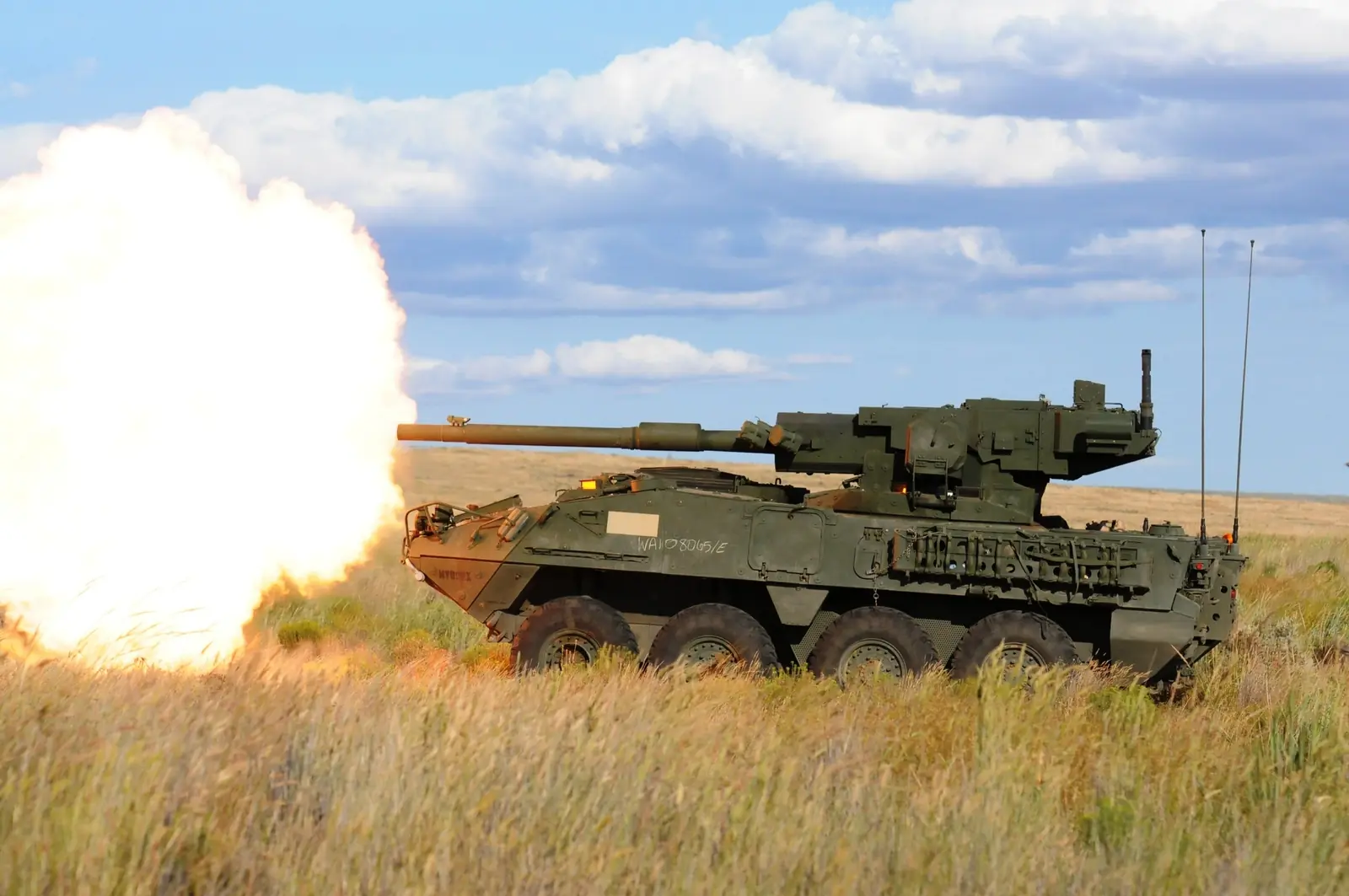
- M1128 MGS, fire support. 105 mm M68 gun with autoloader. Retired in 2022.
- M1129 MC, mortar carrier. 120 mm mortar. In service.
- M1130 CV, command. M2, communications systems. In service.
- M1131 FSV, fire support. Target location and designation system. In service.
- M1132 ESV, engineer. Plough or mine-clearing rollers. In service.
- M1133 MEV, medical evacuation. Unarmed. In service.
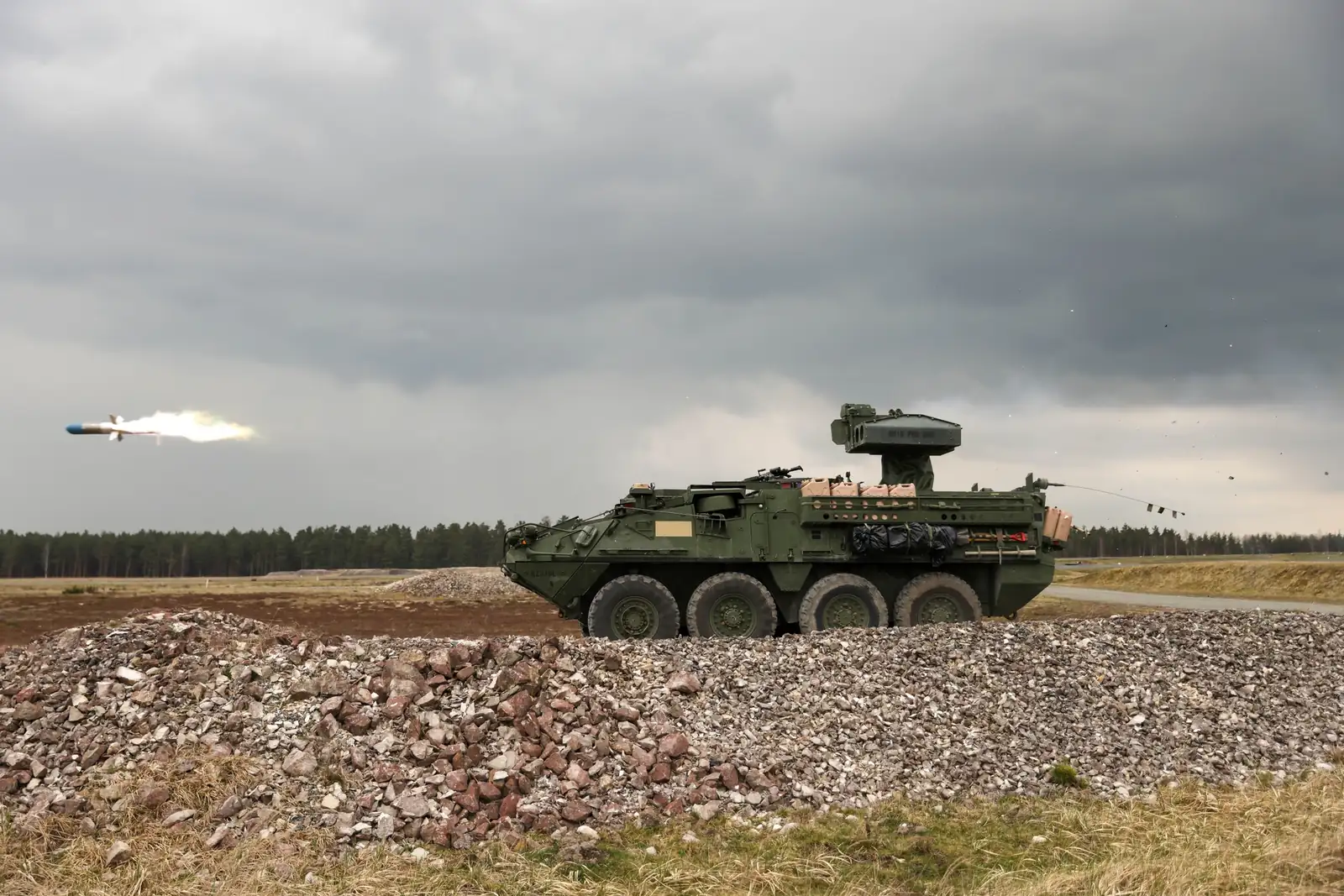
- M1134 ATGM, anti-tank. Twin TOW-2 launcher. In service.
- M1135 NBCRV, CBRN reconnaissance. Chemical and biological threat sensors. In service.
- M1296 Dragoon, infantry fighting vehicle. 30 mm XM813 cannon in an MCT-30 turret. In service since 2018.
- SGT Stout (M-SHORAD Inc 1), short-range air defence. Stinger, 30 mm XM914 cannon, radar. In service since about 2021.
The versions with a Double V hull have their own designations (for example M1256 for the ICV and M1253 for the anti-tank version). The role stays the same.
The anti-tank M1134 uses the same TOW-2 missile as the Hellenic Army (see our TOW-2 profile).
Why the M1128 MGS was retired
The M1128 Mobile Gun System was the version with a 105 mm gun, designed to support the infantry with direct fire against fortifications and light armour. In May 2021 the US Army announced it would retire it by the end of fiscal year 2022. According to the Army, a study judged it obsolete. The gun and the autoloader had systemic problems and expensive maintenance. In addition, the vehicle had stayed with a flat bottom and was never upgraded against mines and improvised explosive devices. The Army preferred to put the money into the 30 mm cannon and other upgrades.
Double V Hull and the Stryker A1
The first Strykers had a flat-bottom hull. In Afghanistan, mines and improvised explosive devices became the greatest threat. The answer was the Double V Hull (DVH): a double-“V” shaped hull that channels the blast of an explosion sideways, away from the occupants. The Army ordered 450 DVH vehicles in July 2011. The order grew to 742 within a few months and to 760 in 2012. The first were sent to Afghanistan in 2011. The price was more weight and less ground clearance.
The next step was the Stryker A1, which came out of the ECP1 engineering change programme. According to the US Army and GDLS it includes:
- a Caterpillar C9 450 hp engine instead of the 350 hp C7,
- a 910-amp generator instead of 570, with headroom for new sensors and systems,
- a strengthened chassis, transmission and suspension for greater weight,
- an internal digital network and new power distribution.
The combination is called DVH A1. In 2018 the Army approved converting the fleet to this configuration and later extended it to flat-bottom vehicles as well. ECP2, according to the Army, concerns mainly mission equipment, that is armament and systems, and not the automotive side. On May 15, 2026 GDLS received a framework agreement of $229.6 million for 50 new Stryker DVH A1, with completion by June 2028.
New armament: Dragoon, Javelin and M-SHORAD
After the annexation of Crimea in 2014, the Americans in Europe found that a Stryker with a 12.7 mm machine gun could not deal with Russian combat vehicles. The 2nd Cavalry Regiment at Vilseck, Germany, submitted an urgent request in April 2015, and the same year the upgrade of 81 vehicles was approved.
- XM1296 / M1296 Dragoon: carries Kongsberg’s MCT-30 remote turret with the 30 mm XM813 cannon, an evolution of the Mk44 Bushmaster II. It keeps the squad of nine. The first prototype was delivered in October 2016 and the regiment received it in 2018. In 2021 the Army selected Oshkosh to continue integrating a 30 mm cannon on Stryker (the MCWS programme). The turret has only 150 rounds ready to fire.
- CROWS-J: a variant of the CROWS weapon station with a Javelin launcher. The 2nd Cavalry Regiment made the first firings in 2018, at ranges of 1,200 to 1,500 m, and the Army planned more than 80 systems. Later the 2nd Stryker Brigade of the 4th Infantry Division also received CROWS-J. The crew thus fires Javelin without leaving the vehicle.
- M-SHORAD Increment 1 (SGT Stout): the anti-aircraft version on a Stryker DVH A1, with a turret configured by Leonardo DRS. The initial configuration had four Stinger and two Hellfire. According to the Congressional Research Service (CRS) report of April 2026, the current configuration has eight Stinger, a 30 mm XM914 cannon, an M240 machine gun and a radar. The original plan was for 144 systems. Four battalions, among them the 5-4 ADA in Germany, have received them, with 36 vehicles each. For 2027, $712.7 million was requested for 14 more systems.
Combat use: Iraq, Afghanistan, Ukraine
Iraq (2003–2011)
The first Stryker brigade (3rd Brigade, 2nd Infantry Division) arrived in Iraq in November 2003, with about 311 vehicles. The vehicle proved fast, quieter than tracked vehicles and suited to patrols in cities. To withstand RPG rockets, however, it received slat armour, which added about 2.3 tonnes. With it, it no longer fitted in a C-130, so the original idea of air transport was not applied in practice.
Afghanistan (2009–2014)
The 5th Brigade of the 2nd Infantry Division was the first Stryker unit in Afghanistan, in summer 2009. Its mission in Kandahar was one of the bloodiest of the war, with 37 dead and 238 wounded. Many casualties came from improvised explosive devices under flat-bottom vehicles. This experience led directly to the Double V Hull.
Ukraine (from 2023)
The United States announced the first 90 Strykers for Ukraine on January 19, 2023. According to official Pentagon fact sheets, commitments reached 189 Strykers by the end of 2023, a number that stayed the same in the June 2024 sheet. Among them were M1132 engineer vehicles with mine rollers. Most went to the 82nd Air Assault Brigade, which entered combat in the Zaporizhzhia counteroffensive in summer 2023, near Robotyne. The brigade also used Strykers in the invasion of Kursk in August 2024 and in the fighting at Vovchansk. The 81st Air Assault Brigade also uses Strykers.
What the experience shows:
- Losses: the Oryx database, which counts only losses with photographic or video documentation, records 113 M1126 and 9 M1132 destroyed, damaged, abandoned or captured (checked on October 8, 2026). The figure is a minimum, not a total.
- Protection: according to testimonies of Ukrainian soldiers in Ukrainian military media, the vehicle withstands frontal 12.7 mm fire and protects the crew well. A testimony to the Financial Times from Kursk describes a Stryker hit by a man-portable anti-tank weapon, with the driver suffering only concussion and the vehicle recovered. These are isolated testimonies, not an official assessment.
- Mobility: the same soldiers praise the speed, the movement in mud and the tyre pressure control system.
- Limits: no armoured personnel carrier survives long under sustained artillery and FPV drone fire. Ukrainians describe short, fast carry-and-dismount missions, not staying on the battlefield. The 12.7 mm machine gun is considered weak against Soviet vehicles. No official US or Ukrainian analysis of Stryker losses has been published.
Which countries use the Stryker
- United States: more than 4,400 vehicles of all versions. The main user.
- Ukraine: 189 according to the Pentagon sheets (2023–2024). In combat since 2023.
- Thailand: about 130 from 2019–2021 lots, and 17 more through EDA, announced in February 2026. In service.
- Bulgaria: 183 (90 Dragoon, 33 M1130, 24 M1133, 17 M1126, 10 M1135, 9 M1132), DSCA approval in 2023. First vehicles at Burgas on February 14, 2026.
- North Macedonia: 42 M1126 (down from 54 originally) through FMS. 17 delivered in February 2026.
- Argentina: M1126, first 8 through FMS, aiming for more than 200. 8 delivered between November 2025 and February 2026.
- Poland: an offer of 250 used vehicles for a symbolic $1. Possible interest.
- Greece: the US–Greece joint statement refers to the “provision of Stryker vehicles”. No number, versions or contract.
On Poland, Defence Minister Władysław Kosiniak-Kamysz said in December 2025 that Warsaw was preparing to accept the offer once the condition of the vehicles was checked. The Chief of the Polish General Staff placed the final decision in the second half of 2026.
Lithuania had approval for 84 Strykers in 2015, but chose the German Boxer.
How much a Stryker costs
There is no single “Stryker price”. The cost depends on the version, the condition of the vehicle and the contents of the contract:
- Original contract (2000): about $4 billion for up to 2,131 vehicles.
- DVH A1 (May 2026): $229.6 million for 50 vehicles, about $4.6 million per vehicle by simple division. This is not an official unit price and, according to the trade press, funds had not yet been committed at signing.
- Bulgaria: estimated value of $1.5 billion for 183 vehicles together with support, spares and training.
- Used vehicles through EDA: the vehicle may be given free or for a nominal sum, but the recipient pays for transport, repair, spares and training. That is why “free” can be misleading, as the Geopolitiki analysis of the Greek case explains.
Strengths and weaknesses
Strengths
- Speed and road range, without tank transporters.
- A family on a common chassis, with common training and spare parts.
- Combat experience: the problems are known and have solutions (DVH, A1, new armament).
- Upgrade headroom thanks to the A1’s electrical power.
- A large fleet, hence long-term support from the United States.
Weaknesses
- Weight: the upgrades made it much heavier than designed.
- Protection: it withstands small arms and fragments, not medium-calibre guns or modern anti-tank weapons. Flat-bottom vehicles are vulnerable to mines.
- Light armament on the basic M1126.
- Not amphibious, unlike several competing 8×8s.
- High centre of gravity, with a risk of rollover on rough terrain.
The Stryker’s future in the US Army
A common misconception is that the new XM30 vehicle will replace the Stryker. It will not. The XM30 is the successor to the tracked Bradley in the armoured brigades. For the Stryker no successor has been announced.
What is changing is the structure. On May 1, 2025 Army Secretary Dan Driscoll and Chief of Staff General Randy George announced the Army Transformation Initiative. Infantry brigades are being converted into “mobile” brigades (Mobile Brigade Combat Teams), with light ISV vehicles, drones and new systems. The change also concerns the two National Guard Stryker brigades. The 56th of Pennsylvania handed over its Strykers and has officially been a mobile brigade since March 31, 2026. The 81st of Washington began returning vehicles in October 2025. It is from these vehicles that the surplus now being offered to allies, such as Poland and Greece, arises.
In the active units the opposite is happening. In July 2026 the 3rd Armored Brigade of the 4th Infantry Division handed over its Abrams and Bradleys and is being converted into a Stryker brigade. The 4th Division will become the only pure Stryker division of the US Army, with a Pacific mission. In Europe, the announcement of May 2026 about the withdrawal of 5,000 US troops from Germany was linked in press reports to the 2nd Cavalry Regiment at Vilseck. Which units will leave has not been officially confirmed.
Bottom line: the US Army keeps fewer but more modern Strykers (DVH A1, Dragoon, M-SHORAD), still buys new ones and makes the older ones available to allies.
What it means for Greece
On October 7, 2026 the joint statement of the Greece–US Strategic Dialogue referred for the first time officially to the “provision of Stryker vehicles” to Greece. The number, versions, form of transfer and cost have not been announced. What was confirmed, what is under discussion and where the vehicles would go are examined in our analysis of the Greek case.
Three things will decide the value of the deal. First, the hull: a flat-bottom Stryker and a DVH A1 are different vehicles in protection and upgrade headroom. Second, the versions: with only M1126, the Hellenic Army gets a transport vehicle, while with M1129, M1130 and M1134 it gets a whole family. The M1134 in fact uses the same TOW-2 the Army already has. Third, its place in the fleet: the Stryker does not replace the 4×4 M1117, which does a different job. It is the most realistic solution for replacing part of the ageing M113s in carrying infantry.
Ukraine’s experience shows the limits too: without counter-drone protection, upgraded armament and good support, even a proven vehicle has limited survivability. This should go into the cost from the start.
Frequently asked questions
What is the Stryker?
A US Army 8×8 wheeled armoured vehicle made by General Dynamics Land Systems. It is based on the Canadian LAV III and the Swiss MOWAG Piranha III. It entered service in 2002.
How many versions does the Stryker have?
There are ten basic versions, from the M1126 infantry carrier to the M1135 CBRN reconnaissance vehicle. The M1128 with a 105 mm gun was retired in 2022. Newer ones are the Dragoon with a 30 mm cannon, the Javelin-armed system and the anti-aircraft M-SHORAD.
What is the Stryker Double V Hull?
A double-“V” shaped hull that diverts the blast of a mine explosion away from the occupants. It was introduced in 2011 after losses from improvised explosive devices in Afghanistan. Combined with the 450 hp engine, it forms the DVH A1 configuration.
What is the Stryker Dragoon?
It is the XM1296 (M1296), an infantry-carrier Stryker with a Kongsberg MCT-30 remote turret and a 30 mm cannon. It was created after 2015 for the 2nd Cavalry Regiment in Germany and entered service in 2018. Bulgaria has approval for 90 Dragoons.
How did the Stryker perform in Ukraine?
The US committed 189 vehicles, which fought in Zaporizhzhia in 2023 and Kursk in 2024. Oryx records more than 120 losses with visual documentation. Soldiers praise the protection and mobility, but the vehicle is vulnerable to drones and anti-tank weapons, like any armoured personnel carrier.
Will the Stryker be replaced by the XM30?
No. The XM30 replaces the Bradley in the armoured brigades. The US Army is taking Strykers out of the National Guard, but keeps them in active units. It is still buying new DVH A1 and is converting an armoured brigade into a Stryker brigade.