Analysis
Analysis: Stryker for Greece, what the US has confirmed, what remains open and what changes for the Army
Analysis: The United States has officially confirmed it will provide Stryker armoured vehicles to Greece, but the joint statement gives no number, versions, cost or timetable. What is known, what is still open, and what the Stryker would change for the Hellenic Army, especially on the Eastern Aegean islands.

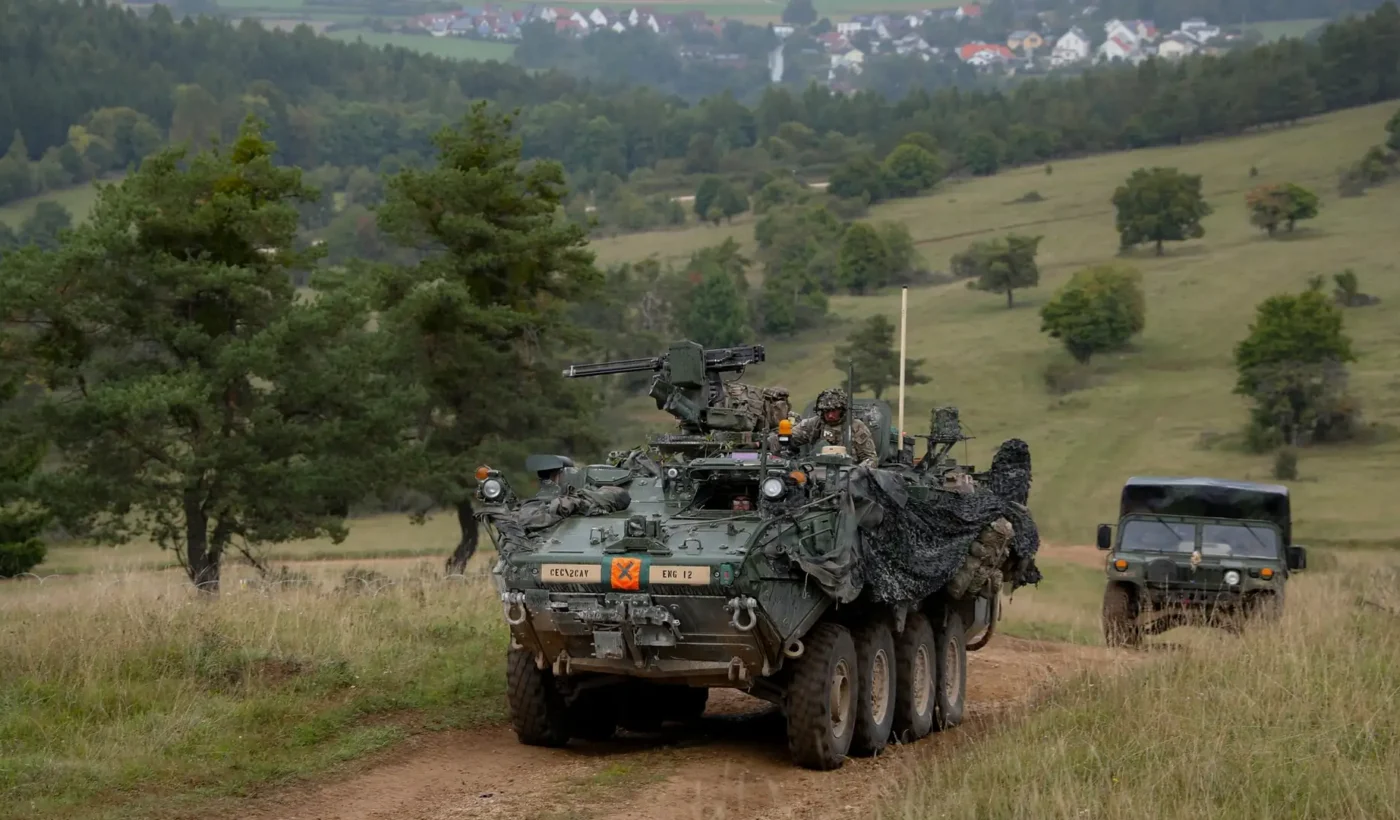
The United States has officially confirmed that it will provide Stryker armoured vehicles to Greece. The reference is in the joint statement of the sixth Greece–US Strategic Dialogue, issued by the State Department on October 7, 2026 (our news report). The statement gives no number of vehicles, versions, cost or timetable. According to what is known, the Hellenic Army is asking for at least 250 to 300 vehicles through the US Excess Defense Articles (EDA) programme. The main destination is the islands of the Eastern Aegean. The real cost will depend on the condition of the vehicles, which Greek teams are inspecting these days in Germany and the United States.
In brief
- What was confirmed: the provision of Stryker vehicles to Greece, in an official text of the two governments.
- What was not confirmed: number, versions, form of transfer, cost, dates.
- What is under discussion: 250–300 vehicles, mainly M1126 infantry carriers.
- Where they would go: mainly the islands of the Eastern Aegean and, if the quantity allows, Evros.
- The critical question: not whether the vehicles are “free”, but how much each will cost until it joins a Greek unit fully operational.
What the joint statement says exactly
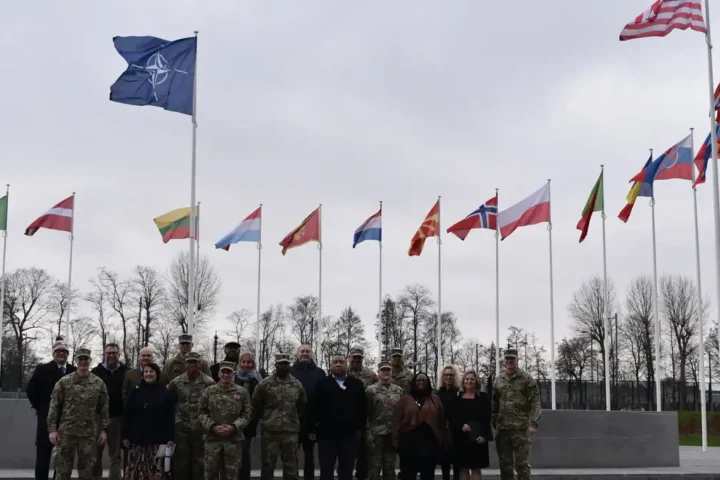
The joint statement was issued after US Secretary of State Marco Rubio met Giorgos Gerapetritis. In the defence cooperation section it mentions three things:
- $4 billion in defence sales through Foreign Military Sales (FMS), for Greece’s long-term defence plan.
- The finalisation of Greece’s participation in the US National Guard State Partnership Program, with Florida as its partner.
- Enhanced interoperability “through the provision of Stryker vehicles to Greece”.
The wording matters. The text speaks of “provision”, not sale, and does not link the Strykers to the $4 billion in FMS. Nor does it explicitly mention the EDA programme. That the transfer will take place through EDA follows from what is known and from the way Strykers have been given to other allies, not from the statement itself.
How we got here
- December 2025: the US proposes to Poland 250 used Strykers for a symbolic $1.
- February 2026: Bulgaria’s first Strykers (new vehicles, through government-to-government agreements) arrive in Burgas.
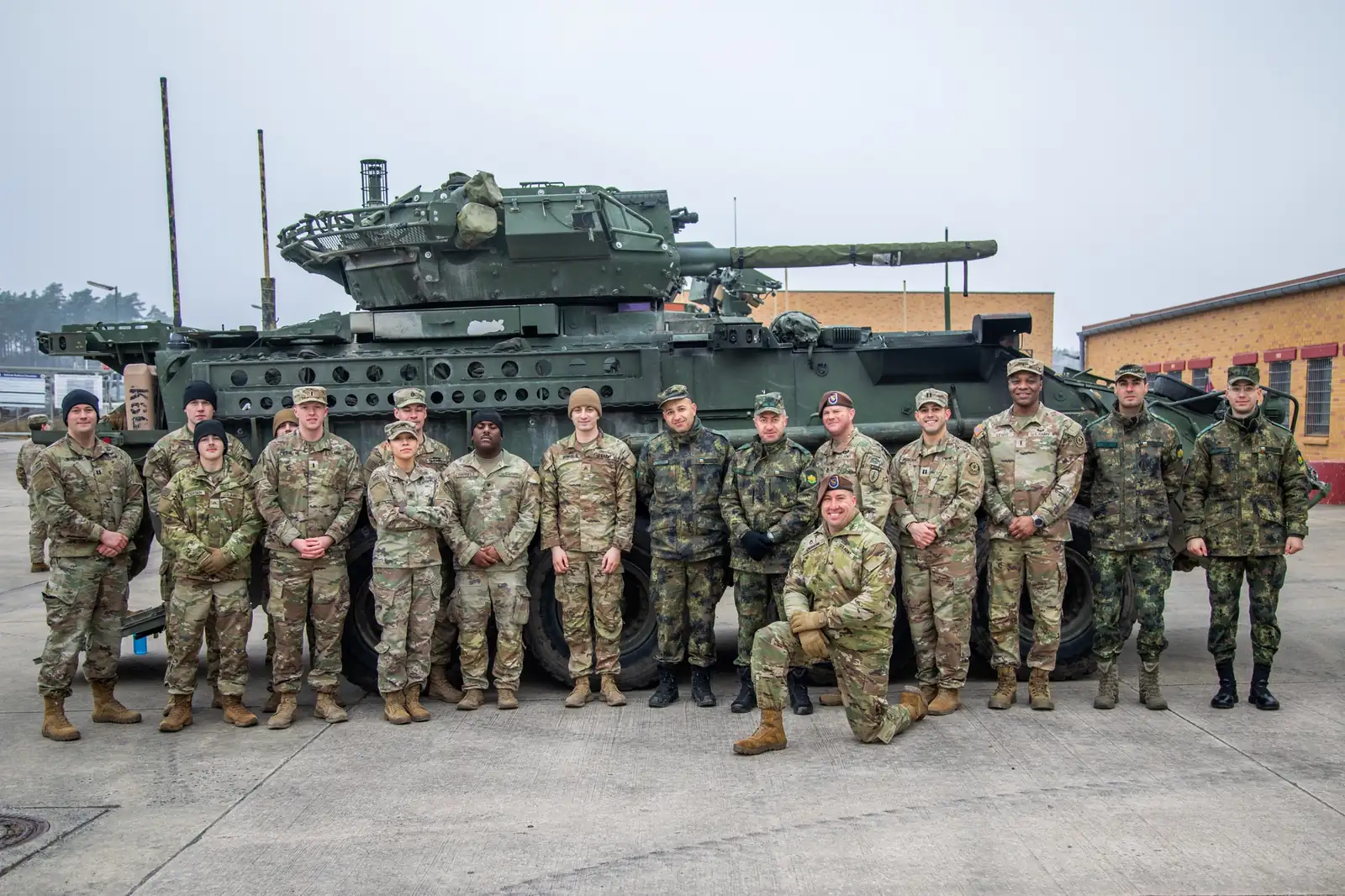
- August 2026: reports say the Hellenic Army General Staff (GES) is examining Strykers through EDA, and that the American side appears positive.
- September 2026: the Army asks for 250–300 vehicles, in competition with Poland and Romania.
- Early October 2026: Greek technical teams inspect vehicles in Germany and the United States.
- October 7, 2026: the joint statement of the Strategic Dialogue confirms the provision of Strykers.
Why the US is giving away Strykers now
The US Army is changing its structure. Under the Army Transformation Initiative of 2025, Stryker brigades are being converted into lighter brigades that move on Infantry Squad Vehicles (ISV). According to Inside Defense, the conversion of the 81st Stryker Brigade leaves the Army with surplus vehicles, which it plans to offer to partners.
Part of these vehicles is already in Europe, mainly in Germany. For Washington it is cheaper to hand them to allies where they are than to return them to the United States. The same reasoning was followed in the proposal to Poland of 250 Strykers for $1.
This does not mean the US Army is abandoning the Stryker family. In May 2026 it awarded General Dynamics Land Systems a contract for 50 new Stryker Double-V Hull A1 vehicles. What is leaving are the older vehicles of units that are changing role.
Which vehicle Greece would get
The main interest is the M1126 ICV (Infantry Carrier Vehicle), the infantry carrier version:
- An 8×8 wheeled vehicle by General Dynamics Land Systems, based on the Canadian LAV III.
- A crew of two and a squad of nine soldiers with full equipment.
- A Caterpillar engine of about 350 hp in the early versions, a road speed of about 100 km/h and a range of around 500 km.
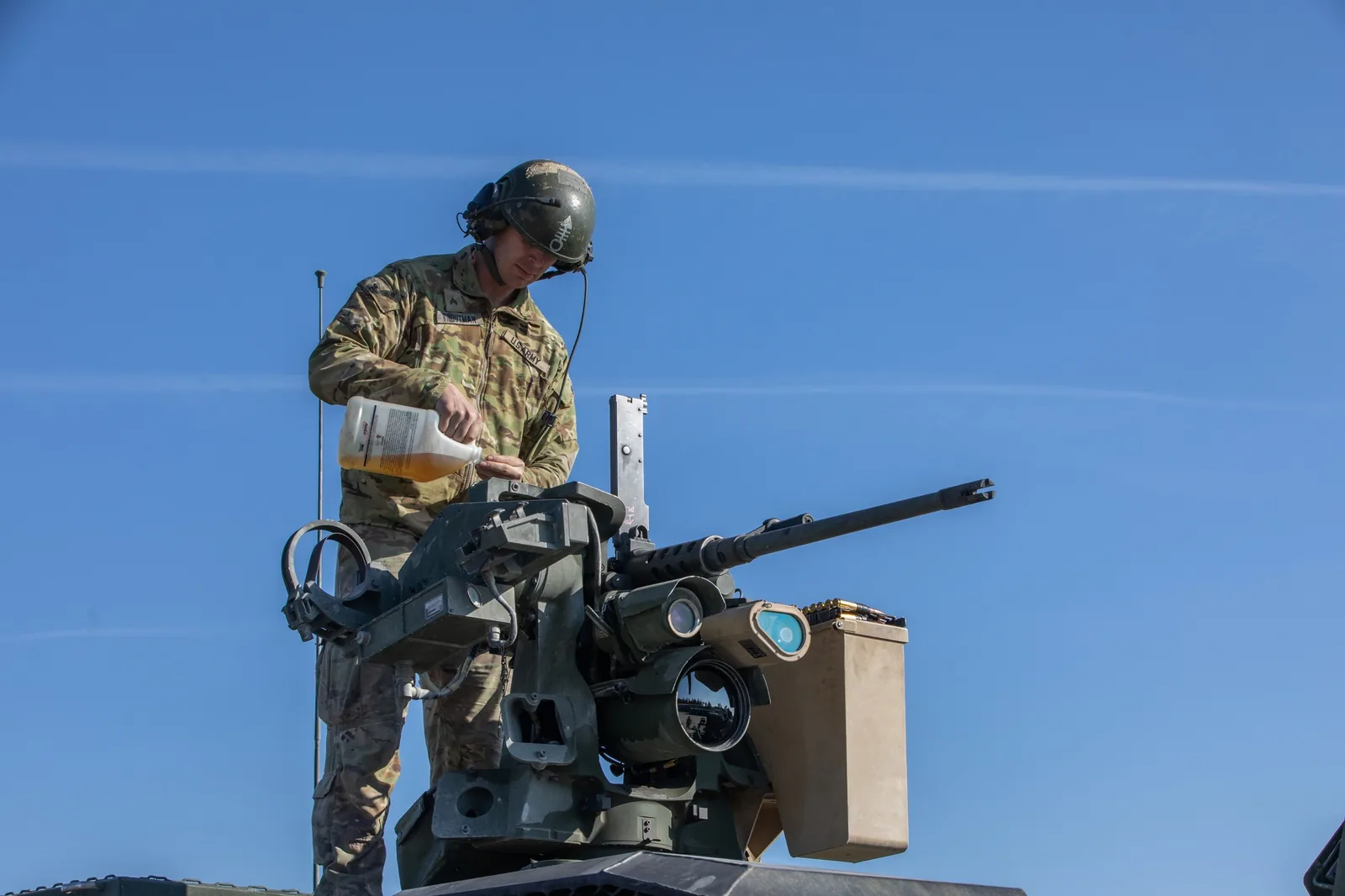
- A remote weapon station with a 12.7 mm M2 machine gun or a 40 mm Mk19 automatic grenade launcher.
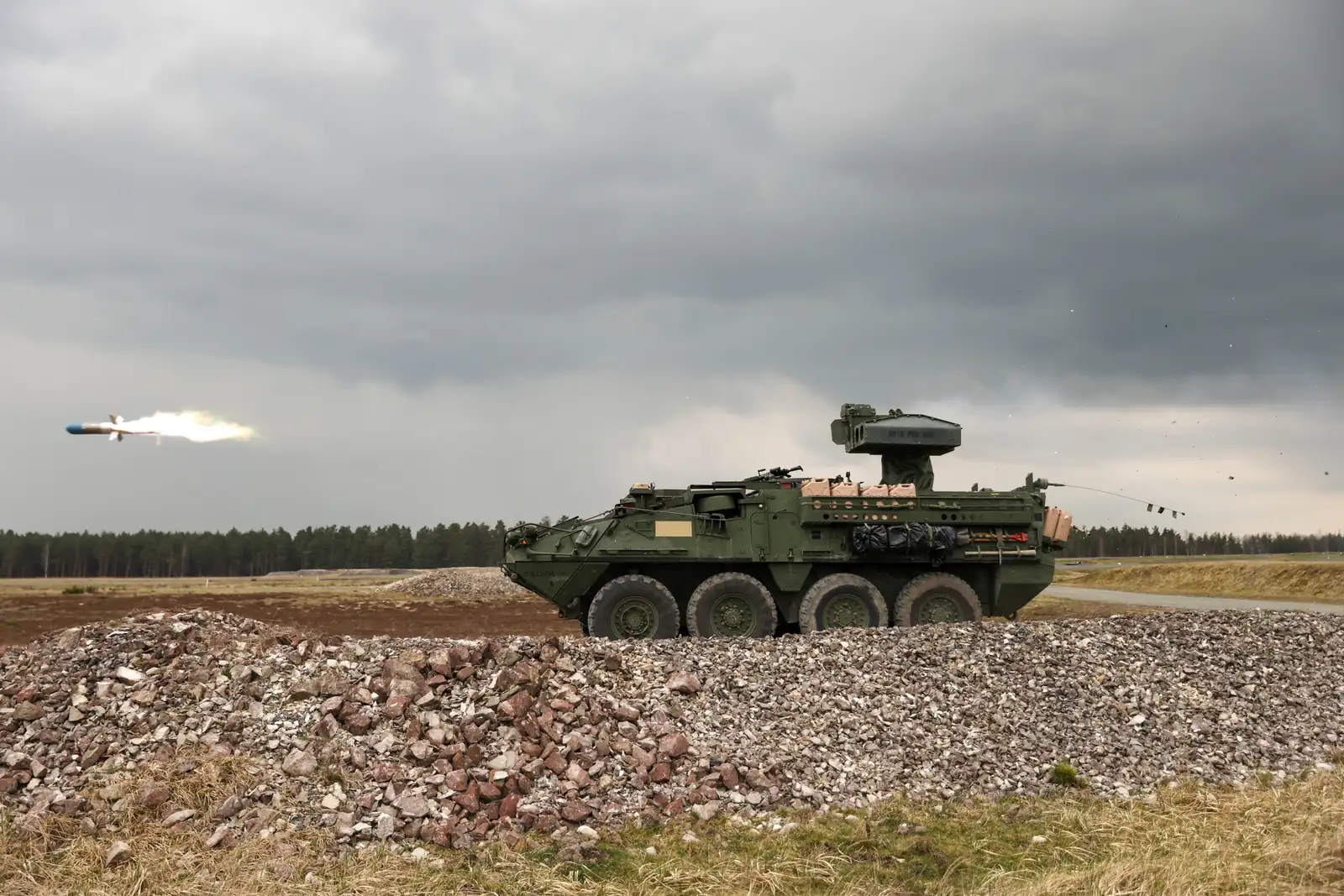
Other versions of the family exist: command (M1130), reconnaissance (M1127), 120 mm mortar carrier (M1129) and anti-tank (M1134 with TOW). None has been officially confirmed for Greece. As for the M1128 with a 105 mm gun, which the US Army withdrew in 2022, there is no indication that it is included.
A crucial technical detail is the hull. The first Strykers have a flat bottom. The newer Double-V Hull versions protect far better against mines and improvised explosive devices. Which of the two will be given to Greece has not been announced.
What the Stryker really offers operationally
The Stryker is not simply one more armoured personnel carrier. It was designed in the late 1990s to fill the gap between heavy tracked units and light infantry, and since 2002 it has been the basis of the US Army’s Stryker brigades. Its logic is a single one: to bring a full infantry squad, protected, quickly to where it is needed, with its own means.
Speed and range without tank transporters
A tracked vehicle usually covers long distances on a tank transporter. The Stryker moves on its own wheels on the road network at about 100 km/h with a range of around 500 km. The most characteristic example is Operation Dragoon Ride in March 2015: about 100 vehicles of the 2nd Cavalry Regiment, including about 60 Strykers, crossed six countries, from Estonia to Bavaria, covering about 1,800 kilometres under their own power.
In the Aegean islands the distances are much shorter, but the principle is the same. A reserve with Strykers can move from one end of an island to the other in minutes, without waiting for transporters and without wearing out the road network as tracks do.
A full infantry squad, ready to fight
The M1126 carries nine soldiers with full equipment, who dismount from the rear ramp close to the point of action. The basic armour protects against small-arms fire and artillery fragments, and is supplemented with additional armour and slat cages against anti-tank rockets. The remote weapon station lets the operator fire from inside the vehicle without being exposed.
Tested in real war
Strykers operated in Iraq from late 2003, with their first mission in Mosul, and later in Afghanistan. Soldiers of a Stryker brigade described them as faster, quieter and safer than other combat vehicles, and its commander said they had saved the lives of hundreds of soldiers. The experience also exposed weaknesses, chiefly in protection against mines and improvised explosive devices. The answer was the add-on protection packages and eventually the Double-V hull. That is exactly the advantage of a platform with a combat history: its problems are known and have solutions.
A family of vehicles, not one vehicle
On the same chassis there are versions for infantry carrying, command, reconnaissance, 120 mm mortar carrier, anti-tank, medical evacuation and engineer roles. A unit that uses only Strykers has common training for drivers and technicians, common spares and common logistic support. For the Hellenic Army, which today maintains many different types of old vehicles, such standardisation has great value in itself.
A platform with a future
The US Army continues to develop the Stryker: an A1 version with an engine of about 450 hp and more electrical power, the Dragoon with a 30 mm cannon, and a short-range air defence version. The electrical power and the space in the vehicle leave room for future Greek additions, such as counter-drone systems or new weapon stations. This is a possibility, not something that has been decided.
What it means for the defence of the islands
The value of the Strykers in the Aegean is rapid reaction. In a landing or airborne scenario, the defender wins if it reaches the spot first with sufficient firepower. A battalion with Strykers can cover a much longer coastline than a battalion with M113s, with better protection than a battalion with light vehicles. Its limits are clear: it is not amphibious, it is not a tank, and the basic M1126 has no cannon. It works together with the tanks, the anti-tank weapons and the artillery, not in their place.
How many and where
The number heard most often is 250 to 300 vehicles. It is possible that the US could make more available. For comparison, Poland is discussing 250 and Bulgaria has ordered 183 new Strykers of various versions, including 90 Dragoons with a 30 mm cannon.
The main destination is the islands of the Eastern Aegean. There the road network favours wheeled vehicles, distances are short, and speed of reaction counts for more than the armour of a tracked vehicle. A Stryker can carry an infantry squad from one end of an island to the other much faster than an M113, with better protection than a light vehicle. The idea is not new: NemesisHD had examined the Stryker as a solution for the Higher Military Command of the Interior and Islands (ASDEN) as early as 2023.
If the quantity allows, a second destination is Evros, with the possible formation of new units.
Stryker, M113 and M1117: which does what
The Hellenic Army already has 1,200 wheeled M1117 Guardians, also from surplus US stocks. The vehicles do not cover the same need:
- M113: tracked armoured personnel carrier. Role: infantry carrying. Carries an infantry squad. Road speed: lower.
- M1117 Guardian: 4×4 wheeled vehicle. Role: security, escort, reconnaissance. Carries a small team. Road speed: high.
- M1126 Stryker: 8×8 wheeled armoured personnel carrier. Role: carrying a full infantry squad. Carries 2 + 9. Road speed: about 100 km/h.
The M1117 was designed for security and reconnaissance missions and does not carry a full infantry squad. The Stryker is a mechanised infantry vehicle and could gradually replace part of the M113s, which are still the backbone of the armoured personnel carriers. The two wheeled vehicles can work in a complementary way.
The cost: why “free” does not mean cheap
Under the EDA programme the vehicle is handed over free or at a low price, but on an “as is, where is” basis. The recipient pays for transport, inspection, repairs, spare parts, training and any modifications it wants.
For Greece’s Strykers, at least the following will be needed:
- Overhaul where required (engine, transmission, suspension).
- Greek communications and connection to the Hellenic Army’s command and control systems.
- Weapons and remote weapon stations, if they are not supplied with the vehicles.
- A stock of spare parts and maintenance infrastructure, ideally in Greece.
- Training of crews and technicians.
A useful point of reference: the May 2026 contract for 50 new Stryker A1 vehicles corresponds to about $4.6 million per vehicle, if the amount is simply divided. If a used Stryker needs so much work that its cost approaches that figure, the advantage of EDA is lost. NemesisHD has analysed the cost in detail in a separate article in Greek, on the illusion of the “free” Stryker from EDA and the comparison with the Patria 6×6.
The positive precedent is the M1117. The first 44 came from US units in Europe in working condition and did not need costly restoration. If the Strykers in Germany are in similar condition, the deal could prove very advantageous.
What “interoperability” means
The joint statement links the Strykers to interoperability, and in the same paragraph mentions cooperation with the Florida National Guard. In practice, a Greek army with Strykers uses the same vehicle as the US 2nd Cavalry Regiment in Germany and, soon, Bulgaria. This makes joint exercises easier, as well as the exchange of spare parts and support from the American supply chain in Europe.
There is also a political dimension. Poland and Romania are interested in the same limited stock. The reference in a joint text of the two governments indicates that the Greek case has received political approval at a high level, something that has not been announced publicly for the other two countries.
What remains open
- The number. Will it be 250, 300 or more? It will depend on how many vehicles the US makes available and how many prove economically worthwhile after inspection.
- The versions. Only the M1126, or also command, mortar and anti-tank vehicles?
- The condition. Flat or Double-V hull? Mileage, operating hours, completeness of the electronics?
- The weapons. Will they come with their weapon stations, or will a Greek solution be needed?
- The support. Repair and maintenance in Greece, with possible participation of Greek companies, without an official decision.
- The timetable. When the first vehicles will reach the islands.
Conclusion
The joint statement turns the Strykers from a scenario into an official commitment of the two governments. For the Hellenic Army it is a rare opportunity to acquire a large number of modern wheeled infantry carriers in a short time, where they are needed most: on the islands. The value of the deal, however, will be judged by the details that have not yet been announced: how many vehicles, in what condition, at what cost of restoration and with what support. The results of the inspections in Germany and the United States are the next critical step, and the clarification of the agreement.