Analysis
Ecumenical Patriarchate explained: what Turkey does not recognise
The Ecumenical Patriarchate sits in Istanbul but has no legal personality in Turkey. What the European Commission, the US Congress and the Archdiocese of America say about its title, property and the Halki seminary.

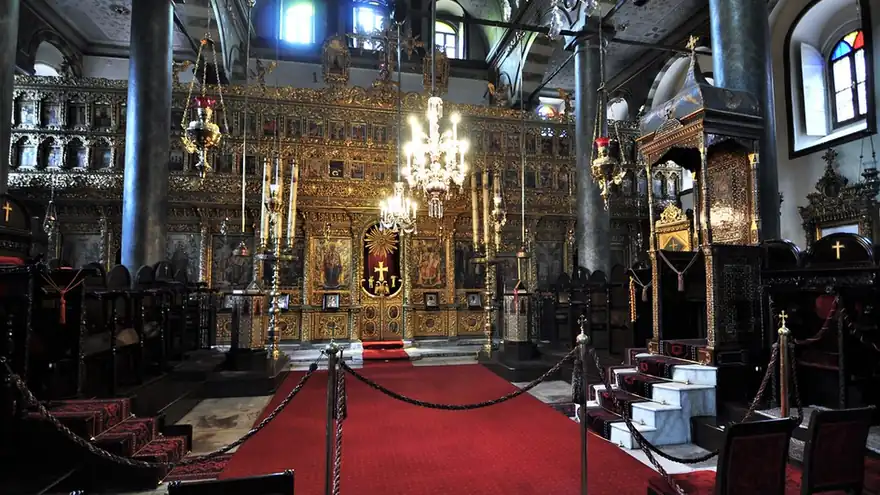
Photo: fusion-of-horizons / Flickr (interior of the Ecumenical Patriarchate of Constantinople)
The Ecumenical Patriarchate is the See of the Archbishop of Constantinople, based at the Phanar in Istanbul, which a US House resolution describes as the centre of the Orthodox Christian Church worldwide. Turkey does not recognise the Patriarchate as a legal entity, and the European Commission lists its refusal to let the Patriarchate use the title “Ecumenical” among the unresolved problems. That gap between the Patriarchate’s global role and its status at home is the heart of a long-running dispute that involves Greece, the Greek diaspora, the United States Congress and the European Union.
Key points
- The title “Ecumenical” goes back to the 6th century, according to a US House resolution; the European Commission’s 2024 report says the Venice Commission’s recommendation on the right to use it was not implemented.
- The Commission found that the non-Muslim communities still lack legal personality, and that the Venice Commission’s recommendations on their status and on the title were not implemented.
- Property, the seminary of Halki (closed since 1971) and the rules on who may sit on the Holy Synod are the three practical battlegrounds.
- The Patriarchate’s constituency reaches far beyond Turkey; the Greek Orthodox Archdiocese of America belongs to it.
What is the Ecumenical Patriarchate?
Speaking at a briefing of the US Commission on Security and Cooperation in Europe in 2005, Archbishop Demetrios, then head of the Greek Orthodox Church in America, traced the Patriarchate to apostolic times and said it took the institutional form we know when Constantine moved the capital of the Roman Empire to Constantinople. He added that the seven ecumenical councils of the undivided Church were held in and around the See, and that it continued after the fall of Byzantium in 1453, under Ottoman rule and under the Turkish Republic.
A 2013 resolution introduced in the US House of Representatives records that the title of Ecumenical Patriarch was formally accorded to the Archbishop of Constantinople by a synod in the city in the 6th century, and that Bartholomew I has held the post since November 1991. The same text calls the See the centre of the Orthodox Church worldwide and says it was awarded the Congressional Gold Medal in 1997 for Bartholomew’s contribution to religious understanding and peace.
The Greek Orthodox community of Istanbul, Imvros and Tenedos falls under the minority provisions of the Treaty of Lausanne (see our explainers on the Treaty of Lausanne explained: borders, islands and minorities and on Imvros and Tenedos explained: what Turkey promised the Greeks at Lausanne). The Patriarchate’s own website, in its news section, reports that the Patriarch received the President of the Hellenic Republic at the Phanar on Saturday, 28 November 2026 (see Tasoulas meets Erdogan at Dolmabahçe Palace for 35 minutes as minorities and the Aegean top the Turkish readout), and, on 26 November, a meeting of Imvriot organisations and officials.
What does Turkey not recognise?
The European Commission’s 2024 report on Turkey sums up the position in one passage: the lack of legal personality for the non-Muslim and Alevi communities “remained a problem”, notably for places of worship, and the Venice Commission’s recommendations on the legal status of non-Muslim religions and on the right of the Greek Orthodox Ecumenical Patriarchate to use the title “Ecumenical” were not implemented.
The 2005 briefing set out the same grievances in more detail. Emmanuel Demos, General Counsel of the Greek Orthodox Archdiocese, told the Commission that the Turkish government insists on approving or vetoing the person nominated as Patriarch and that he be a Turkish citizen, and that it has also insisted that the twelve members of the Holy Synod be Turkish residents and citizens. In his words, there is “absolutely no basis in Turkish law for this”, and he argued that the Treaty of Lausanne makes such interference unwarranted. Those are the views of the Archdiocese’s counsel, put on the record before a US government commission; Ankara’s own position on the question was not part of that briefing.
Co-Chairman Christopher Smith opened the briefing by listing the Commission’s concerns: property expropriation, the continued closure of the Halki seminary, obstacles to owning and repairing churches, and “the steadfast refusal of Turkish authorities to recognize the ecumenical status of the Orthodox patriarch”. He added that current government policies “appear targeted to bring about the eventual exodus of the Greek Orthodox from Turkey entirely”.
How did the community shrink?
Archbishop Demetrios told the 2005 briefing that the riots of 1955 in Istanbul and Smyrna, which he said were provoked by the Turkish government, reduced a community of over 100,000 Greek Orthodox in Istanbul alone to a remnant of 2,000 to 3,000. These are his figures, given in 2005. Our explainer on the Istanbul pogrom of 1955 explained: what US records show looks at the documentary record of that night.
On property, Smith said at the same briefing that patriarch-owned properties had shrunk by almost 80 percent, from 8,000 in 1936 to 1,700 at that time, and that 1,100 of the remaining 1,700 were not legally recognised and were especially vulnerable to seizure. He described the pattern as one in which properties are threatened with expropriation when a religious community’s population falls below a certain level, after which the government decides a property has fallen into disuse and takes over its management.
Why does Halki matter?
The Theological School of Halki, on the island the Turks call Heybeliada, was founded in 1844 and was, according to the 2013 House resolution, the principal seminary of the Patriarchate until Turkish authorities forcibly closed it in 1971. Smith said in 2005 that it was seized when the government nationalised all institutions of higher education, and Archbishop Demetrios warned that without a school there are no clergy. The European Commission’s 2024 report says no steps were taken to reopen it. Our Halki seminary explained: closed by Turkey since 1971 covers the closure in full.
The same Commission report records other signals that concern Greeks and Orthodox Christians: it notes the dialogue with UNESCO over the World Heritage Committee’s concerns about Hagia Sophia being turned back into a mosque, and that in May 2024 the Monastery of Chora, a UNESCO World Heritage Site, was converted into a mosque by the authorities.
What has Turkey changed?
The 2013 House resolution also lists steps it welcomed: the liturgy celebrated by the Patriarch at the Sumela Monastery in August 2010, the first since 1922; the handing over of the formal title to the former Greek Orphanage on Prinkipos (Büyükada) after a unanimous decision of the European Court of Human Rights; and the return in January 2013 of 190 hectares of forestland to the foundation registered as owner of the Halki school. It still urged Turkey to reopen Halki “without condition or further delay” and to address other long-standing concerns.
Why does it matter beyond Turkey?
The briefing record shows how far the Patriarchate’s reach goes. Archbishop Demetrios said that his own church in America, which he put at between 1.5 million and 2 million people, belongs ecclesiastically to the Ecumenical Patriarchate and that what happens to the Patriarchate “has a direct impact on us”. The Archdiocese was established in 1922, according to the Commission’s introduction. The House resolution adds that the Halki question has been repeatedly raised by members of the Helsinki Commission and by US delegations to OSCE meetings.
Sources
European Commission, Turkey 2024 Report, SWD(2024) 696; US Commission on Security and Cooperation in Europe, The Greek Orthodox Church in Turkey: A Victim of Systematic Expropriation, briefing of 16 March 2005; US House of Representatives, H. Res. 188 (113th Congress); the Ecumenical Patriarchate’s news section for the November 2026 items.