Analysis
Analysis: Achilles Shield, what capabilities Greece is buying from Israel, when it arrives and how it answers Turkey’s “Steel Dome”
Analysis: the “Achilles Shield” is Greece’s first attempt to build a single integrated air-defence network, with David’s Sling, Barak MX, SPYDER AIO and a new national command-and-control system under a roughly EUR 3 billion deal with Israel. What was signed, who controls the code, when it becomes operational and how it compares with Turkey’s Steel Dome.

The “Achilles Shield” is not just another purchase of missile batteries but Greece’s first attempt to build a single integrated air-defence network, in which every radar, every command centre and every launcher sees the same picture and knows who takes which target. The intergovernmental agreement with Israel, worth about EUR 3 billion, was signed in Tel Aviv on August 31, 2026. It brings three systems for three different altitudes and ranges, David’s Sling, Barak MX and SPYDER AIO, together with multi-mission radars and a new national command-and-control system. We assess that the programme’s real value will be decided less by the range of the missiles than by three things that do not show up in photographs: control of the code, the survivability of the sensors and the number of missiles in the magazines.
The timing makes the subject even more topical. In early October 2026 Turkey awarded ASELSAN a record EUR 2.46 billion contract to expand its own multi-layer system, the “Steel Dome”, lifting orders for Turkish industry’s air defence above EUR 10 billion since late 2023. The two Aegean countries are building air-defence domes at the same time with different philosophies, and that comparison explains better than any technical table why the “Shield” is the most important armaments programme of the decade for Greece. Below we set out what was signed, what each system does, where the source-code issue stands, when operational readiness is expected and what all this means against Turkey.
What the Achilles Shield is and what was signed with Israel
The term first appeared publicly on April 2, 2025, when Prime Minister Kyriakos Mitsotakis presented the 12-year armaments programme to 2036 in Parliament and described a “dome” of anti-aircraft, anti-ballistic and counter-drone protection. In government terminology the “Achilles Shield” is used more broadly for the new deterrence doctrine, but in public debate it has become identified with the Israeli air-defence package, which is its core. The Government Council for National Security (KYSEA) approved the programme on July 23, 2026, as part of a wider C5ISRT architecture (command, control, communications, computers, cyber, intelligence, surveillance, reconnaissance and targeting), and Defence Minister Nikos Dendias committed to full operational deployment within about 35 months of the programme’s activation.
The agreement was signed on August 31, 2026 at the Israeli Ministry of Defense headquarters by its director general, Maj. Gen. (res.) Amir Baram, and his Greek counterpart Ioannis Bouras. It is government-to-government (G2G) and worth about EUR 3 billion, while Greek press reports give a precise figure of EUR 3.035 billion. According to the Israeli Ministry of Defense, as reported by JNS, it is the largest defence export in the history of relations between the two countries and the first time Israel has exported an entire multi-layer defence array to another state, from ballistic missiles to drones. A separate EUR 26 million contract for Rafael Drone Dome systems was signed alongside it, to protect strategic facilities from small unmanned aircraft.

The industrial side is just as important. The participation of Greek companies as subcontractors of Rafael and IAI is estimated at about EUR 750 million, more than 25% of the programme, and the agreement provides for technology transfer. Intracom Defense (IDE) is expected to play a central role; it has been majority-controlled by IAI since 2023 but operates as a Greek company under NATO and EU security rules. Nikos Dendias stressed that Greece becomes the first EU country with such a system, while Rafael announced that Greece becomes the second country in Europe, after Finland, to acquire David’s Sling. The number of batteries, radars and missiles has not been announced.
The three layers: David’s Sling, Barak MX and SPYDER AIO
The logic of multi-layer air defence is simple: each threat is handled by the right “layer” according to its altitude, range and cost, so that a cheap drone does not use up a multi-million-euro anti-ballistic missile. In the upper layer is David’s Sling, developed by Rafael with the American Raytheon, which intercepts short- and medium-range ballistic missiles, cruise missiles, heavy rockets and aircraft. The system’s interceptor, the Stunner, carries no explosive warhead but destroys the target by direct impact (hit-to-kill) and has a dual seeker, electro-optical and radar. In the Greek configuration it is expected to gradually replace the S-300 PMU1 on Crete, and from it derives the SkyCeptor, which is also being proposed for Patriot launchers.

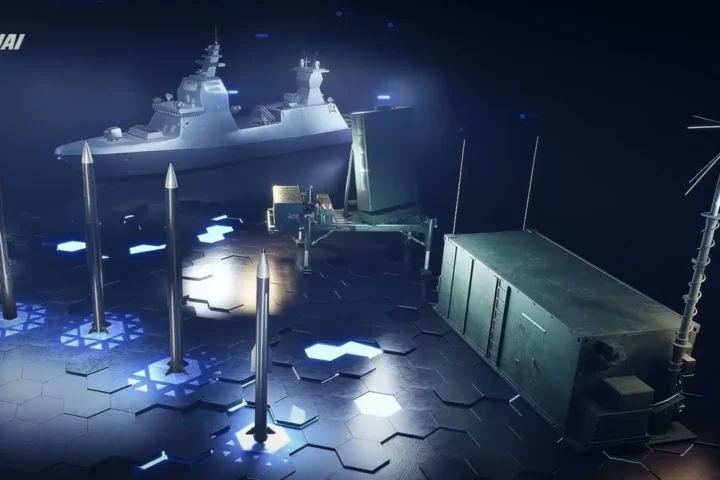
In the middle layer, Israel Aerospace Industries’ Barak MX is a network-centric family in which a common battle-management system handles four interceptors: the Barak SR out to 15 kilometres, the MRAD to 35, the LRAD to 70 and the Barak ER to 150 kilometres with a booster. What distinguishes it from SPYDER is that Barak’s missiles do not derive from fighter-aircraft missiles but were born as surface-to-air and ship-borne anti-aircraft missiles, which allows a larger seeker, a heavier warhead and a more powerful motor. For Greece the Barak MX is expected to gradually replace the old HAWK, and the fact that the same system is already operational in Cyprus creates, for the first time, a common air-defence platform for Athens and Nicosia, with joint training, support and real-time picture sharing.

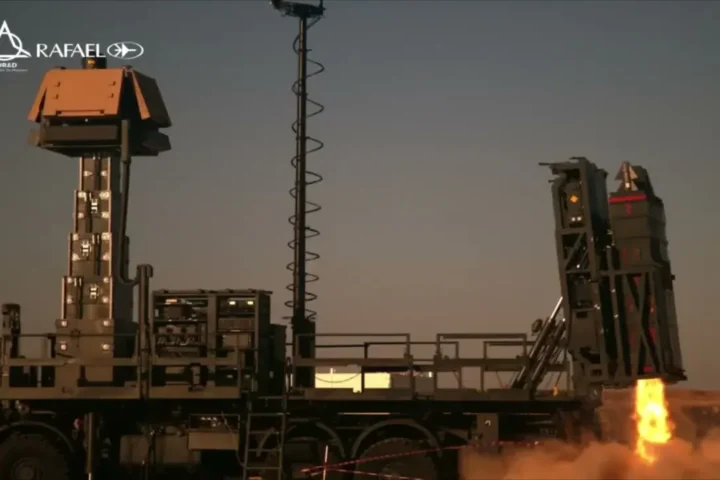
In the lower layer, Greece chose the SPYDER in its All-in-One (AIO) configuration, a complete battery on a single 8×8 truck of about 30 tonnes: four fixed AESA radar panels cover the full horizon, the Toplite electro-optical system visually identifies the target, two operators work from the cab and up to eight missile canisters rise at the rear. The system fires Python-5 missiles with infrared guidance and I-Derby missiles with an active radar seeker, and Rafael gives the I-Derby ER a range of 40 kilometres. Its great advantage in Greek conditions is that it searches for targets on the move and goes to firing readiness in about three minutes, which, as we explain in our analysis of Rafael’s video, makes it ideal for protecting islands, radars and Patriot batteries. Israeli press reports said part of the SPYDERs will be deployed on Greek islands, without official confirmation.

The lowest layer of the “Shield” is Rafael’s Drone Dome, which Greece acquired under a separate EUR 26 million contract, signed the same day as the main agreement. It is not a missile system but a counter-small-drone (C-UAS) system, introduced in 2016 and operated by a single operator. RADA RPS-42 radars detect the drone, CONTROP electro-optical sensors identify it and the jammer cuts its link to its operator and its satellite-navigation signal so that it loses control or returns (soft kill). Rafael also offers a version with a laser that burns the target (hard kill), but which configuration Greece bought has not been announced. The systems are intended to protect strategic facilities such as airfields, radars and command centres, that is, exactly the targets a swarm of Turkish drones would try to hit first. Their value is that they deal with a drone worth a few thousand euros without spending a missile, leaving the SPYDERs and Barak for threats that really need them.

The three systems “see” through ELTA’s EL/M-2084 MMR multi-mission radars (ELTA is an IAI subsidiary), three-dimensional electronically scanned radars based on GaN (gallium nitride, which delivers more power with less heat), which simultaneously perform airspace surveillance and artillery location. At the lowest tier are the Hellenic Aerospace Industry (EAB) systems “Kentavros” and “Hyperion”. Kentavros has been tested in real conditions with Hellenic Navy frigates in the Red Sea, and its integration into the architecture will allow drone swarms to be countered by electronic jamming, without consuming missiles. For readers who want each system’s technical data in depth, with range and engagement-altitude tables, NemesisHD has published a detailed technical presentation of David’s Sling, Barak MX, SPYDER AIO and Kentavros.
The US-made Patriot batteries of the Hellenic Air Force are not included in the Israeli contract but remain a central layer against ballistic threats, as the Greek battery in Saudi Arabia showed. The challenge, as we discuss in our analysis of Greece’s Patriots, is to connect them to the new national command system so that they do not operate as a separate island. By contrast, the Russian-designed S-300 PMU1, TOR-M1 and OSA-AK, which face support and NATO-integration problems, are expected to be gradually retired by the next decade, with no dates announced.
The national command system and the source code
The most critical part of the “Shield” is not a missile but the new national command-and-control (C2) system, which, according to the Israeli Ministry of Defense, Rafael will develop with the participation of Greek companies. There the picture from all sensors, Israeli, Greek and NATO, will be merged and it will be decided which weapon takes each target. Israeli reports say the centre will follow a model similar to Israel’s and will use artificial intelligence to manage data and engagements. Without this “brain”, the three systems would simply be three separate purchases.
The dispute over the source code broke out around this centre. On July 23 Nikos Dendias said Greece keeps the source code of the command system, but after the signing the head of Israel’s Missile Defense Organization (IMDO), Moshe Patel, told Kathimerini that the code is not included in the licence, prompting reactions in Athens and celebrations in the Turkish press. On September 8 the Israeli Ministry of Defense clarified that the code being developed for the programme will be Greek and will remain under exclusive Greek control, while the references to the code of the Israeli systems themselves do not concern the agreement.
In practice these are two different things, and the confusion between them fuelled the whole debate. The internal code of the radar, the missile and each battery’s station is not handed to any export customer, even in the case of Patriot. The code of the national C2, which links the systems together, is the one with operational significance, and, as we explain in our analysis of the source code, Greece must control interfaces, cryptographic keys, the update chain and the rules of engagement. Because the contract and its technical annexes are not public, how complete Greek control really is will become clear only at acceptance. The irony, as we have noted, is that the concern over the code is voiced by Turkey, whose S-400s remain a Russian “closed box” outside the NATO network.

The Achilles Shield against Turkey’s “Steel Dome”
Ankara reacted immediately. On September 2 Recep Tayyip Erdoğan, without naming Israel, called on Greece to stop arming the islands, and Turkish media presented the agreement as part of an “axis” of Greece, Cyprus and Israel. The Greek position is that it is a defensive system that raises the cost of an attack without creating an offensive capability, and, as Dr Konstantinos Balomenos explains, the Turkish reaction shows that deterrence is built with projects.
The comparison with the “Steel Dome” (Çelik Kubbe) is instructive. Turkey is building its own multi-layer network almost exclusively with domestic ASELSAN and Roketsan systems, from Korkut guns and HİSAR missiles to the SİPER for longer ranges, with the HAKİM command system uniting the whole. Ankara’s advantage is scale and industrial autonomy, with more than EUR 10 billion in contracts since late 2023. Athens’s advantage is that it is buying systems proven in real conflicts and can deploy them faster, while for the upper layer Ankara is, according to Turkish reports, also looking at the French SAMP/T NG as part of the new roadmap with Paris.

The essential difference, however, is geographical. The Greek “Shield” has to protect islands a few kilometres from the Turkish coast, within range of drones, loitering munitions, cruise missiles and the ballistic Tayfun, so reaction time is measured in minutes. The Turkish dome, correspondingly, is the environment the Hellenic Air Force would have to penetrate in a crisis. We assess that in the Aegean of the next decade the balance will be decided not by who has the missile with the longest range, but by who has the most missiles, the most resilient sensors and the fastest command network.
That is why the open issues of the “Shield” are specific. The 35-month timeline, which leads to about summer 2029, is exceptional for such a complex project. Integrating the Patriots, the Air Force’s radars, the Navy’s frigates and the Greek counter-drone systems into the same C2 is technically harder than buying the systems themselves, but not unachievable. The survivability of the radars against a first strike will determine whether the network holds, and the number of air-defence missiles will decide how long the defence lasts in a saturation attack.
Frequently asked questions about the Achilles Shield
What is the Achilles Shield?
It is Greece’s new multi-layer air-defence, anti-ballistic and counter-drone protection system. Its core is the Israeli David’s Sling, Barak MX and SPYDER AIO, ELTA’s MMR radars and a new national command-and-control system that links all sensors and weapons.
How much does the Achilles Shield cost?
The intergovernmental agreement with Israel is about EUR 3 billion (EUR 3.035 billion according to Greek press reports). There is also a separate EUR 26 million contract for Drone Dome systems. Greek industry’s participation is estimated at about EUR 750 million.
When was the agreement with Israel signed?
On August 31, 2026, at the Israeli Ministry of Defense headquarters in Tel Aviv. KYSEA had approved the programme on July 23, 2026.
When will the Achilles Shield be operational?
Defence Minister Nikos Dendias has committed to full operational deployment within about 35 months, that is, around summer 2029. Deliveries will be phased and no dates per system have been announced.
Which SPYDER is Greece buying?
The SPYDER in the All-in-One (AIO) configuration, where radar, electro-optics, command and launcher are on one 8×8 vehicle, with Python-5 and I-Derby missiles.
Does Greece get the source code?
On September 8, 2026 the Israeli Ministry of Defense stated that the code being developed for the national command system will be Greek and under exclusive Greek control. The internal code of the Israeli systems themselves is not part of the agreement, as with any export weapon system.
Does the Achilles Shield replace the Patriots?
No. The Patriots are not part of the contract and remain in service. The new systems gradually replace the Russian-designed S-300 PMU1, TOR-M1 and OSA-AK, while the Barak MX is expected gradually to take the place of the HAWK.
How does it differ from Turkey’s Steel Dome?
Turkey’s “Steel Dome” relies almost entirely on domestic ASELSAN and Roketsan systems, with contracts above EUR 10 billion since late 2023. Greece is buying ready-made, proven Israeli systems, with Greek industrial participation and a national command system.